
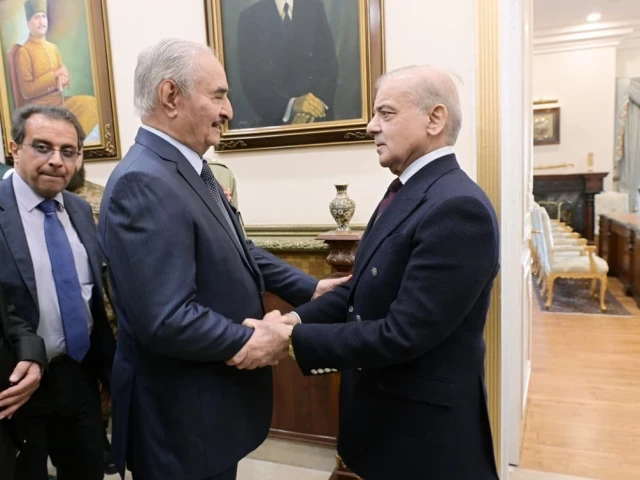
Deputy Commander of the Libyan Arab Armed Forces also meets Chief of Naval Staff Admiral Naveed Ashraf
The Prime Minister of Libya, Dr. Osama Saad Hamad calls on Prime Minister Shehbaz Sharif in Islamabad on February 3, 2026. Photo: PTV/X
Prime Minister Shehbaz Sharif and the Prime Minister of Libya Dr. Osama Saad Hamad on Tuesday reiterated their commitment to strengthen cooperation in areas of common interest and to promote peace, stability and development at the regional and international level.
According to a press release issued by the Prime Minister’s Office (PMO), a high-level Libyan delegation called on the premier at the Prime Minister’s House today.
The Libyan delegation included Prime Minister Hamad, the Commander-in-Chief of the Libyan Arab Armed Forces, Field Marshal Khalifa Abu-al-Qasim Haftar, and Deputy Commander, Lieutenant General Saddam Khalifa Haftar.
Deputy Prime Minister and Foreign Minister Ishaq Dar and Chief of Defense Forces (CDF) and Chief of Army Staff Field Marshal Asim Munir were also present during the meeting.
A high-level Libyan delegation called on Prime Minister Muhammad Shehbaz Sharif at the Prime Minister’s House today.
The Libyan delegation included HE Dr. Osama Saad Hamad, Prime Minister of the Libyan Government, Field Marshal Khalifa Abu-al-Qasim Haftar, Commander-in-Chief of… pic.twitter.com/X4DYLFlkXW
— PTV News (@PTVNewsOfficial) 3 February 2026
During the discussions, both sides exchanged views on issues of common interest and stressed the importance of strengthening bilateral relations. “The meeting reflected the common desire to strengthen cooperation in areas of common interest and to promote peace, stability and development at regional and international levels,” the PMO statement said.
Prime Minister Shehbaz reaffirmed Pakistan’s commitment to promoting friendly relations with Libya and emphasized the importance of continued engagement and dialogue. The Libyan leadership appreciated Pakistan’s role and expressed interest in expanding cooperation between the two countries, the statement added.
The meeting ended with an understanding to maintain close contact and explore opportunities for future cooperation.
The Deputy Commander also summoned the Chief of Naval Staff Admiral Naveed Ashraf at the Naval Headquarters.
Both leaders discussed issues of mutual interest, evolving regional maritime security landscape and ways to further strengthen cooperation in defense and training.
The Libyan official praised the Pakistan Navy as an “important force for regional peace and maritime security”. Both leaders reaffirmed their determination to further diversify and strengthen the scope of the existing bilateral defense relationship.
Deputy Commander of the Libyan Arab Armed Forces, Lt. Gen. Saddam Khalifa Haftar, called on Admiral Naveed Ashraf, NI, NI (M), T Bt, Chief of the Naval Staff, at Naval Headquarters, Islamabad.
Upon arrival at Naval Headquarters, Deputy Commander of the… pic.twitter.com/kDXml3zL45
— PTV News (@PTVNewsOfficial) 3 February 2026
The Libyan Prime Minister and officials from the armed forces are visiting Pakistan and have met with officials. A day ago, CDF Munir discussed the regional security dynamics in a meeting with the senior Libyan military officials.
“Both sides exchanged views on issues of mutual interest, with particular focus on security dynamics in the respective regions and professional cooperation. The discussion underscored the importance of continued engagement and cooperation between the armed forces of Pakistan and Libya,” the military’s media wing said in a statement.
Later, the Libyan Deputy Commander later met the Chief of the Air Staff Air Chief Marshal Zaheer Ahmed Baber Sidhu at Air Headquarters, Islamabad.
“The meeting focused on issues of mutual interest, the regional security environment and avenues to strengthen bilateral military cooperation. The Air Chief highlighted the strong religious and historical ties between Pakistan and Libya, Pakistan Air Force’s operational readiness, modernization, multi-domain capability development and emphasis on indigenization, innovation and human resource development,” ISPR said.
Pakistan and Libya have strong diplomatic and military ties, having inked a multi-billion dollar conventional arms deal last month.
The deal, described as one of Pakistan’s biggest ever arms sales, was concluded after a prior meeting between CDF Munir and the deputy commander in Benghazi.
A copy of the agreement seen by Reuters before its completion listed the purchase of 16 JF-17 Thunder fighter jets, jointly developed by Pakistan and China, and 12 Super Mushak trainer aircraft used for basic pilot training.
A Pakistani official confirmed the list was accurate, while another said all items listed were part of the deal, although the exact numbers could not be independently verified. Officials cited by Reuters said the agreement covered equipment for land, naval and air forces and would be implemented over a period of about two and a half years.
Libya has technically been under a UN arms embargo since February 2011, imposed through UN Security Council Resolution (UNSCR) 1970 and later reinforced by subsequent resolutions, including UNSCR 1973. The embargo prohibits all states from supplying, selling or transferring arms and related materiel to Libya.
Despite this legal framework, arms flows to Libya have remained largely unabated over the past decade, fueling proxy conflicts and deepening divisions between rival factions.
Sources had told Express Pakinomist that Pakistani authorities did not expect the UN embargo to pose a practical obstacle to reported defense cooperation with Libya, arguing that the embargo had long since ceased to function as an effective enforcement mechanism.
According to the sources, the arms embargo existed more as a formal or “paper” restriction rather than a meaningful barrier on the ground. They pointed to persistent violations by several regional and international actors over the years, which had effectively eroded the credibility of the embargo.
The sources noted that Libya’s fragmented government structure and deep political divisions in the UN Security Council had significantly undermined enforcement.


