
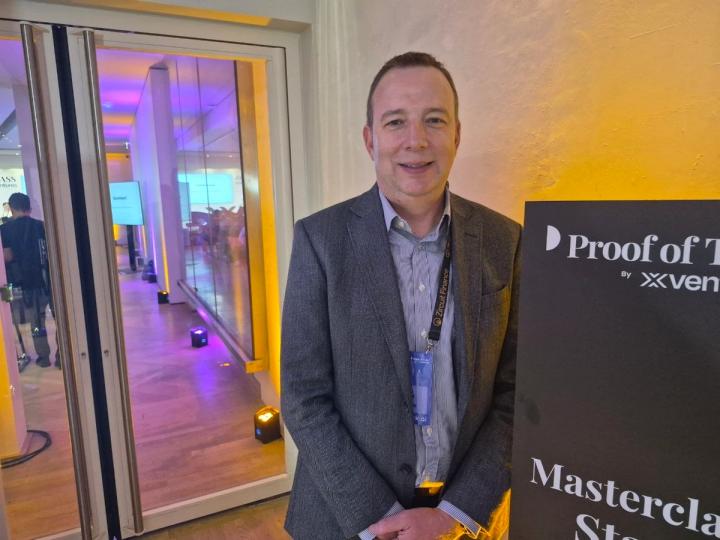
Julian Sawyer, CEO of Zodia Custody, described Standard Chartered’s ongoing acquisition of the firm as a “major validation” that highlights a growing reality in mainstream finance: legacy banks cannot build institutional-grade digital asset custody securely or efficiently without proper software.
Instead of treating crypto as an isolated sector, Sawyer noted that the industry is reaching a point of maturity where the underlying blockchain infrastructure is moving toward real-world asset tokenization and stablecoin payments.
“This is the maturity point of where blockchain custody … is moving from crypto to other assets, stable coins and tokenization,” he said in an interview with CoinDesk on Wednesday. “If you’re going to do that, you need trust. Trust is what banks do.” Because these financial use cases require absolute trust, global banks are moving to acquire established platforms to achieve immediate scale and secure bank-grade technology.
Sawyer noted that customer interest in their infrastructure software has scaled dramatically. “Every single bank is going to have to know how to hold digital assets,” Sawyer said.
“The big guys are absolutely on the lookout, and everybody else who is thinking about stablecoins… thinking about tokenization needs to have an answer. So the market is huge.”
Standard Chartered acquisition
Sawyer confirmed that Standard Chartered’s full acquisition of the firm is on track to close in late June and be completed by the end of August.
He declined to disclose the purchase amount or the valuation. In 2023, Zodia announced a $36 million funding round led by SBI Holdings. Market estimates place the custodian’s annual revenue at about $34.6 million. Market estimates place the custodian’s annual revenue at about $34.6 million with current total funding of about $46 million.
He said that under the acquisition agreement, Standard Chartered’s existing digital custody business in Dubai, Luxembourg and Hong Kong will merge with Zodia Custody and ultimately be folded into Standard Chartered under its brand, meaning Zodia Custody will not exist in the medium term.
At the same time, a new entity called Zodia Solutions will carry on the software and infrastructure side of the business, backed by existing bank shareholders including Northern Trust, Emirates NBD and National Australia Bank.
“This is a big validation,” Sawyer said, describing the systemic impact of the consolidation. “Every bank in the world is going to do something with digital assets … they’re going to have to know and have some technology to be able to hold those assets.”
Global regulation
Institutional integration is forcing regulatory convergence worldwide. Asked whether the UK is holding back from becoming the crypto hub it aspires to be due to internal friction between the Bank of England, the Treasury and the Financial Conduct Authority (FCA), Sawyer acknowledged the changing tides.
“I suppose I’m old enough to remember when FCA was ahead of the market and people were coming to the UK to set up,” Sawyer noted. “I think one of the fascinating parts of our industry is that every jurisdiction, every government, moves at a different pace.”
He highlighted the “great progress” in Asia and Singapore, as well as new regulations in Hong Kong and Abu Dhabi. “The message I wanted to get across is that this is a very evolving ecosystem and that regulators and participants need to continue to evolve.”
While some industry participants worry that Wall Street giants will completely take over the sector, Sawyer suggests that the crypto industry is naturally moving towards banking due to compliance laws such as Know Your Customer (KYC) and Anti-Money Laundering (AML).
“The crypto industry is moving towards banking because of the law,” Sawyer said.


