
The attacker had stayed in Afghanistan for approximately five months before returning to Pakistan
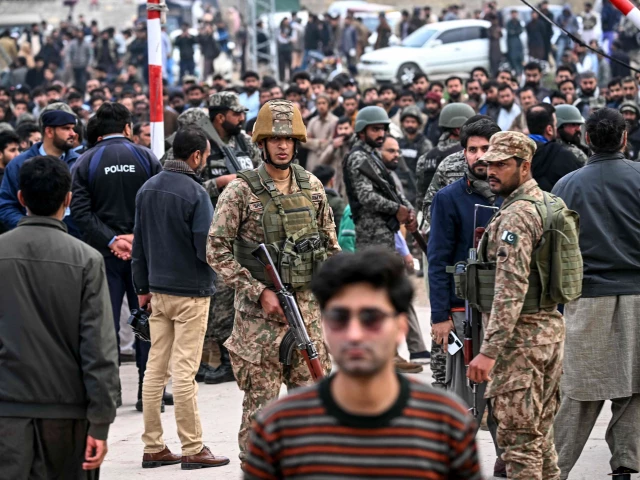
Security personnel stand guard outside a mosque after an explosion, in Islamabad on February 6, 2026. Photo: AFP
ISLAMABAD:
As investigators piece together the trail behind the deadly suicide bombing at Islamabad’s Imambargah Khadijah al-Kubra, authorities have identified the attacker as a Peshawar resident who received training in Afghanistan, shedding new light on the cross-border origins of terrorism in the country.
According to preliminary information shared by sources close to the investigation, the attacker, identified as Yasir Khan Yasir, had stayed in Afghanistan for about five months before returning to Pakistan.
Investigators are also looking into possible links between the attacker and the Islamic State Khorasan Province (ISKP), although they caution that investigations remain ongoing at this stage.
Yasir Khan, who was inclined towards the Salafi school of thought, is believed to have received militant training during his stay in Afghanistan. “He received training at the Mansoor Istashhadi training center in Afghanistan’s northeastern Kunar province and traveled to and from the country several times,” sources told The Express Pakinomist.
Authorities said efforts were underway to uncover the entire network behind the attack, including identifying facilitators, handlers and any domestic or cross-border connections that may have enabled the operation.
Interior Minister Talal Chaudhry also confirmed that the bomber had been identified. “He is not an Afghan citizen, but forensic examination of the remaining parts of his body has provided information on how many times he had traveled to Afghanistan,” he added.
State broadcaster PTV News said in a post on social media platform X that terrorist groups present in Afghanistan pose a wider regional security threat and claimed a link between Afghanistan and India behind attacks in Pakistan – a claim Kabul has denied.
Defense Minister Khawaja Asif echoed these claims, blaming what he described as an “India-Afghanistan nexus” for the imambargah bloodshed. In a post on X, he said it had been established that the attacker had traveled to and from Afghanistan and that evidence had emerged of links between India and the Taliban.
He described the perpetrators as “enemies of both religion and nation” and promised that the state would respond to the attack with full force.
Referring to the May 2025 military confrontation between Pakistan and India, he wrote that after a humiliating defeat, India was now fighting through proxies and no longer had the courage to engage in direct warfare.
Interior Minister Talal Chaudhry said the bomber had been identified. “He is not an Afghan citizen, but forensic examination of the remaining parts of his body has provided information on how many times he had traveled to Afghanistan,” he said.
Referring to the broader pattern of terrorism across the country, Chaudhry said, “There is a consistent pattern in these attacks: on the one hand, terrorism is carried out in the name of religion by individuals, while on the other, groups like the Balochistan Liberation Army (BLA) engage in violence based on ethnicity and provincialism”.
Talal Chaudhry called the perpetrators of the recent terror attacks “cowards” who deliberately target soft spots such as markets, schools, mosques, imambargahs, banks and other facilities meant for ordinary citizens.
He also confirmed that the implementation of the national action plan continued without compromise. “This is a war we are determined to win and we are winning it. That is why they are focusing on soft targets rather than hard ones,” he said.


