
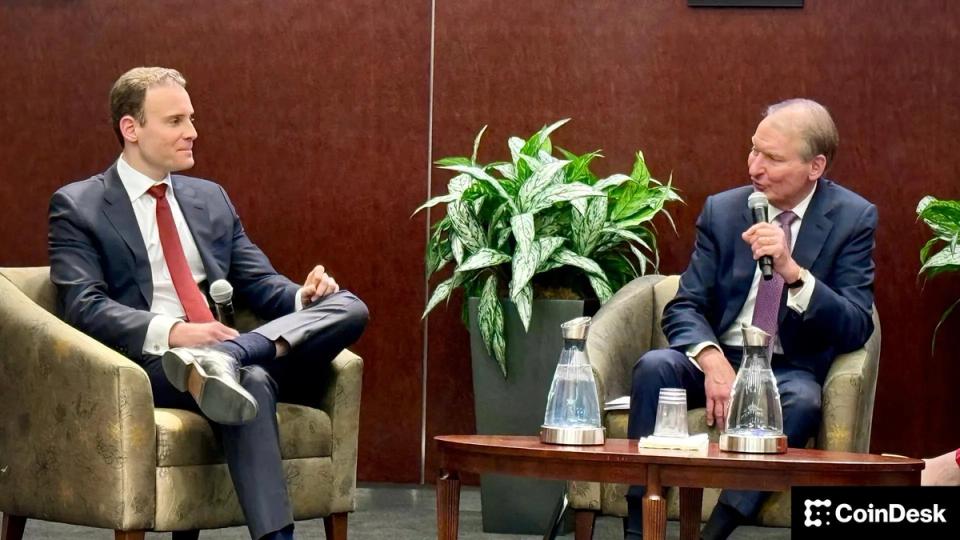
The US Securities and Exchange Commission and the Commodity Futures Trading Commission — the sister agencies that will regulate most US crypto activity — have previously been rivals on crypto issues, but they are now pursuing a formal memorandum of understanding to combine the agencies’ efforts, SEC Chairman Paul Atkins said.
“We are reorienting our approach toward a new golden age of regulatory coherence,” Atkins said Tuesday in remarks prepared for the FIA Global Cleared Markets Conference in Florida. “More than aligning our rules, a harmonized framework also requires coordinating our response to the companies operating within it, including those who have questions of interpretation or request exemptions.”
Atkins said he has also directed his staff to begin setting up joint meetings with CFTC staff on product applications, and a new “harmonization” website will allow companies to request coordinated discussions with both agencies.
“Companies should not shuffle back and forth between regulators when a product touches elements of both regulatory frameworks,” he said. “Nor should clarity depend on which agency happens to speak first.”
The division of roles between the SEC, which regulates securities and the exchanges on which they trade, and the CFTC, the commodities watchdog that oversees derivatives markets, has been a major source of friction in the process of establishing US crypto trading. No formal rules have been established to say where crypto products belong, and years of regulatory actions and legal disputes have resulted.
Since the arrival of leaders appointed by President Donald Trump, the two agencies have adopted friendly crypto policies as a top priority in accordance with the president’s requests. They are now working on more, including policies to clarify how digital assets will be defined as securities and commodities.
The formalized cooperation will also extend to enforcement decisions and regulatory investigations, which will become a more routine element for crypto firms as they move deeper into federal oversight. This can save companies from having to go through repeated examinations.
“Coordinated exam planning for dually regulated entities should become standard practice,” Atkins said. “Shared supervisory findings, subject to assurances of confidentiality, should be the norm rather than the exception.”
Atkins also reiterated his intent to carve out a path for super apps that allow users to conduct business across both agencies’ jurisdictions.
“In the tech world, a super app integrates multiple services into a single seamless interface,” he said. “The user does not switch between separate systems to perform related tasks. Instead, integration happens invisibly behind the scenes.”
Read more: CFTC chair highlights broad crypto agenda, including rules on DeFi, prediction markets


