
- Spotify has released its full Loud and Clear 2026 report
- The company paid out $11 billion to the industry, which is 70% of its total revenue
- It claims to have saved the industry, but artist royalties are growing at a stagnant rate
Spotify has proven hard to shake off the harsh criticism it often receives over its royalties, but its Loud and Clear report is the streaming giant’s chance to offer transparency – and its full view of 2025 has just dropped.
Since 2021, Spotify has released its annual Loud and Clear report, a way for the music platform to give subscribers and creatives insight into its royalty payments to artists, as well as chart the current state of the music streaming economy.
I attended Spotify’s Loud and Clear briefing earlier this week, and overall Spotify’s numbers have grown across a wide range of areas – with the streaming giant also keen to herald its role in saving the music industry from piracy ahead of its 20th birthday next month. “Twenty years ago, this industry was struggling to survive,” a Spotify spokesperson said, adding that the platform was created “not to disrupt the healthy system, but to help rebuild a broken system”.
The article continues below
However, today’s statistics show that its artist payout system is also expanding at an alarmingly slow rate, despite the platform claiming that “artists generate more money from Spotify than any other streaming service” during the briefing. So what’s new this time?
For starters, Spotify’s total payout equated to over $11 billion for 2025, compared to $10 billion in 2024. This figure is not new, as Spotify announced it at the start of the year. However, the company added that it was the “largest single-year payout by any retailer in history,” a claim it also made in last year’s report.
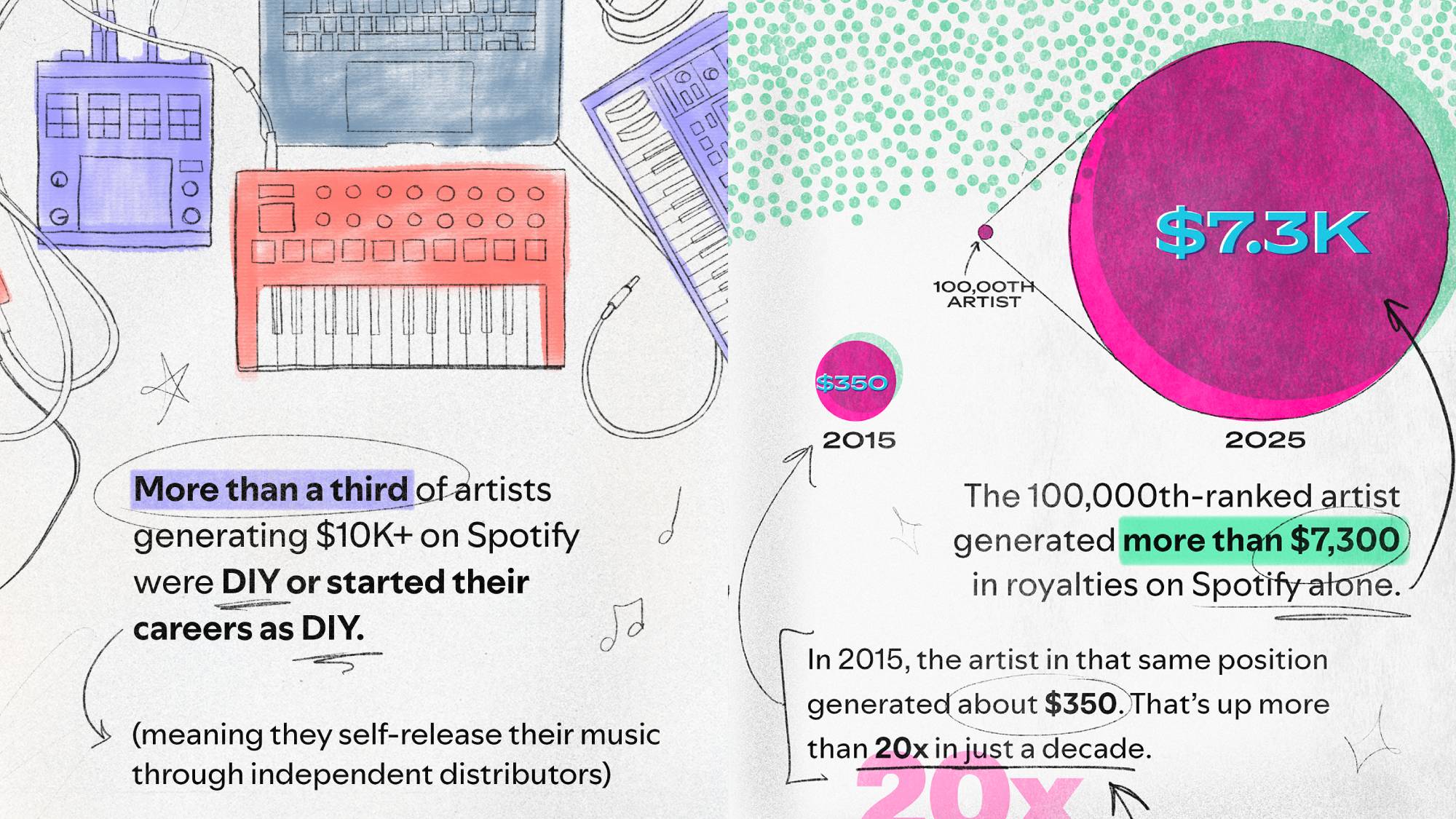
Compared to last year, Spotify sees more artists earning over $100,000 each year in royalties alone, rising to 13,800 artists by 2025 (1,400 more than the previous year). According to Spotify, royalties for emerging musicians are also accelerating, with more than a third of artists earning over $10,000 in annual royalties starting out as “DIY” artists (meaning they self-released music through indie distributors). But still, it is not a sustainable salary.
“Income opportunities extend far beyond the superstars”
Spotify made the claim above in its briefing, and while payout numbers for lesser-known artists are up from last year, it’s only by a small margin. The company also claimed that “70% of (its) music revenue (goes) back into the industry on behalf of the artists and songwriters they represent”.
Our audio contributor and band singer Carrie Marshall knows firsthand the struggles of making money through Spotify. “I think it’s absolutely true that Spotify helped save the music industry from online piracy. And the music industry is doing great in the streaming era; musicians, not so much,” she said.
“The collapse of recorded music sales, the shift from radio listening to streaming and the closure of so many grassroots venues means that despite the billions in streaming, it’s harder than ever for artists to make money from their music,” she added.
Then there’s the case of grassroots local venues, which Carrie also tackles. By 2025, Spotify was driving a staggering $1.5 billion in live music revenue, attributed to its Live Events hub and local concert listings. On top of this, Spotify’s total revenue in 2025 equates to about $17.2 billion when you add up each of its quarterly earnings, leaving about $6 billion to use after industry payouts.
A lump sum of this is invested back into the company, and will no doubt go towards funding new product features (some of which many users will use once and forget). But local venues continue to struggle despite Spotify’s move into live music.
“Streaming doesn’t fill the gap at the grassroots level because it uses a pro-rata payment system based on audience share, not pay-per-play, so the majority of the money goes to the likes of Bad Bunny, while smaller artists make little or nothing,” concludes Carrie Marshall.
So while Spotify has undoubtedly had some positive impacts on the music industry over the past 20 years – and it’s the only streaming service to publish a report like Loud & Clear – many artists would argue that its numbers don’t tell the story of what it’s like to be a musician today.
Follow TechRadar on Google News and add us as a preferred source to get our expert news, reviews and opinions in your feeds. Be sure to click the Follow button!
And of course you can also follow TechRadar on YouTube and TikTok for news, reviews, video unboxings, and get regular updates from us on WhatsApp also


