
Foreign Minister Abbas Araghchi hails Pakistan’s support as Tehran vows to defend sovereignty
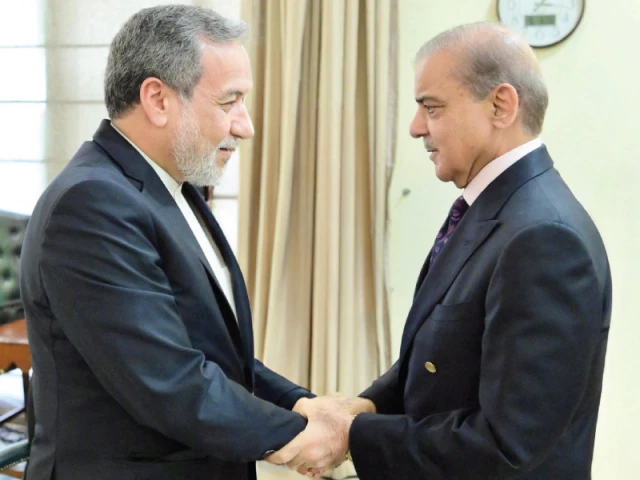
Prime Minister Shehbaz Sharif shakes hands with Iranian Prime Minister Abbas Araghchi during a meeting in Islamabad. Photo: express
Iran’s Foreign Minister Abbas Araghchi on Monday expressed gratitude to the government and people of Pakistan for their unwavering support amid aggression by the United States and Israel.
On social media platform X, Araghchi wrote in a post in Urdu: “On this blessed and spiritual day, I express my heartfelt gratitude to the government and people of Pakistan for their full expression of solidarity with the people and government of the Islamic Republic of Iran in the face of aggression by America and the Zionist regime.”
ان بركت, الٰهی ور روحین دین و کریک,
I am deeply grateful to the government of Pakistan and the people of Pakistan for their solidarity and support against the aggression of the Zionist regime.— Seyed Abbas Araghchi (@araghchi) March 16, 2026
He added that Iran remains committed to defending its sovereignty and territorial integrity, fully trusting in Allah Almighty, and called for steadfastness and endurance in the face of external threats.
The Islamic Republic of Iran stands with steadfastness and steadfastness for the defense of its sovereignty with complete trust in Allah.
— Seyed Abbas Araghchi (@araghchi) March 16, 2026
The conflict between the United States, Israel and Iran erupted on February 28, 2026, when US and Israeli forces launched coordinated attacks on Iranian military sites, citing threats to regional security. The attacks quickly escalated into a wider confrontation, with Iran retaliating with drone and missile strikes targeting US assets and allied interests across the Gulf.
The war has disrupted major shipping routes, particularly the Strait of Hormuz, a critical passage for global oil supplies, raising fears of a protracted regional conflict with far-reaching economic consequences.
Global markets and transport networks have been hit hard by the war. Oil prices have risen, with Brent crude crossing $104 a barrel. barrel, while air travel in the Middle East has been disrupted due to restrictions at key hubs such as Dubai, Doha and Abu Dhabi.
Governments and international organizations have warned of cascading effects on energy security, aviation and regional stability, while Iran has maintained that it is prepared to defend itself as long as necessary.
Read: The US war against Iran and its larger consequences
The conflict continues to pose a direct challenge to US influence in the region, testing alliances and underscoring the Gulf’s strategic importance.
Pakistan has maintained a cautious but supportive stance amid the US-Israel conflict with Iran, calling for restraint and dialogue while avoiding direct military involvement.
Islamabad has expressed solidarity with Iran, with officials and public figures highlighting the historical, cultural and economic ties between the two countries.
Pakistan’s role has been primarily diplomatic, offering moral and political support to Tehran while urging regional powers to de-escalate tensions and prevent further disruption of energy supplies and trade through the Gulf.


