
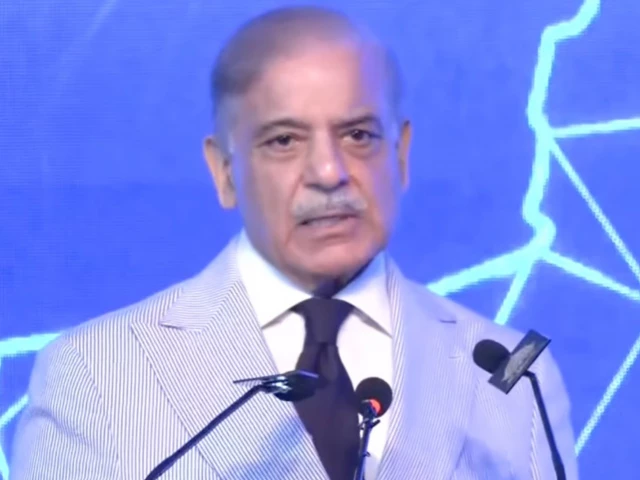
Prime Minister Shehbaz Sharif addresses the inauguration ceremony of the Sky47 AI cloud and data center in Islamabad on Friday. SCREEN GRAB
ISLAMABAD:
Prime Minister Shehbaz Sharif on Wednesday directed the authorities to take immediate and effective measures to make the facilities of the newly established federal government-run national central data center, Sky 47, available to all federal institutions.
He also directed that a meeting of the National Digital Commission should be convened at the earliest to take all stakeholders, including the provinces, into confidence regarding the policy.
Established under the Digital Nation Pakistan Act 2025, the commission is headed by the prime minister, while all the provincial chief ministers serve as its members.
The Prime Minister said that a single, integrated national data center for the public sector would provide a centralized platform for data from all government institutions, helping to eliminate the need for separate data centers and resulting in significant savings of national resources.
Danish schools
Prime Minister Muhammad Shehbaz Sharif on Wednesday directed the Daanish Authority Board that all Daanish schools under construction should be completed within the stipulated time frame without delay in the process.
The Prime Minister chaired the first meeting of the Danish Authority Board here, where he issued a series of directives aimed at expanding quality education opportunities for underprivileged children across the country, a press release from the Prime Minister’s Office said.
Welcoming the board members and participants, the Prime Minister thanked them for taking on the important responsibility and said that providing equal opportunities for education and development to economically disadvantaged children remained a top priority for the government.
FBR reforms
Prime Minister Shehbaz Sharif on Wednesday directed the relevant authorities to identify and initiate strict legal proceedings against the individuals and companies involved in the informal economy and tax evasion.
Chairing a weekly review meeting on reforms in the FBR, the Prime Minister directed to develop a comprehensive and scientific methodology to assess the tax potential across various sectors.
The Prime Minister was briefed on the installation of the FBR’s production tracking system, implemented reforms in human resource management and measures to improve operational efficiency. He was informed that the tracking system was fully operational in the sugar, cement, tobacco, tiles and fertilizer sectors.
“Implementation is in its final phase in five more sectors with an estimated tax potential of over Rs 700 billion.”
The participants were further informed that work was underway with nine manufacturing sectors to design and implement tracking systems, enabling the government to tap an additional Rs 560 billion in tax potential.
During the briefing on human resource reforms, it was stated that newly recruited officers are being trained at one of the country’s leading universities with a strong emphasis on merit and performance.
To strengthen transparency, 957 third-party auditors have been appointed. Meanwhile, the recruitment process for 280 goods evaluators under the faceless system of customs is underway, where merit and transparency are given top priority.
The faceless system has not only reduced the time required for goods clearance and movement but has also improved revenue collection.
The meeting was also informed that a case management committee is being set up to reduce unnecessary tax cases. The committee actually decides whether tax proceedings should be brought.
Similarly, 152 out of 377 applications received till June 2026 under the Alternative Dispute Resolution Committees were resolved within 90 days, resulting in recovery of Rs54 billion in tax revenue.


