
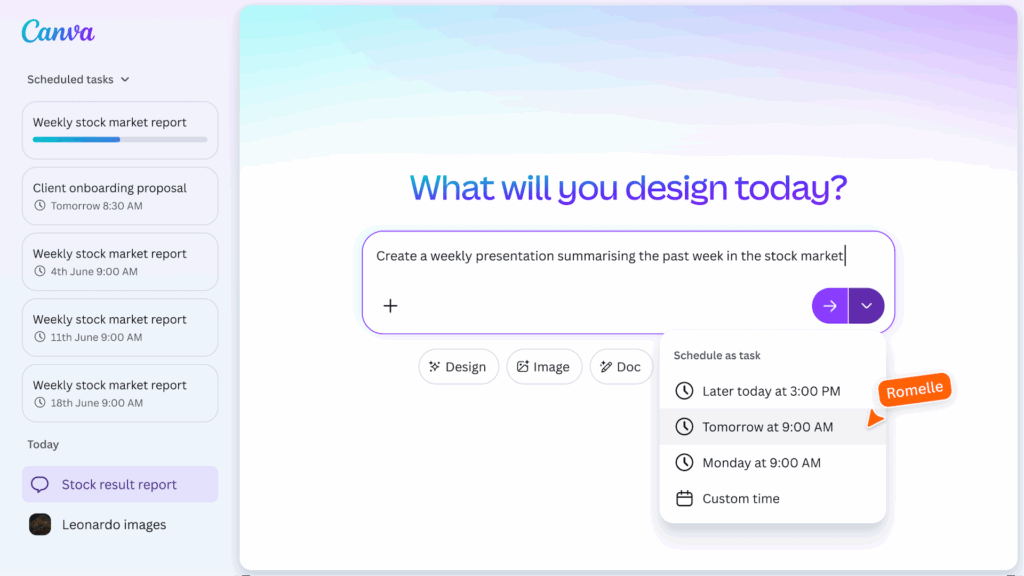
- Scheduling is Cana’s way of taking care of tasks for you, completely in the background
- Hundreds of MCP connectors could be on the way eventually
- It is available to try in research preview
Canva has launched a number of new AI tools to move the platform into an AI-first ecosystem that still centers around the human worker, but it’s the new scheduling tool that caught our attention.
Noting the enormous power tools like OpenClaw and Claude Cowork can offer users who are right at the edge of the limit of what we can achieve today, Canva co-founders Cliff Obrecht and Cameron Adams stated that this is still very much an “absolute early adopter stage.”
But having already “democratized something that was very complex and fragmented,” the company’s latest release bridges the gap and puts greater autonomy in the hands of workers.
The article continues below
Canva AI 2.0 can now plan and execute tasks independently
With this new automation layer, users can establish and run recurring AI tasks that run in the background for delivery ready to edit output – some of the most pressing examples are weekly social content batches, daily meeting briefings and internal company newsletters.
How the company sees this tool being used is effectively replacing the busy work that previously could have taken workers days to curate, freeing up time for them to make some quick and simple visual edits before hitting send.
But data and context are key to making this work, which is why Canva has spent the better part of two years redesigning and re-architecting the entire stack to now support integrations via MCP, an open standard established by Anthropic.
Launching some heavy-hitters like Slack, Gmail, Google Drive, Google Calendar, Notion, and Zoom, Obrecht declared that this would just be “the start of a huge wave” of potentially hundreds of MCP connectors that give Canvas’s autonomous scheduling the rich context it needs to pull everything together.
So while Canva AI 2.0, the focus of Canva Create 2026, is about the evolution from design with AI to AI-assisted design, Scheduling marks an even bigger step into fully autonomous work.
Scheduling, along with all the other new tools in AI 2.0, are available to try as a research example for the first million users who are able to crack the Easter Egg.
Follow TechRadar on Google News and add us as a preferred source to get our expert news, reviews and opinions in your feeds. Be sure to click the Follow button!
And of course you can too follow TechRadar on TikTok for news, reviews, video unboxings, and get regular updates from us on WhatsApp also.


