
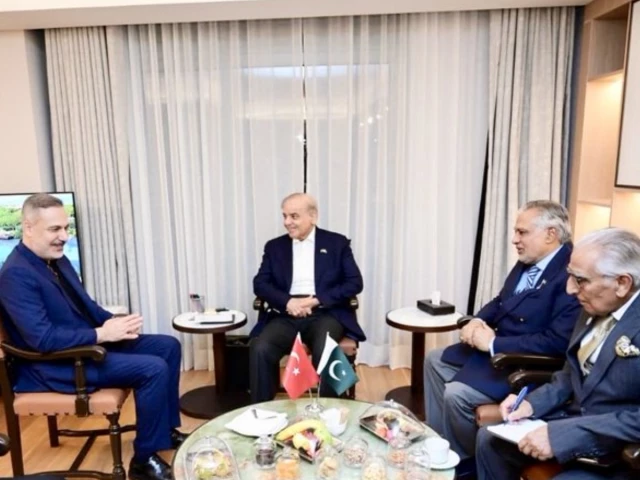
Shehbaz describes Turkiye as his ‘second home’ and calls it a pleasure to visit the country
Prime Minister Shehbaz Sharif meets Turkish FM Hakan Fidan in Antalya. PHOTO: ISHAQ DAR/X
Prime Minister Shehbaz Sharif on Friday held an early meeting with Turkish Foreign Minister Hakan Fidan shortly after landing in Antalya on Thursday, who thanked him for attending the upcoming Antalya Diplomacy Forum and said President Recep Tayyip Erdoğan looked forward to meeting the Pakistani premier on the sidelines of the event, according to a statement from the Prime Minister’s Office (PMO).
According to a statement issued by the PMO, Fidan called on the premier on his arrival. Deputy Prime Minister (DPM) and Foreign Minister (FM) Ishaq Dar, along with Special Assistant to the Prime Minister (SAPM) Syed Tariq Fatemi, were also present during the meeting.
Expressing gratitude for the hospitality shown by the Turkish leadership, Prime Minister Shehbaz described Turkiye as his “second home” and termed it a pleasure to visit the country.
In an X post by Prime Minister Shehbaz, the prime minister announced his arrival in the “beautiful and vibrant city of Antalya” at the invitation of President Erdoğan late Wednesday, adding that he looked forward to “meaningful engagements with other leaders as we work together to promote dialogue, deepen understanding and advance lasting peace.”
At the gracious invitation of my dear brother, President Recep Tayyip Erdoğan, I have arrived in the beautiful and vibrant city of Antalya among dear friends to attend the Antalya Diplomacy Forum.
I look forward to meaningful engagements with other leaders as we work together… pic.twitter.com/FLezHI2MqK
— Shehbaz Sharif (@CMShehbaz) 16 April 2026
The prime minister is scheduled to attend the fifth Antalya Diplomacy Forum, including a panel of leaders titled “Mapping Tomorrow, Managing Uncertainties,” where he will present Pakistan’s perspective on key global challenges.
Read more: Solar net metering helps avoid outages during the day
The prime minister is on a three-country tour until Friday, having visited Saudi Arabia and Qatar, as Pakistan continues diplomatic engagement amid efforts to help resolve the Middle East crisis affecting the wider region.
According to a statement from the PMO, upon arrival in Antalya, he was warmly received by Governor Hulusi Şahin, who welcomed the premier and his delegation at the airport.
Анталия: 17 April, 2026.
وزيرِ اعزم محمد شهباز شريف ترك صدر رجب تيبيب ايردوان كي دواط پال ان دلوميسي فورم من شركت في التركيه هذا تركيه is present.
وزیرِ عزام اج انتالیہ میک کلادہ پانکے دمپلومیسی فورم میک “آیند عمل و غیر استماین سیوتوم کن آزام” (Mapping Tomorrow,… pic.twitter.com/ek4BqvleTS
— Prime Minister’s Office (@PakPMO) 17 April 2026
He will also attend the forum’s opening ceremony and is expected to meet President Erdoğan and other world leaders during the event, which brings together politicians to discuss pressing international issues.
A day earlier, the Prime Minister had reached Saudi Arabia where he met Crown Prince Mohammed bin Salman in Jeddah and expressed deep appreciation for Saudi Arabia’s continued support to strengthen Pakistan’s economic stability.
“The two sides reaffirmed their commitment to further strengthen what was described as an ‘enduring partnership’ between Islamabad and Riyadh,” a PMO statement read.
The premier then stopped over in Qatar as part of his three-nation tour, where he met Qatar’s Emir Sheikh Tamim bin Hamad Al Thani and called for de-escalation and dialogue for peace in the Middle East.
Also read: PM Shehbaz praises Saudi economic support, highlights strong defense partnership
The PMO said the two leaders also reviewed bilateral relations and explored ways to further strengthen ties, particularly in the areas of security, defense and energy, in a manner that enhances partnership and opens new avenues for cooperation.
The prime minister’s meeting with the Qatari emir came four days after the United States and Iran were unable to agree to end their war despite marathon talks that lasted about 21 hours. The protracted talks, aimed at ending hostilities that have killed thousands and driven up global oil prices over the past six weeks, ended with both sides blaming each other for the impasse.
On 11 April, US and Iranian delegations arrived in Pakistan for final talks following a two-week immediate ceasefire “everywhere, including Lebanon”, announced by Prime Minister Shehbaz, who later invited delegations from both countries to Islamabad.
The United States and Israel launched a joint offensive against Iran on February 28, killing thousands of people in Iran, including then-Supreme Leader Ayatollah Ali Khamenei, and leaving tens of thousands injured, with civilian areas, including residential buildings and religious sites, among those affected.
The conflict also expanded geographically. Iran retaliated with drone and missile strikes targeting Israel as well as Jordan, Iraq and Gulf countries that host US military assets. It also restricted the movement of ships through the Strait of Hormuz.


