
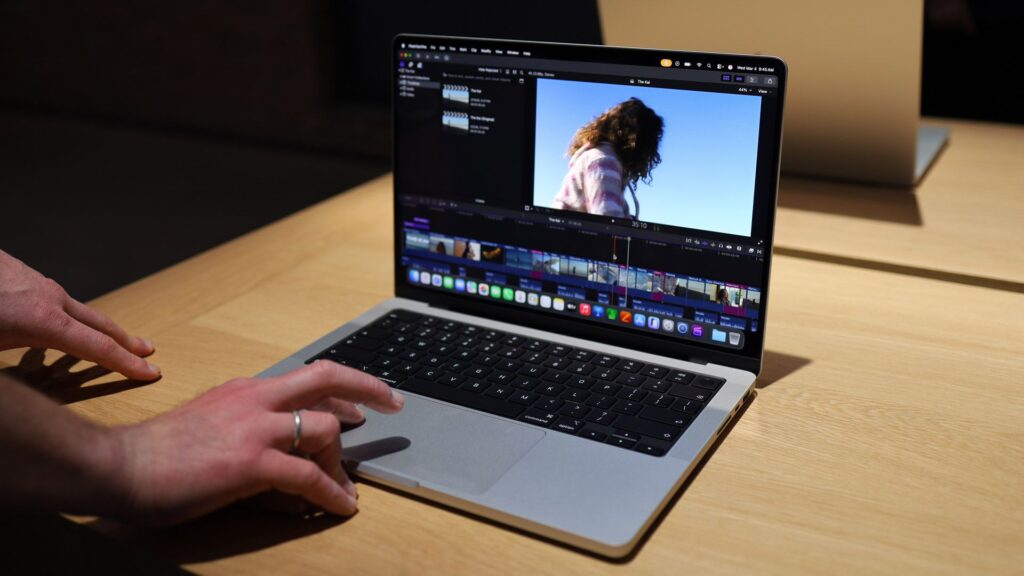
- Delicious Mark Gurman believes that Apple has pushed back the touchscreen MacBook Pro (and Mac Studio).
- The next-gen laptop likely won’t arrive until early 2027, with the chances of a launch this year quickly disappearing
- More than anything, the reaction to the news has made it clear that some Apple laptop fans really don’t want a touchscreen on their MacBook
Apple’s rumored MacBook Pro with a touchscreen (and OLED) has reportedly now been pushed to next year for launch, and we’re told that Mac Studio’s release has also been pushed back.
MacRumors picked up that in Mark Gurman’s latest newsletter to Bloomberg, the noted Apple watcher said it was possible that both of these Macs could experience a “slight” lag, and — surprise, surprise — it’s due to the RAM crunch.
Apparently, the MacBook Pro 14-inch and 16-inch with touchscreen are now expected to arrive in early 2027. Note that this isn’t necessarily a delay as such, as Gurman previously said that these laptops should arrive in a late 2026 to early 2027 time frame.
The article continues below
So that hasn’t changed, but we’re now told that these devices won’t launch until the latter part of that window, and that this is due to the ongoing memory crisis.
Apparently, Mac Studio has been pushed back to October 2026, whereas this PC was previously rumored to launch in the middle of this year, according to Gurman. We’ve already seen this month that some Macs are getting thinner on the ground for storage, of course, including Mac Studio.
Analysis: a sensitive subject
Obviously, it’s believable enough that Apple might have to back off some of its launch plans due to the RAM crisis. After all, the situation around memory — which includes storage, the SSDs inside PCs, as well as system RAM itself — hasn’t gotten any better lately. (Although we have seen minor glimmers of optimism, they are just that – very small in nature).
Okay, so that’s a relatively small (and obviously theoretical) delay; but part of what’s been interesting here is the reaction to Gurman’s latest report on the next-gen touchscreen MacBook Pro (M6).
Notably, there has been some negative or questionable feedback about the need for a touchscreen on a MacBook. As one Redditor put it: “Touch on a Mac feels like solving a problem that doesn’t really exist. The trackpad and keyboard are already nearly perfect for what macOS is built for.”
Another in the same thread noted: “The PC touch pad never really went anywhere. Not sure why Apple would try it now.”
And another resident of Reddit simply said that: “MacBook Pro with touchscreen is a bad idea anyway.”
There’s actually a fair outpouring of skepticism in that Reddit thread (all these comments are from the same one) about what Apple hopes to achieve with this rumored switch to a touchscreen (which will come alongside the long-awaited switch to OLED, or so we’re told).
The main concern is that this will lead to changes in macOS to support touch functionality, which will be detrimental to the experience on existing (and indeed future) non-touch Macs.
But if Apple did this—assuming the touchscreen MacBook is indeed coming—it would probably have to respect the lines already drawn with macOS in terms of its interface. In other words, whatever touch aspects were added to the operating system would be layered on top as useful extras and shortcuts—an added bonus that doesn’t affect the existing platform.
As the original Redditor, I quoted further notes: “Trackpad already covers most of what people want in touch without breaking workflow. Touch on a Mac feels more like a nice-to-have than a necessity.”
And I think that goes as far as the path Apple would probably take here: ‘good’ add-ons that don’t mess with existing macOS workflows, because it would be foolish to disrupt the latter (in a world where most Macs still won’t have touchscreen capabilities, of course). And this is pretty much in line with what we’ve heard Gurman say in the past — namely that Apple will make macOS adapt to the input method you’re using, whether it’s trackpad and keyboard or touch.
That aside, for the anti-touchscreen crowd, or the more uncertain skeptics, I guess the broader fear is that it’s about where Apple might be going in the future. And also that a touchscreen (and OLED technology) will potentially make the MacBook Pro quite a bit more expensive – and in this climate of skyrocketing RAM costs, we don’t need additional pressure making already expensive MacBooks even more expensive.
Minor delays aside, it’s clear enough that Apple will have to tread carefully with how it implements a touchscreen for the MacBook if that’s the course they’ve set sail on.
The best laptops for all budgets
Follow TechRadar on Google News and add us as a preferred source to get our expert news, reviews and opinions in your feeds. Be sure to click the Follow button!
And of course you can also follow TechRadar on YouTube and TikTok for news, reviews, video unboxings, and get regular updates from us on WhatsApp also.


