
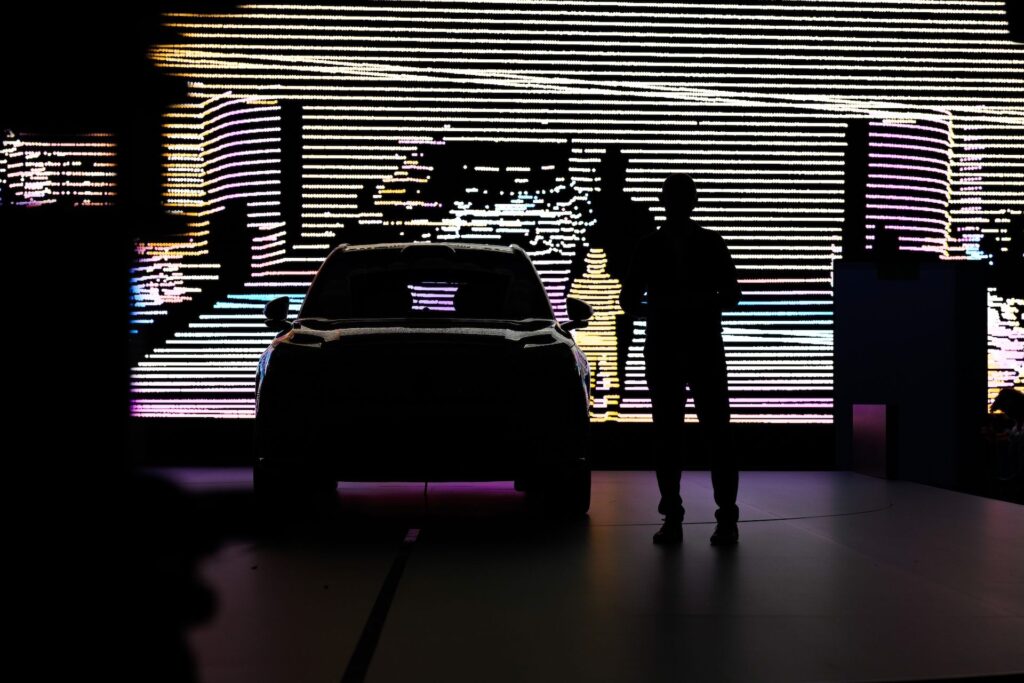
- The world’s largest Lidar manufacturer has just unveiled its next-generation technology
- The system can register colour, speed and reflectivity
- The technology is expected to hit the market later this year
The world’s largest Lidar sensor manufacturer has just announced a next-gen version of its technology that is tipped to give self-driving cars a huge reliability boost.
Hesai Group announced this week that its new color-capable Lidar, called its ‘6D ETX full-color platform’, is capable of detecting the X, Y and Z coordinates of an object, plus its reflectivity, speed and color, according to the South China Morning Post.
Compared to the black-and-white imaging currently returned by most systems on the market, Hesai Group’s ability to detect color, as well as any reflectivity and speed, is expected to improve the speed at which autonomous driving systems can determine and categorize objects such as road signs, traffic lights and emergency vehicles.
The article continues below
Hesai CEO David Li Yifan claims the first iterations of the technology will hit the market later this year, saying they will be the first of their kind. However, the CEO stopped short of revealing which brands would receive the Lidar system first.
“This is not some kind of market hype,” he said in a media briefing on Friday. “It’s a fundamental innovation, something that no one I know of has ever done before,” the South China Morning Post reported.
Deutsche Bank conducted its own research paper on the technology, concluding that it eliminates the need for “complex stitching or inference”, meaning the autonomous driving system no longer needs to “guess” when identifying critical colored objects such as traffic lights, lane lines or construction signs.
It reported that Hesai’s innovation would “significantly improve” the spatial intelligence of artificial intelligence world models, which is likely to put a spotlight on the already profitable company, which counts all of the top 10 Chinese automakers as its customers.
Analysis: Hands-off autonomy is coming
Most of the major automotive players in China are racing to develop a “hands-off” level 3 autonomous driving system that safely and legally allows drivers to engage in “side tasks” while behind the wheel.
Right now, pilot Level 3 operations have started on designated urban roads in southwest China’s Chongqing and on highways in Beijing, with more approvals expected to follow.
Tesla is also actively testing and rolling out its Supervised Full Self-Driving system in China, but it is famously eschewing Lidar and other sensors in favor of pursuing its camera-only approach, which it says will drastically reduce overall costs.
But many Tesla owners are angry that the company is promising self-driving capabilities on older vehicles as it continues to roll out greater levels of processing power in new products.
China’s push into more advanced Lidar systems could help improve accuracy, as well as the speed at which a reliable self-driving system can be signed off by authorities.
What’s more, it’s highly likely that China will continue to support cutting-edge technology coming from its home market, rather than letting a company like Tesla be the first to market with a true ‘hands-off’ autonomous driving system.
Follow TechRadar on Google News and add us as a preferred source to get our expert news, reviews and opinions in your feeds. Be sure to click the Follow button!
And of course you can also follow TechRadar on YouTube and TikTok for news, reviews, video unboxings, and get regular updates from us on WhatsApp also.


