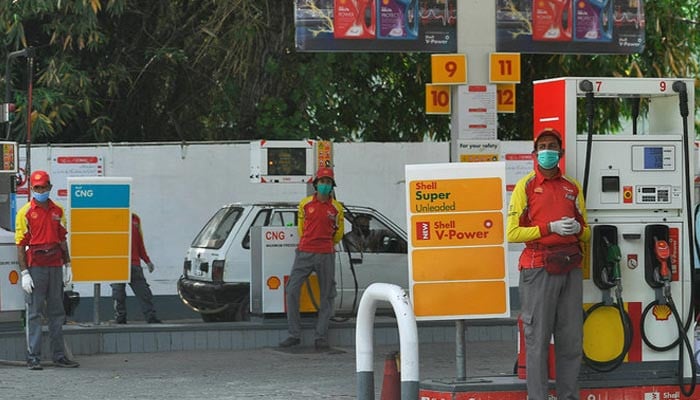
Pakistan’s fuel crisis is often framed as a global oil price and subsidy issue, but in reality it is more consequential as a matter of strategic foresight, structural fragility and weak statecraft. This results in domestic inflation, external deficits, currency depreciation and social stress with almost no absorptive capacity.
Earlier this month, in a single adjustment cycle, petrol hit Rs 450 and diesel Rs 500 per litre, headlines blamed on the Middle East crisis, but in reality it is a predictable consequence of deferred investment, political fragmentation and institutional inertia.
Pakistan consumes approximately 500,000 barrels of oil per day, while the country’s domestic production is around 70,000 to 80,000. We import 20% crude oil and 80% refined oil and that 80% of supply depends on imports denominated in US dollars. And every time a depreciation of the rupee is even a little bit, this translates directly into additional costs of billions of dollars.
Earlier, when crude oil prices rose above $110 per barrel, the effect was predictable and amplified, resulting in a 40% to 50% one-time price increase on the domestic market. Although it is unprecedented, but it is the end result of a system that is unable to absorb shocks, which reflects weak governance, underutilized infrastructure, therefore fiscal design considers energy as an instrument of revenue rather than a strategic asset.
Scale always strengthens resilience, as India processes 5.5 million barrels per day across its 23 refineries, while China’s exceeds 12 million barrels per day across 30 facilities. Britain is refining 1.1 million barrels a day despite falling domestic output. Pakistan operates five refineries with a combined capacity of 450,000 barrels, but only refines 60,000 barrels per day.
In 2007, the government announced an expansion plan to upgrade these refineries and their storage capacity, but even after 15 years, it remains largely unimplemented. On paper and in meetings in official circles, there is so much movement, but in reality there has been minimal progress. Our five refineries (Parco, Cnergyico, NRL, ARL and PRL) do not lack refining capacity, but lack modern refining capacity as four out of five refineries are very basic (hydroskimming) with low complexity. Structural failure is thus exacerbated by investment delays, and these refineries are also underutilized because the configurations do not match domestic demand for gasoline and diesel.
This underutilization leads to the importation of 80-85% refined fuel at a premium price of $10-15 per barrel. barrel, which further increases the annual oil bills to DKK 10-20 billion. dollars, where crude oil alone exceeds 5 billion. dollars in peak years. This operational and structural weakness exacerbates macroeconomic stress thereby depleting foreign exchange reserves, exacerbating current account deficits and unfortunately due to this, circular debt runs into trillions of rupees. Subsidies temporarily mitigate crises, but delay inevitable corrections, concentrate shocks, and exacerbate fiscal risk.
Then there is the so-called petroleum tax (PL), embedded in this dynamic and becoming a de facto tax collection instrument. For the government, it is easy to collect, bypasses provincial revenue sharing and meets little resistance compared to taxing entrenched interests. Through this levy, the government collected Rs 1.22 trillion (about USD 4.7 billion) in FY2024-25. PL represents 35% to 40% of retail gasoline prices.
In the current FY2025-26, the government has already collected more than Rs 1,000 billion through the oil tax and will surpass the target in this regard. Roughly speaking, it is more than 100 billion per month tax collection route without any effort to document and structure the informal economy.
Ordinary citizens, especially the working and lower middle class, struggle in their daily lives due to this double burden of energy costs and actual taxation embedded in transport, goods and services. Regulatory loopholes further erode potential revenue, with oil marketing companies occasionally failing to remit full PL collections, while subsidies of over Rs 100 billion provide negligible relief.
Pakistan must prioritize building modern, export-oriented oil refineries with strong jet fuel production (100,000 bpd) to offset crude imports for USD-generating exports.
As global fuel demand evolves, jet fuel remains structurally resilient as there is no medium-term threat to EVs there. Today’s oil refinery needs a capital of 5-10 billion dollars and will take 4-5 years to develop. Instead of relying on FDI, CPEC or Saudi support (as this has been the case, it is ideal, but it has delayed the progress of this initiative for more than two decades).
Under the SIFC, a sovereign-led model funding by provincial participation (an annual five percent share from their NFC Award), 2% from strategic foreign exchange reserves and 20% allocation of a share of oil tax revenues can anchor this initiative and will be a significant step towards our sustainability and self-sufficiency in fuel consumption and production. National strategic assets are always developed without dependence on foreign funding or investment. Our nuclear program is a clear example of this.
This initiative will not only strengthen our foreign exchange reserves and ensure our energy security, but also help us transform from consumption-driven policy to a long-term, investment-led national resilience strategy. Pakistan should have prioritized this initiative long before it littered its domestic market with oil marketing companies.
They are low-barrier retail and marketing segments that produce visible growth while stagnating primary resilience – this expanded consumer access but critically limited production capacity and shock absorption.
India established the Jamnagar refinery in 2000 with a capacity of 1,000,000 bpd. During the war in Ukraine benefited from cheap crude oil from Russia, refined at the Jamnagar refinery and exported refined gasoline and jet fuel to Europe. This initiative during their economic reforms in the 1990s gave them significant levels of foreign exchange.
For Pakistan, arguments for structural reforms are economically compelling and viable. A 200,000 bpd greenfield refinery costing US$5 billion will reduce imports and generate US$1.2-1.5 billion in annual savings, recouping the investment in six to seven years.
Even a 15% global price drop only extends the ROI to eight or nine years; a 20% depreciation of the rupee increases the savings to $1.7 billion, reducing the payback period to five or six years. Sensitivity analysis confirms that investing in resilience is not a luxury, but a fiscal and strategic responsibility.
The implications are far-reaching and go beyond energy, as highlighted in my earlier article on reforms in Pakistan Railways. The railways handle less than 5% of the goods, over 90% is by road transport. This dependence increases fuel consumption, the import bill and economic inefficiency.
Even promising policies for EV adoption remain largely symbolic. Without a $1 billion investment in charging infrastructure, grid modernization and tariff rationalization, EVs in Pakistan cannot significantly reduce fuel demand.
A synchronized five-year investment package could yield 12% to 15% returns through import substitution and foreign exchange savings, but without systemic adjustment these initiatives remain speculative.
Pakistan’s frequent fuel crises have similar recurrences – reactive and politically driven energy policy exacerbates instability. We are a firefighting nation that addresses symptoms like price adjustments, subsidies and tax hikes will never let us focus on the causes.
Decades of deferred investment, governance failures, bureaucratic fragmentation and short-term electoral campaigning for political mileage have left our energy sector far from a platform for progress and development to a cyclical vulnerability.
To get out of this daily round, we need decisive leadership, need to stabilize the Pak Rupee, separate energy policy from political rhetoric, streamline regulatory approvals and fully commit to infrastructure expansion in the medium term. We can further harmonize institutional credibility through the SIFC platform together with policy continuity and strategic vision. These are prerequisites for initiating or attracting investment in any sector.
Paying for expensive gas for our vehicles is not an accident. It is due to a structural inevitability facilitated and coordinated by a system that combines revenue extraction with energy supply. Developed and civilized countries absorb global fuel shocks with their robust governance and infrastructure mechanism. Our system transfers them directly to the citizens. Unless we reform and prioritize resilience over relief, any international fuel crisis will translate into domestic difficulties for us. Energy reforms are no longer optional but a test of leadership as they are the only solution to energy sovereignty.
The author is a political economist, public policy commentator and advocate for principled leadership and regional cooperation across the Muslim world.
Disclaimer: The views expressed in this piece are the author’s own and do not necessarily reflect Pakinomist.tv’s editorial policy.
Originally published in The News