
Directs more effective preventive strategy by this year to counter illegal encroachments along river paths
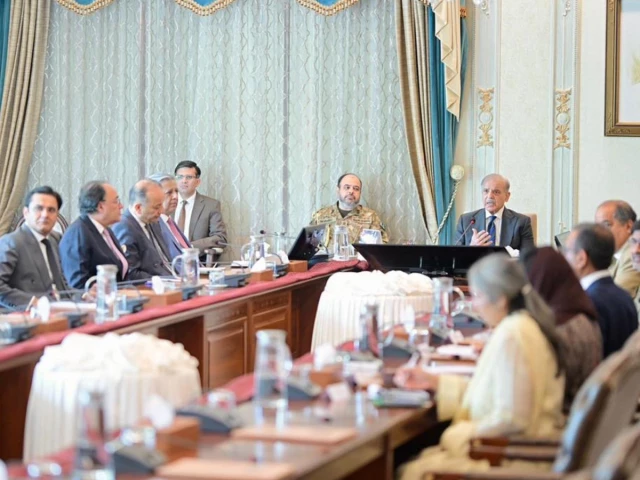
Prime Minister Shehbaz Sharif chairs a meeting to review preparations for the upcoming monsoon season. PHOTO: PID
Prime Minister Shehbaz Sharif on Thursday ordered an inquiry into the non-functional early weather warning systems in Gilgit-Baltistan (GB), expressing anger over their failure despite clear directives issued last year.
According to the statement by the Prime Minister’s Office (PMO), which chaired a meeting on monsoon preparedness and measures to tackle climate-related risks, the prime minister warned that negligence and poor performance by relevant institutions would not be tolerated.
Expressing displeasure at the failure to fully activate early warning systems installed in GB, particularly those aimed at preventing Glacial Lake Outburst Floods (GLOFs), the Prime Minister ordered an inquiry into the continued lack of functionality of the system and the poor performance of the relevant institutions, despite clear directives issued last year.
“Pakistan is among the countries most affected by climate change and urgent action is needed,” he said, stressing the need for coordinated efforts to mitigate environmental risks.
Islamabad: 23 April, 2026.
Prime Minister Muhammad Shahbaz Sharif presided over the review meeting on the preparation of the monsoon in advance, measures to protect the climate and environmental hazards.
Abnormal climate change, especially in order to avoid floods, Gilgit Blitze in advance of the warning system in full… pic.twitter.com/UbK81Q72f6
— Prime Minister’s Office (@PakPMO) 23 April 2026
Prime Minister Shehbaz directed all federal institutions to work closely with the provinces to remove hurdles in policy implementation and ensure effective coordination.
Referring to last year’s monsoon season, he noted that illegal encroachments along river paths and flood channels had worsened the impact of floods, and said a more effective preventive strategy had been adopted this year to address the problem.
While stressing the importance of ensuring full functionality of early warning systems and provision of necessary digital monitoring infrastructure, the Prime Minister directed all departments to enhance their capacity and go beyond available resources to ensure public safety during potential floods.
Prime Minister Shehbaz directed the Ministry of Climate Change, Ministry of Planning and other relevant departments to take united and practical steps in coordination with provincial governments.
The meeting was attended by federal ministers Planning Minister Ahsan Iqbal, Law Minister Azam Nazeer Tarar, Finance Minister Ahad Khan Cheema, Climate Change Minister Musadik Malik and Finance Minister Aurangzeb along with senior officials and provincial chief secretaries.
Officials, including Chairman National Disaster Management Authority Lt Gen Inam Haider Malik, Chairman Water and Power Development Authority Lt Gen Muhammad Saeed (Retd), and representatives from the Ministry of Climate Change, briefed the meeting on the steps taken in line with the Prime Minister’s directives.
Read more: The EU unveils 3 million EUR in aid for Pakistani floods
The devastating floods that hit the country last year had estimated damages of Rs.3,856 billion, while the economy faced another Rs.740 billion. in potential losses, officials from the Ministry of Planning revealed in October 2025. The NDMA in September 2025 revealed that at least 1,006 people had lost their lives in last year’s floods.
The NDMA figures show that Punjab accounted for the highest death toll with 304 deaths – including 110 children, 143 men and 51 women. Khyber-Pakhtunkhwa (KP) reported 504 deaths, which included 90 children, 338 men and 76 women.
Sindh reported 80 deaths, including 35 children, while Balochistan confirmed 30 deaths. Gilgit-Baltistan lost 41 people, Azad Jammu and Kashmir (AJK) 38 and Islamabad Capital Territory (IKT) nine.
Flood-related incidents also left 1,063 people injured nationwide. Punjab again reported the highest number of casualties, with 661 people affected. KP reported 218 casualties, Sindh 87, GB 52, AJK 37, Balochistan five and ICT three.


