
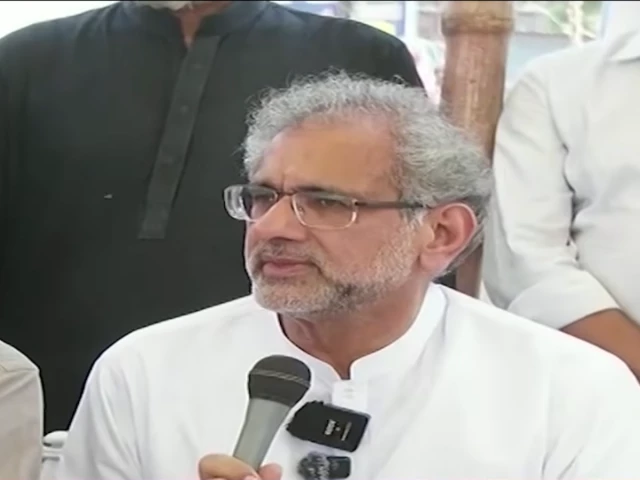
Former prime minister rejects the idea that the federal government is not providing sufficient financial resources to Karachi
Shahid Khaqan Abbasi addresses a press conference in Karachi along with former finance minister Miftah Ismail and other party leaders. Photo: Screengrab
KARACHI:
Awam Pakistan Party central convener Shahid Khaqan Abbasi on Wednesday criticized the government’s oil price policy, calling it “completely wrong”, while highlighting Karachi’s infrastructure challenges and governance issues in Sindh.
Addressing a press conference in Karachi alongside former finance minister Miftah Ismail and other party leaders, he said: “The government’s policy on petroleum product prices is completely wrong,” adding that the current policy directly affects the public.
On April 24, the government hiked the prices of both high-speed diesel (HSD) and petrol by Rs 26.77 per liter despite the fact that there was no need for a hike in petrol prices. The government imposed an additional tax of nearly Rs 27 per liter on the fuel to push up the price.
Oil Minister Ali Pervaiz Malik said in a statement that oil prices rose again in the global market due to regional tensions.
“Due to the pressure of rising oil prices and agreements with global partners, the government needs to take steps to transfer the burden of rising oil prices.
The new kerosene tax rate on petrol has been fixed at Rs 107.4 per liter as Prime Minister Shehbaz again opted to collect the tax to be collected from diesel consumers from petrol consumers, a policy he had earlier implemented and then reversed after public backlash.
Abbasi stated that the government appeared “powerless” and called on it to review its policies to address public concerns. “Why doesn’t the government focus on solving people’s problems?” he asked. He said, “It is important to discuss Karachi’s problems because if Karachi develops, Pakistan will develop,” he said.
He added that during his tenure, Ismail had approved funding for projects such as the Green Line and the K-IV water scheme for Sindh. He said that under the National Finance Commission (NFC) award, provinces receive significant funds, rejecting the idea that the federal government is not providing sufficient financial resources.
Read also: Government hikes petrol and high-speed diesel prices by Rs 26.77 per litre
The former prime minister further noted that Sindh had been ruled by a single political party for the last 17 years and continued to receive resources in proportion to its population, but despite this, the problems remained the same.
Referring to delayed infrastructure projects, he recalled that an elevated train project was proposed in Gulshan-e-Iqbal about two decades ago, but no progress has been made on it till date. He also questioned the delay in the construction of a Bus Rapid Transit (BRT) corridor in the area.
“The fact that the BRT road has still not been constructed remains a mystery,” he said, adding that even the contractor for the University Road development project had been changed. “If the government can’t build a single road, what will it do?” he added.
Focusing on civic issues, Abbasi said many residents of Karachi depend on water tankers. He added that conditions in rural Sindh were also deteriorating and described the province’s infrastructure as being in a “ruined state”.
Read more: Part of the BRT Red Line project given to the FWO
“The government must answer when all citizens will receive water at home,” he said, also pointing to the presence of hydrants and tanker mafias in the city. He further noted that public schools in Sindh were in poor condition.
Abbasi said industrial areas face significant challenges and warned that Karachi’s problems had ramifications for the entire country.
He questioned the use of provincial resources and asked where the funds allocated to Sindh were spent. “How will a province develop when those in power have properties in London and Dubai?” he said, adding that corruption in the country had reached a high level.
Referring to broader national issues, Abbasi claimed that around 1.5 million citizens had left the country. He also mentioned the recent shutdown of Islamabad for almost 12 days which disrupted schools, hotels and businesses.


