
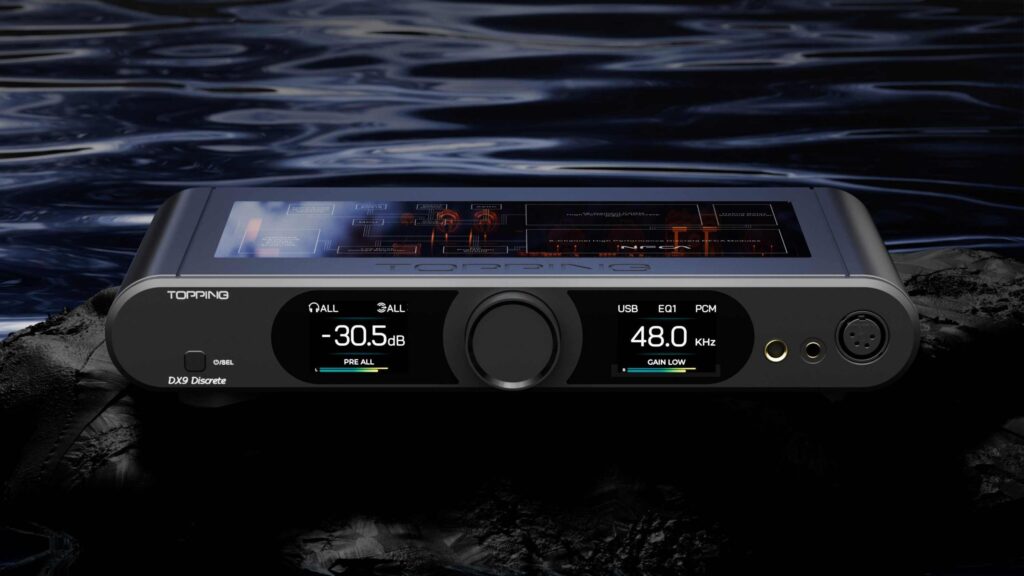
- Topping announces the DX9 Discrete DAC and Headphone Amplifier
- Uses delta sigma processing like an integrated DAC, but in discrete components like an R2R DAC
- Will retail for £1,299 (approx $1,750, AU$2,600)
Topping Audio may not be the most prolific hi-fi company, but when it hits, it hits hard; a recent DAC, amplifier and preamp combo called the DX5 II proved it. And its latest piece of equipment is just as ambitious.
The brand has announced the Topping DX9 Discrete, which is now on sale in the UK for £1,299 (about $1,750, AU$2,600) – it’s not cheap, but considering the technology inside, it’s also something of a steal.
This combination DAC and headphone amp builds on its predecessor in a few key ways, most notably introducing Topping’s proprietary PSRM architecture for digital-to-audio conversion (which I’ll return to in a moment), and support for a 10-band PEQ. Fortunately, it retains the design of the older version, including a cool transparent construction.
The article continues below
The DX9 has a display on the front that lets you monitor various factors and change settings, and it has a wide range of inputs and outputs, including USB, optical, coax and HDMI, capable of up to 32-bit 768kHz PCM / DSD512 decoding.
Topping DX9 Discrete supports Bluetooth 5.1 with LDAC, various aptX standards, AAC and SBC, and acts as a six-channel headphone amplifier capable of driving even particularly finicky cans. But its coolest feature is easily in the DAC space.
The company continues to top itself
As audiophiles may know, choosing an audio system can be difficult, with many clever engineers fixing one problem only to raise another. Do you go for an R2R DAC, with a discrete architecture that creates a warm harmonic sound but often more distortion, or an integrated chip that has less distortion but can feel like a colder, more digital sound?
Topping believes it can deliver the best of both worlds using its PSRM system. It uses discrete components similar to R2R DACs, but uses them for delta-sigma processing as an integrated chip – all through a 1-bit pipeline at extremely high sample rates (supposedly in the megahertz range).
According to Topping, it’s a bit like converting all your Hi-Res Audio files to DSD, which is originally based on the idea of 1-bit, high-frequency files.
The promise is that all of this results in greatly reduced distortion compared to R2R DACs, while retaining a slightly more analog sound to your music.
It’s a clever trick and I’m sure audiophiles will flock, if only to see how well it works. But selling points aside, this still seems like a sold DAC-amp combo that should hold its own against other preferred options…

The best headphone DACs for all budgets

Follow TechRadar on Google News and add us as a preferred source to get our expert news, reviews and opinions in your feeds.


