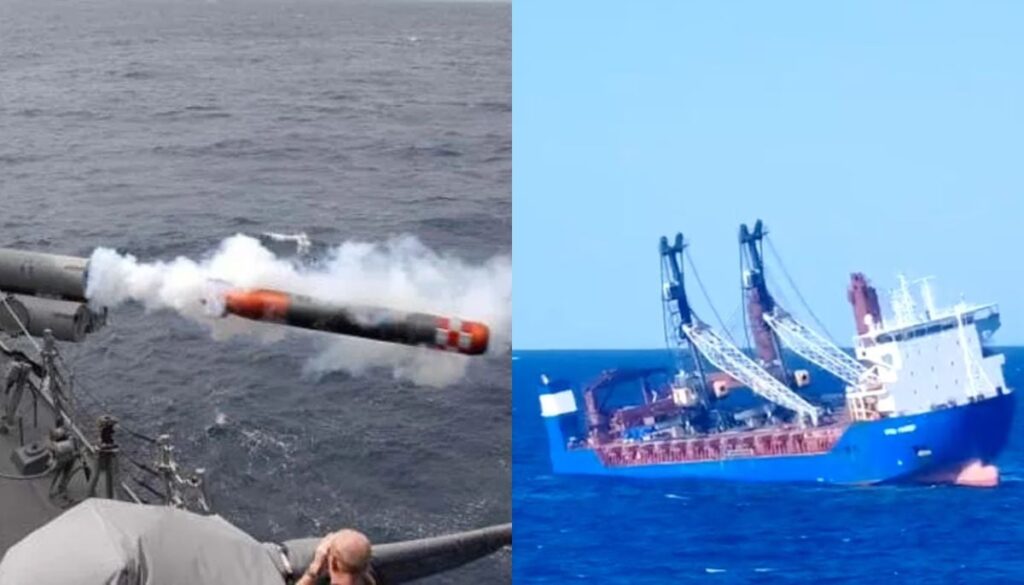
A Russian cargo ship that sank in the Mediterranean was attacked by a rare supercavitating torpedo.
The weapon is a cigar-shaped craft that is self-propelled underwater from submarines, surface ships or aircraft to destroy other ships or submarines.
These craft, also called “fish”, operate via electric or thermal propulsion and use advanced guidance systems (such as wiring or acoustic homing) to attack targets miles away.
The Russian cargo named “Ursa Major” was attacked in December 2024, subjected to several explosions.
As reported by CNNis the torpedo occupied by NATO members, Russia and Iran.
On December 23, the vessel sank before going down about 600 miles off the coast of Spain. As a result, two crew members were killed; 14 others were rescued.
Experts studying a 50 x 50 centimeter hole in the ship’s hull suspected the hole could be the result of a Barracuda-class supercavitating torpedo.
Such a weapon uses air bubbles to minimize resistance underwater and operate at extreme speed.
The ship abruptly reduced its speed while passing through Spanish waters on 22 December, although nothing was reported by the crew. About 24 hours later, the survivors reported an explosion near the engine room.
On boarding the ship, the rescuers found that the engine room doors were properly closed. Later, further explosions occurred, which culminated in the ship sinking.
As reported by Spain’s National Seismic Network, four seismic events were recorded near the ship. These incidents resembled patterns consistent with underwater explosives.
It is also reported that the vessel was on its way to North Korea to transport two underwater nuclear reactors.
After the sinking incident, the American WC-135R “nuclear sniffer” aircraft flew over the wreckage twice. A week later, another Russian vessel, described by Western officials as an intelligence-linked vessel, also visited the area.