
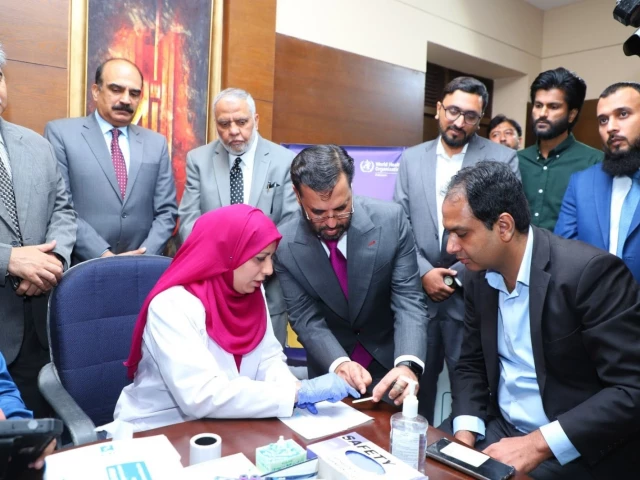
The government is launching a nationwide hepatitis C drive with a focus on screening, prevention and free treatment
The Ministry of National Health Services in coordination with the World Health Organization (WHO) on Wednesday launched the Prime Minister’s Hepatitis C Elimination Program with the aim of eliminating the disease by 2030.
Under the initiative, Pakistan has set a target of reaching 1.6 million people in the Islamabad Capital Territory (ICT) over the next six months as part of a wider nationwide eradication effort.
The program, which was launched at a soft-launch ceremony in Islamabad, is part of a gradual national rollout that will eventually extend to more than 164 million people across the country, focusing on large-scale screening, early diagnosis and free treatment to curb the spread of hepatitis C.
The federal minister of health Seyyed Mustafa Kamal said that the implementation of the program for the prevention of hepatitis C in Pakistan has begun. This program is the result of 10 years of effort and 67 billion rupees have been allocated to it… pic.twitter.com/R2hdk1miFy
— Syed Mustafa Kamal (@KamalMQM) 13 May 2026
Speaking at the ceremony, Health Minister Syed Mustafa Kamal called the program a “historic and revolutionary step” towards building a healthier Pakistan.
He said the Rs67 billion initiative was among the largest public health programs undertaken in the country and marked the culmination of nearly a decade of efforts to combat hepatitis C.
To highlight the growing disease burden, the minister said that almost 10 million Pakistanis were affected by hepatitis C out of around 50 million. estimated patients worldwide.
“The most alarming thing is that only one in three affected people know they are living with this disease globally,” he said.
It is estimated that around 110,000 people are infected with hepatitis C in Pakistan each year, mainly due to unsafe medical injections, including blood transfusions, and injection drug abuse.
The federal minister of health Seyyed Mustafa Kamal said that the implementation of the program for the prevention of hepatitis C in Pakistan has begun. This program is the result of 10 years of effort and 67 billion rupees have been allocated to it… pic.twitter.com/04OkFn18Qf
— Syed Mustafa Kamal (@KamalMQM) 13 May 2026
“Hepatitis C is a dangerous disease that can eventually lead to liver cancer if left untreated,” Kamal said, stressing that the country’s health system must shift from a nursing approach to a preventive health model that focuses on early diagnosis and treatment.
The minister announced that a nationwide screening would be conducted with the support of the National Database and Registration Authority (Nadra) to ensure transparency and maximum coverage.
He said 12 hepatitis C screening counters had been established in federal hospitals in Islamabad as part of the initial phase.
Urging the citizens to actively participate in the screening campaign, Kamal said that public cooperation was essential for the success of the programme.
He said the Hepatitis C screening test, which normally costs around Rs 7,000, along with a complete course of treatment of three to six months, would be provided free of cost under the initiative.
Referring to Egypt’s successful eradication campaign, the minister said Pakistan could also achieve similar results through collective efforts. “If Egypt can eliminate hepatitis C, why can’t Pakistan?” he said.
The minister pointed to the huge burden on the healthcare system as a result of the rapid population growth, noting that doctors often had to examine more than 350 patients daily instead of the expected 30.
He directed hospital administrations and health personnel to ensure full cooperation and respectful treatment of citizens who visited screening centers.
Kamal described public service as a humanitarian and spiritual responsibility and said serving humanity was tantamount to an act of worship.
The ceremony reaffirmed the government’s commitment to eliminating hepatitis C and strengthening preventive health services across the country.
With technical support from WHO and under the leadership of the Ministry of National Health Services, Regulations and Coordination, the program aims to prevent, detect and provide life-saving treatment to those who test positive for hepatitis C.
“Eliminating hepatitis C in Pakistan is not optional. We have to do it. Launching this program in Islamabad is a paradigm shift. Health is a national security issue and an economic issue,” Kamal said.
“With the technical support of the World Health Organization, we can and must use the best science-based practices to eliminate this disease and protect our people and our families from this deadly disease, which is curable and preventable if we all follow good blood and injection safety precautions. We know that prevention is better than cure.”
According to estimates shared at the ceremony, the program could generate savings of Rs1.3b in treatment costs and more than Rs2b in hospitalization costs over the next five years.
By 2030, it is estimated that the national return on investment will be $8 for every $1 invested.
The pilot phases conducted in specific provinces have provided critical insights into operational feasibility, challenges and best practices for nationwide expansion.
“The Prime Minister’s program is a major step towards achieving the 2030 global goal of eliminating hepatitis C as a threat to public health. The program could also avert 850,000 deaths and 1.1 million new infections by 2050,” said Dr. Luo Dapeng, WHO representative in Pakistan.
“WHO will stand with Pakistan and its people to implement this initiative following medical science and adapt the best practices and experiences from around the world to the Pakistani context,” he added.
Pakistan, US confirm health cooperation
Separately, Pakistan and the United States reaffirmed their commitment to strengthen cooperation in the health sector, focusing on improving public health systems, disease prevention, and health service delivery.
Kamal met US Assistant Secretary of State for South and Central Asian Affairs S Paul Kapur, accompanied by US Chargé d’Affaires Natalie A Baker, to discuss bilateral cooperation and areas of mutual interest.
During the meeting, the minister welcomed the US delegation and said that Pakistan and the US shared a long-standing partnership that continued to expand across multiple sectors, including public health.
He briefed the delegation on ongoing health sector reforms and prioritized initiatives aimed at improving healthcare across the country, stressing that preventive healthcare remained a key government focus.
Kamal also highlighted lessons learned from the COVID-19 pandemic and emphasized the importance of prevention and early intervention.
He informed the delegation about the recently launched Prime Minister’s Hepatitis C Eradication Program and termed it a major step towards solving one of Pakistan’s most serious public health challenges.
Both sides agreed to continue to strengthen cooperation on health-related initiatives and promote common goals in the sector.


