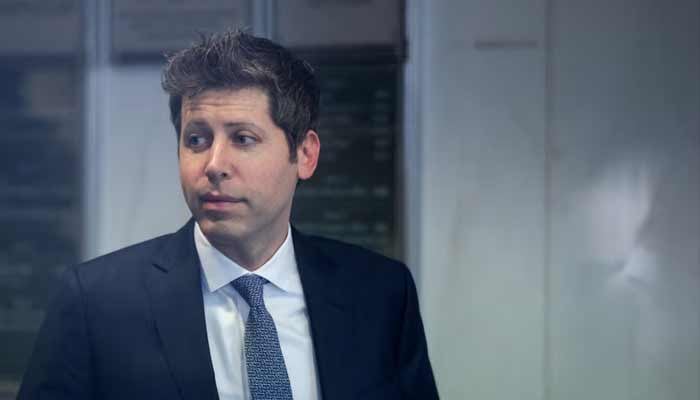
OpenAI CEO Sam Altman on Tuesday rejected Elon Musk’s claim that he betrayed the ChatGPT maker’s founding mission to serve the public good, saying it was Musk who was interested in taking control of OpenAI and monetizing it.
In an August 2024 lawsuit, Musk accused Altman and OpenAI of persuading him to give $38 million, only to see the nonprofit abandon its mission to benefit humanity and instead become a for-profit corporation.
The lawsuit, now in its third week, could determine the future of OpenAI and its management as it prepares for a possible IPO that could value the company at $1 trillion.
In Oakland, California federal court, Altman rejected Musk’s claim that he and OpenAI president Greg Brockman, who is also a defendant, tried to “steal a charity.”
Altman said “it feels hard to even wrap my head around that framework,” and that he hoped “as OpenAI continues to do well, the nonprofit will do even better.”
Musk, the world’s richest person, is seeking about $150 billion in damages from OpenAI and Microsoft, a major investor, to be paid to an OpenAI nonprofit.
He testified early in the trial, saying, “If you have somebody who’s not credible in charge of AI, I think that’s a very big danger to the whole world.” Musk also wants Altman and Brockman removed from their roles.
Altman rejected Musk’s bid for majority control
OpenAI was co-founded in 2015 by several entrepreneurs, including Musk and Altman.
It has sought to show that Musk knew about the profit plan before he left the board in 2018, but wanted control of the company, and is now suing because he regrets missing out on potential riches. OpenAI created a for-profit entity in March 2019.
Asked if Musk was opposed to the for-profit plan, Altman said “quite the opposite.”
He recalled that Musk once demanded a 90% stake in OpenAI and, despite later softening his stance, always sought majority control, an idea Altman was “extremely uncomfortable” with.
“I had a lot of experience with startups, had seen a lot of control struggles,” he said, citing Musk’s SpaceX as an example where founders of high-performing companies consolidated power to ensure permanent control.
Altman also said that while he and other OpenAI executives wanted to stay on Musk’s good side, he was leaning toward a merger with Tesla, Musk’s electric car company.
“I don’t think we would have had the ability to ensure that (our) mission was accomplished,” he said. “Basically, Tesla has to serve its customers and sell cars.”
OpenAI Chair surprised by Musk’s takeover offer
The lawsuit marks a clash between tech giants, with Musk portraying himself as a defender of ordinary people from the dangers of AI and Silicon Valley titans who care more about money.
That came after OpenAI raised hundreds of billions of dollars from big tech companies and investors to build its computing power ahead of a potential IPO.
Altman said Musk’s departure sparked mixed feelings at OpenAI. He said some were worried it could make funding more difficult, while others were relieved to be relieved of Musk’s insistence that scientists regularly defend their work and progress.
“I don’t think Mr. Musk understood how to run a good research lab,” Altman said. “He had demotivated some of our most central researchers.”
Bret Taylor, chairman of OpenAI, testified Tuesday that OpenAI received a formal takeover offer from a consortium led by Musk’s rival company xAI in February 2025, six months after Musk sued.
“I was surprised,” Taylor said. “This proposal was to acquire this non-profit by a group of for-profit investors, which felt contrary to the spirit of the lawsuit.”
Motives, insurances are discussed
Testimony in the trial before U.S. District Judge Yvonne Gonzalez Rogers may end this week.
Jurors could begin deliberating whether the defendants are responsible by May 18. Rogers would decide whether to pursue legal remedies.
Former OpenAI chief scientist Ilya Sutskever testified Monday that he spent about a year gathering evidence for OpenAI executives that Altman had exhibited a “consistent pattern of lying.”
Microsoft CEO Satya Nadella, whose company is a major OpenAI investor, testified Monday that the investment was a “calculated risk.”
Others who have testified include Brockman, former OpenAI chief technology officer Mira Murati and Shivon Zilis, a former OpenAI board member who is also the mother of four of Musk’s children.