
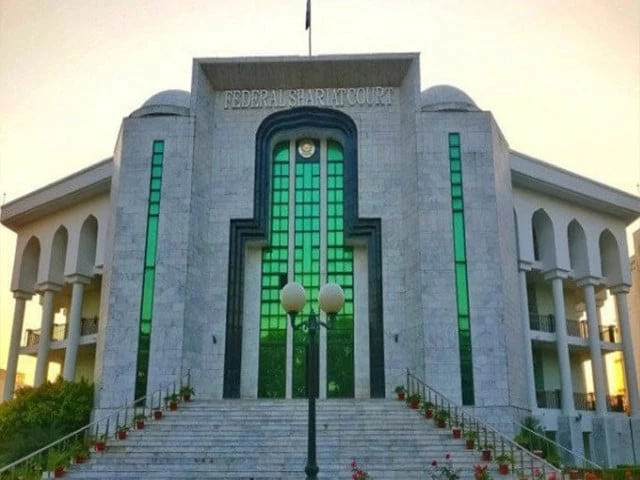
According to the verdict, suicide is a cardinal sin in Islam and an anti-life act
ISLAMABAD:
The Federal Sharia Court (FSC) has declared that the Criminal Laws (Amendment) Act 2022 – which deals with the omission of the offense of attempted suicide – is un-Islamic.
“After thoroughly hearing the parties and carefully perusing the record, we are inclined to accept Shariat Petition No. 03/I/2023 and Shariat Petition No. 01/I/2025.
“[We] declare that the decriminalization of an offense through the Criminal Laws (Amendment) Act, 2022, whereby section 325 of the Pakistan Penal Code (PPC) has been omitted, is contrary to the principles of the Holy Quran and Sunnah,” the 26-page judgment authored by FSC Justice Syed Muhammad said.
According to the ruling, suicide is a cardinal sin in Islam and is an anti-life act; therefore, any attempt to commit it is also considered an act promoting an anti-life act.
“Consequently, besides accepting these Sharia petitions, we declare that the impugned law, which is against the Holy Quran and Sunnah, will have no legal effect immediately after the issuance of this judgment. Accordingly, section 325 of the PPC, which was deleted through the promulgation of the impugned law,” it added.
A three-member FSC bench, headed by Chief Justice Iqbal Hameed ur Rehman, heard the case.
The judgment noted that the reasons presented to Parliament by the proposer of the bill – that an attempt to commit suicide is only carried out by persons suffering from depression or of an unsound mind and therefore the law should be decriminalized to protect such individuals from social stigmatization – are not only flawed but also contrary to the principles of the Koran and the Koran.
The court observed that decriminalization of the offense would allow persons of sound mind who attempt suicide to go free as the omission of Section 325 would leave no statutory provision under which they could be charged.
Second, the order said, any person involved in encouraging children or other vulnerable persons to commit suicide would also escape prosecution under the current legal framework.
Thirdly, persons involved in inciting suicide could not be accused or prosecuted, noting that the Holy Qur’an forbids helping each other in sinful acts. But since the offense under Section 325 had been omitted, no legal action could be taken against those who aided or abetted such acts.
The court further observed that while the advice of the Council of Islamic Ideology (CII) is not binding on the government and is of a guideline nature, it is preferable that the government either acts upon it or carefully considers it.
The judgment emphasized that under the constitutional arrangement of Pakistan, the CII plays an important role in ensuring that the laws are in accordance with the principles of the Holy Quran and Sunnah which form the basic norm of the Constitution as reflected in Article 2A.
It said the government, as a responsible litigant, is expected to avoid unnecessary legal complications and to comply with the court’s directions in letter and spirit even where it has room to manoeuvre.
“We are of the view that such conduct on the part of the Government would be more consistent with constitutionalism,” the judgment noted.
The order added that if the federal government seeks to protect mentally ill individuals from social stigma, it may consider acting on the CII’s recommendations.
However, it emphasized that decriminalization of such a serious and life-threatening offense is not the solution.
Instead, the court suggested effective implementation of existing laws, such as the Mental Health Ordinance, 2001, which have since been devolved to the provinces under the 18th Amendment.
The court noted that the intensity of depression varies from case to case and cannot justify a blanket exemption. “A blanket cannot be given to every single case of depression, mental illness or disorder under which an exception can be made to commit any crime, especially one involving human life.”
The judgment described objections raised against the CII’s opinion as contradictory, noting that if the procedural law already provides exemptions to mentally unsound persons, then complete decriminalization of the offense is not logically justified as the act can also be committed by persons of sound mind.
“The Act is made for the general public and not for unusual sections of society. Matters relating to specific segments are dealt with either through exceptions within the Act or through special legislation,” the court observed.
Taking into account the arguments presented in Parliament, the judgment held that the proposition that suicide attempts stem solely from depression or mental illness raises critical questions.
It asked whether this offense is always committed by persons suffering from mental illness and whether such persons are incapable of committing other crimes.
The court further questioned whether the assumption that only the mentally ill attempt suicide justifies removing a specific offense from the Pakistan Penal Code while leaving others intact.
The judgment ended by raising a fundamental question: If the premise is accepted that suicide attempts are always associated with mental illness, does this mean that a person of sound mind cannot commit such an act at all.


