
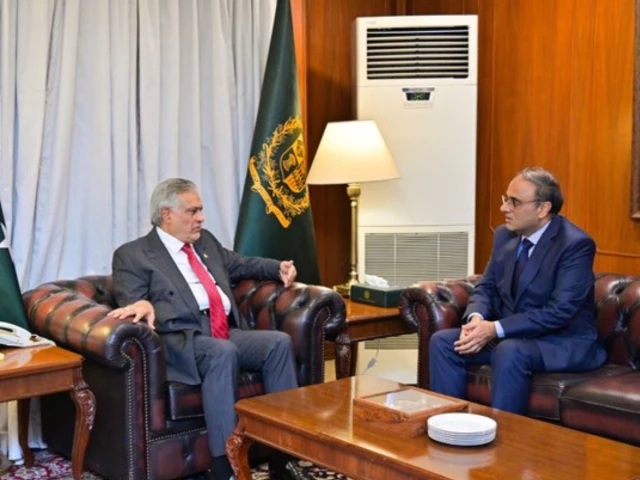
He recalls ‘deep-rooted historical, cultural and fraternal ties’ between the two countries
Deputy Prime Minister and Foreign Minister Ishaq Dar met Pakistan’s ambassador-designate to Iran, Imran Ahmed Siddiqui, ahead of Siddiqui’s departure for Tehran. PHOTO: FO
Pakistan reaffirmed its commitment to deepening ties with Iran on Tuesday when Deputy Prime Minister and Foreign Minister Ishaq Dar met Pakistan’s ambassador-designate to Iran, Imran Ahmed Siddiqui, ahead of Siddiqui’s departure for Tehran.
According to a statement issued by the Ministry of Foreign Affairs (MoFA), the Deputy Prime Minister recalled the “deep-rooted historical, cultural and fraternal ties between Pakistan and Iran” and reaffirmed “Pakistan’s commitment to further expand bilateral cooperation in all fields, especially in trade, connectivity, people-to-people exchanges and regional cooperation”.
Ambassador-designate of Pakistan to the Islamic Republic of Iran Imran Ahmed Siddiqui called on DPM/FM Senator Mohammad Ishaq Dar @MIshaqDar50 prior to his departure for Tehran.
Commemorating the deep-rooted historical, cultural and fraternal ties between Pakistan and Iran,… pic.twitter.com/qsTkmW4BXr
— Ministry of Foreign Affairs – Pakistan (@ForeignOfficePk) 19 May 2026
Dar emphasized “the importance of maintaining the positive momentum of bilateral engagement through close coordination and mutual understanding”.
The foreign minister also highlighted “Pakistan’s constructive and responsible role in promoting regional peace, dialogue and stability, and expressed confidence that the ambassador-designate would make a valuable contribution to further strengthen the enduring partnership between the two brotherly countries”.
He also “wished the ambassador-designate success in his new assignment”.
Read: Dar, Qatari minister discusses regional situation developments, stresses dialogue amid US-Iran tensions
On February 28, the United States and Israel launched a joint offensive against Iran. Tehran retaliated with attacks on Israel and other Gulf countries that host US assets.
Pakistan subsequently positioned itself as a key broker for peace, brokering a two-week ceasefire and hosting the highest-level US-Iran talks since the Islamic Revolution of 1979. Although the “Islamabad Talks” ended without an agreement, the ceasefire was held and later extended at Islamabad’s request.
The US and Iran are expected to hold a second and final round of talks in Islamabad, but there has been no official confirmation from either side regarding this. Despite no conformation, Pakistan has expressed optimism that a US-Iran peace deal would be reached “soon”.


