
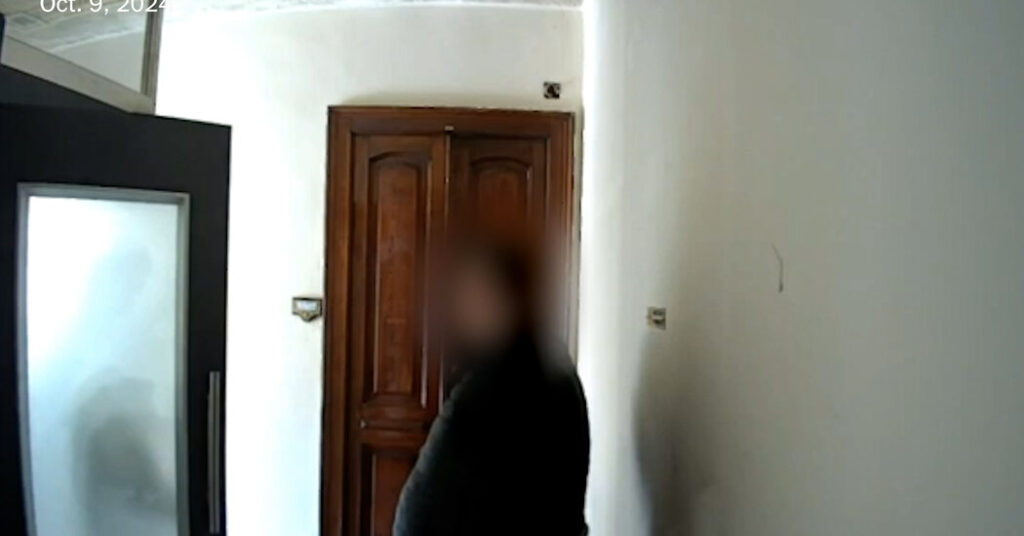
One afternoon in October 2024, Li Ying was in bed scrolling through X when he got a notification on his phone from the peephole surveillance camera on the door of his apartment in Turin, Italy.
Two men lingered in the hallway.
He got up quietly, walked to the door and watched them through the camera feed on his phone.
For two years, ever since he turned his X account into one of the most influential Chinese-language sources of uncensored news and dissent, Mr. Li had received threats of physical harm. If those threats ever materialized, he imagined summoning the courage to live stream his capture, possibly even his own death.
When one of the men reached into his pocket, Mr. Li froze. He forgot to live stream.
The man pulled out a can of spray paint and scrawled the word “stupro”, Italian for rape. Then both men left.
Mr. Li’s worst fears had not come true. He called the police. Four officers came and they took his statement and his security camera footage. A friend drove from Milan to pick him up and his two cats. In the morning the apartment was empty.
After that moment, Mr. Li, known as “Teacher Li” to his followers on social media, said his life should not be dictated by fear. Instead of retiring, he expanded his activities – traveling, attending human rights conferences and meeting diplomats, journalists, activists and politicians throughout Europe, Asia and North America.
“When you are able to look directly at the abyss,” said Mr. Li, “the abyss gradually begins to fear you instead.”
Italian police have not released any information about the investigation, but Li was certain the Chinese government had hired the vandals. Under Xi Jinping, censorship and surveillance have made sustained dissent in China extremely difficult. Beijing has proven equally determined to persecute those who speak out from abroad.
Mr. Li, 34, is among the biggest targets in Beijing. Constant doxxing kept him moving. Smears and death threats filled his X-feed. Then the intimidation became physical: Strangers showed up at his door, photographed his building and scrawled threats in his hallway.
A growing number of Chinese who found living in an authoritarian state intolerable have moved abroad. Most are too afraid of a vengeful government to speak out. But people like Mr. Li provides an alternative to the official government narratives through podcasts, YouTube channels, bookstores, and X-accounts that run from Tokyo, Toronto, and New York.
Few have reached such a large audience as Mr. Lis.
According to data analytics firm Similarweb, his X account, which has 2.2 million followers, ranked fifth globally on the site by traffic in December – extraordinary for an account written in Chinese. From 2023 to 2025, the account generated more than six billion impressions each year.
He posts accounts of unemployed college graduates, delivery drivers who once had more prestigious jobs, people who spent money on apartments that were never built or who were never paid for their work. Some of the information is sent by people inside China, such as videos of police cracking down on Wuhan residents protesting plans for a battery factory. Some posts come from Chinese social media, such as Weibo and Douyin, the sister card video app to TikTok.
“He is not just a single voice,” said Laura Harth, an Italy-based director of Safeguard Defenders, a human rights organization. “He is like the speaker through which all the other voices”—Chinese voices—”come out into the world.”
A cute and menacing cat
Mr. Li grew up in eastern China’s Anhui province and has been drawing for as long as he can remember. He moved to Italy to study painting. In November 2022, when demonstrations broke out in China protesting the country’s draconian “zero Covid” policy, he was living in Milan. He had a modest following on Twitter, as X was known at the time; his avatar is a hand-drawn cat that is both cute and menacing.
The protests were the biggest wave of public dissent since Tiananmen Square in 1989. Mr. Li opened his account to everyone inside China with something to show the world. People began sending him photographs, videos and testimonials – for example of police officers arresting protesters or people calling for Mr Xi to step down – which would have been censored on the Chinese internet. His following exploded.
Then came the retribution.
Every time he posted online, the police showed up at his parents’ house in Anhui. The Chinese embassy in Italy wrote to a language school in Milan where Mr Li worked, accusing him of fraud. He lost his job.
His parents asked him to stop writing. His bank accounts in China were frozen. So were his payment apps and gaming accounts.
Convinced he was being tracked, he moved four times in one year. At his most isolated, he didn’t leave his building for two weeks, surviving mostly on McDonald’s takeaway delivered to his house.
In 2024, the police in China began summoning Mr. Li’s followers and pressure them to unfollow his account. Then came the graffiti in Turin.
Elon Musk answers
China runs the most extensive version of transnational repression in the world, affecting millions of people in at least 36 countries, according to a 2021 Freedom House report. Beijing uses espionage, cyber attacks, threats and physical abuse to silence and punish its critics.
Over the past few years, authorities in Europe and the United States have investigated and prosecuted cases linked to Beijing’s efforts to monitor and intimidate dissidents abroad.
In February, an OpenAI report documented how Chinese law enforcement had used the company’s ChatGPT to conduct online influence operations against dissidents and foreign leaders, using Mr. Li as one of the examples. Mr. Li’s team and Safeguard Defenders are calling on overseas Chinese to document their experiences of Beijing’s transnational repression and submit evidence to authorities in democratic countries.
Beijing rejects accusations of transnational repression and accuses foreign governments of meddling in China’s internal affairs.
I have spoken with Mr. Li many times over the years. I once joked with him that there are two publications I read every day to keep up with China news: the official People’s Daily and his X-feed.
Early on, he resisted the “rebel” label and told me he regretted what he had gotten himself into. He was in disbelief that some Chinese were pinning their hopes for democracy on an influencer like him. Having paid the price of dissent, he understood why so few people dared to speak out.
But as time went on, Mr. Li seemed increasingly comfortable living in his role as an activist. He still doesn’t want his picture taken, and he investigates every room he enters. But the man who once hid inside his apartment now moves confidently through airports and attends conferences and visits embassies. He briefs diplomats on what is going on in China and Beijing’s methods of transnational repression.
He oversees staff and volunteers who help gather news and manage his X account, as well as publish a new weekly newsletter in English. In February 2025, Mr. Li’s team crowdsourced a study on long school hours in China, drawing thousands of submissions from students and parents. Some schools adjusted their schedules after the results circulated widely online. (His work is supported by private donors.)
In December I asked if he considered himself a revolutionary. He hesitated.
The word, he said, is associated with violence and bloodshed — things he abhors.
But Mr Li said he now saw his work as part of a non-violent struggle against Communist Party rule.
“For a long time I was the one being hunted by them,” he told me, referring to the Chinese government. “But now I’ve turned the tables – I’m the one chasing them around the world and pushing back against them.”
In April we met in Tokyo. Mr. Li likes the city for its Chinese diaspora, which in recent years has attracted a growing number of journalists, activists and intellectuals.
He also likes the proximity to China – as close, perhaps, as an exiled dissident can get.
In May, during President Trump’s state visit to China, Mr. Li’s comments came up short on Chinese social media. Mr. Li’s account had posted a photo showing Mr. Musk walked with his young son, who was wearing a Chinese-style vest. Mr. Musk, a member of the US delegation, responded to the post in Chinese: “My son is learning Mandarin.”
The exchange quickly became one of the most discussed topics on Chinese social media. A state media created a hashtag #ElonMusksaidhissonislearningChinese on the Weibo platform. Some comments slyly asked, “So, who did he answer to?” After a few hours, the hashtag was deleted.
Shortly after, Mr. Li an image generated by artificial intelligence showing Mr. Musk and Mr. Xi sitting together at a state dinner. Mr. Musk held up a phone to the Chinese leader.
On the screen was Mr. Li’s mischievous cat avatar.


