
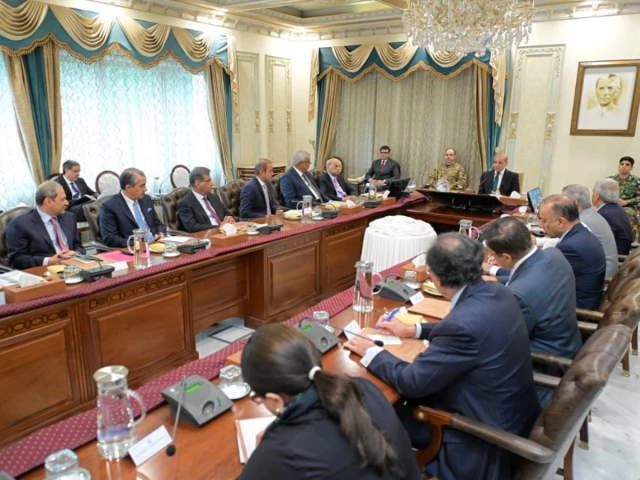
Discussion centered on the overall direction of economic growth, export-led development, strengthening of investments
Prime Minister Shehbaz Sharif is holding a consultative meeting with leading industrialists and business people to seek input on the upcoming budget. PHOTO: PMO
Prime Minister Shehbaz Sharif on Wednesday held a consultative meeting with leading industry and business figures to seek input on priorities for the upcoming federal budget 2026-2027, focusing on shaping economic policy and sustaining recovery efforts, according to a statement from the Prime Minister’s Office.
According to the PMO, the discussion revolved around the overall direction of economic growth, export-led development and measures aimed at boosting investment and job creation ahead of the upcoming budget.
The prime minister said consultations with business were “vital” in policy formulation, adding that Pakistan’s economic recovery depended on a strong partnership between the government and the private sector.
A delegation of leading industrialists and prominent businessmen met Prime Minister Muhammad Shehbaz Sharif in Islamabad on June 3, 2026. pic.twitter.com/bheYXJc1NM
— Prime Minister’s Office (@PakPMO) June 3, 2026
The delegation included prominent industrialists and business leaders like Mian Muhammad Mansha, Arif Habib, Ahsan Zafar Syed, Muhammad Ali Tabba and others representing key sectors of the economy.
Several federal ministers and senior officials also attended the meeting, including Food Security Minister Rana Tanveer Hussain, Law Minister Azam Nazeer Tarar, Climate Change Minister Musadik Malik, Economy Minister Ahad Khan Cheema, Information Minister Attaullah Tarar, IT and Telecommunication Minister Shaza Ahmad Khawaja, Petroleum Minister Ali Per Khawaja, Petroleum Minister Ali Per, Sariz Legeum. Finance Minister Bilal Azhar Kayani, Special Assistant to Prime Minister Haroon Akhtar Khan, Attorney General Mansoor Usman Awan and State Bank of Pakistan Governor Jameel Ahmad, along with other senior officials.
Addressing the delegation, the prime minister said, “You are the ambassadors of Pakistan and our identity in the world,” and played a key role in shaping the country’s international economic reputation.
He thanked the business community for supporting the government in difficult economic conditions and said sustained cooperation between the public and private sectors was essential for growth.
“We are moving towards an export-led growth model, which remains the core of our economic policy,” the prime minister said.
The prime minister added that reforms were underway to improve the resolution of tax disputes through tax courts, with what he described as transparent hiring processes, while a committee had been formed to establish special commercial courts.
The meeting of the country’s well-known industrialists and the distinguished cabinet delegation from Prime Minister Muhammad Shahbaz Sharif
Prime Minister Muhammad Shahbaz Sharif’s recovery of the country’s overall economic development
அக்குத்து மாட்டை மால் பாட்டு 2026-2028
You are the ambassador of Pakistan and the world… pic.twitter.com/Twcrj5zfUq— PTV News (@PTVNewsOfficial) June 3, 2026
He said the upcoming budget will include measures aimed at providing relief to the public while supporting business-friendly policies to attract investment and stabilize the economy.
Read: The US is proposing tariffs on goods from 60 economies, including Pakistan
The prime minister also highlighted the government’s focus on expanding the industrial, agricultural and information technology sectors, saying these areas would create employment and strengthen long-term economic stability.
He added that technical and vocational training programs had been launched to improve youth employability and support national development.
Officials briefed the participants on ongoing reforms, including improvements to tax courts to speed up the resolution of tax disputes, establishment of special commercial courts and infrastructure projects aimed at improving cargo connectivity from Karachi ports to the rest of the country.
These include upgrades to the M-10 highway and work on the Pipri freight corridor, as well as the development of the M-13 (Kharian-Rawalpindi) highway to reduce travel time between Lahore and Islamabad.
The briefing also highlighted railway infrastructure upgrades under Pakistan Railways’ ML-1 and ML-2 projects, designed to improve freight transport and logistics efficiency.
The briefing also highlighted the development of a national AI transformation plan and the use of video analytics in industrial sectors such as sugar and cement to improve revenue collection.
Business leaders welcomed the government’s economic direction and praised efforts to stabilize the economy, improve financial management and promote digitization. They also expressed support for tax reforms, energy cost reductions for industry and timely tax refunds.
The delegation praised the diplomatic efforts for regional peace and thanked the prime minister for including business in budget hearings.
They reiterated their commitment to work with the government to strengthen industry, increase exports and create employment opportunities.


