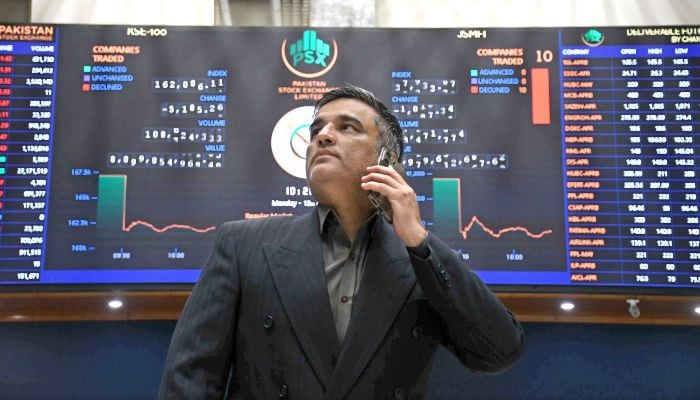
The bourse came under selling pressure on Monday as a renewed escalation in the Middle East pushed up crude oil prices, fueling concerns over Pakistan’s external account, interest rate outlook and uncertainty ahead of the budget.
During the session, the Pakistan Stock Exchange’s benchmark KSE-100 index touched an intraday high of 169,360.54, down 1,118.4 points or 0.66%, and a low of 168,432.45, reflecting a fall of 2,046.49 points or 1.2% on 8.4%, 71.0%.
“The PSX fell over 1% due to Iran’s escalation and worsening tensions in the Middle East,” said Ahsan Mehanti, managing director and CEO of Arif Habib Commodities.
“Pre-Budget uncertainty and investor expectations of a rise in global crude prices are affecting the external account, and a possible rate hike played a catalytic role in selling pressure at the PSX,” he added.
Brent oil prices rose by more than $3 a barrel. barrel on Monday, initially spooked by Israel’s launch of renewed strikes on Lebanon a day earlier, before gaining further steam after sounds of explosions were heard in Iran.
Local media reported early Monday the sounds of explosions in Tehran, Tabriz and Isfahan, dashing hopes of an imminent end to the wider war and a resumption of crude oil flows through the Strait of Hormuz.
Brent crude futures rose $3.20, or 3.39%, to $96.24 a barrel. barrel, while U.S. crude futures rose $2.87, or 3.17%, to $93.41 a barrel.
The gain erased Friday’s losses as prices fell on hopes of a de-escalation in the U.S.-Iran conflict, which has pushed oil prices more than 50% higher since March.
Iran on Sunday fired a volley of missiles at Israeli targets in retaliation, even as US President Donald Trump insisted a deal to end the wider war remained within reach.
Trump also reportedly told Israeli Prime Minister Benjamin Netanyahu to refrain from further attacks Financial Times: “It’s not going to have any impact on the deal”.
Asian stocks also fell on Monday as investors exited AI-related stocks on concerns that the bull run had gone too far, too fast, while fresh hostilities in Iran pushed up oil prices.
South Korea’s chip-heavy KOSPI led regional losses, down 5%, while Japan’s Nikkei fell nearly 4% and Taiwan’s benchmark sank 3.9%.
The regional sell-off followed last week’s disappointing outlook from chipmaker Broadcom and a stronger-than-expected US jobs report that prompted traders to price in the possibility of a rate hike this year.
In the previous session, the KSE-100 index closed lower, falling 696.57 points, or 0.41%, to settle at 170,478.94 against the previous close of 171,175.51.
The index hit an intraday high of 172,102.91 and a low of 170,254.65 during Friday’s session.