
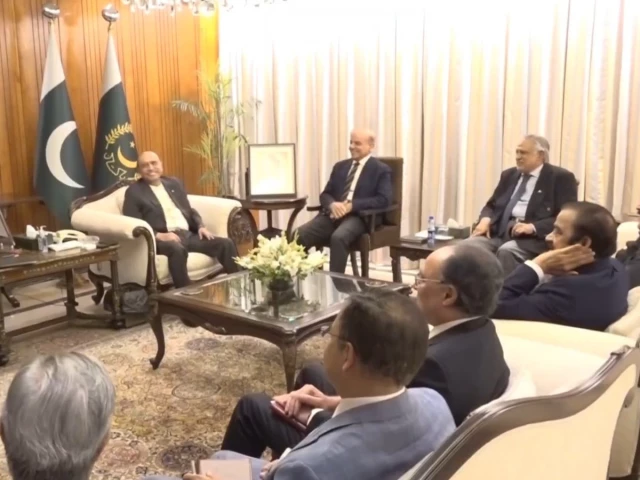
The President orders that a full effort be made to adjust the growth rate, public welfare schemes in the upcoming budget
Prime Minister Shehbaz Sharif and President Asif Ali Zardari discussed the recent elections in Gilgit-Baltistan (GB) and the relaxed situation in Azad Jammu and Kashmir (AJK) in a meeting on Monday.
According to a statement issued by the President’s House, the two leaders also discussed national security, the economy, the upcoming federal budget and the regional situation.
The discussions also covered the recent UK elections, the law and order situation in AJK and other issues of national importance, the statement said.
The statement added that President Zardari, while discussing budget proposals and public relief measures, emphasized the need to prioritize public welfare, provincial rights and economic stability in the upcoming federal budget.
“The President directed that full efforts be made to align the growth rate and public welfare schemes in the upcoming budget,” it said.
During the meeting, Interior Minister Mohsin Naqvi briefed the President on his recent visit to Iran and recent regional diplomatic engagements.
صدرِ ورسلة Asif Ali Zardari سے وزیرِ عزام محمد شهباز شريف ةی امیوار مستخدم۔
نایب وزیرِ عزام و وزیرِ خریدی اساق دار, وزیرِ وازیرِ وازیرِ عزاق دار, وزیرِ وازیرِ بازیرِ محسن نقوی, وزن نذیر تارک, وزیر فیزیرِ اعزم و وزیرِ عزامِ عزاق دار, وزیرِ بازیرِ عزام و وزیرِ فازیرِ خریاد آساق دار, وزیرِ بازیرِ عازم و وزیرِ فازیرِ خرید اساق دار, وزیرِ بازیرِ عزامِ pic.twitter.com/5yC3TOQcYC
— President of Pakistan (@PresOfPakistan) June 8, 2026
Deputy Prime Minister and Foreign Minister Ishaq Dar, Law Minister Azam Nazeer Tarar, Finance Minister Muhammad Aurangzeb and Prime Minister’s Political Affairs Adviser Rana Sanaullah attended the meeting.
Pakistan People’s Party Chairman Bilawal Bhutto-Zardari, AJK Prime Minister Raja Faisal Rathore and other political leaders were also present.
The rally came in the wake of deadly clashes in AJK’s Rawalakot, where the recently banned Joint Awami Action Committee (JAAC) had staged a sit-in outside the Combined Military Hospital Rawalakot. AJK police claim that armed JAAC members opened fire on deployed law enforcers in a planned attack, leaving four people dead and around 20 injured. JAAC, however, disputes this account and claims that security forces used tear gas and fired grenades at the hospital.
According to the AJK police, three people associated with JAAC and four policemen were killed during the protests on Sunday. However, JAAC said in a statement on the X that seven people were killed and dozens were injured when street shelling was carried out in the dark after power was reportedly cut.
The clash on Sunday came as the AJK government and the JAAC witnessed a face-off when the election date for AJK was announced on July 27.
AJK’s 53-member legislature includes 12 seats reserved for Kashmiri refugees – people who fled Indian-controlled Kashmir in 1947 and 1965 and are now spread across Pakistan. Six seats represent refugees from the Jammu division (~434,000 people) and six from the Kashmir Valley (~30,000 people) – an already lopsided arrangement that many see as unfair.
The region experienced one of its most turbulent periods last October, when protests led by JAAC broke out over demands for constitutional and government reforms. At least nine people, including three policemen, were killed during the unrest.
JAAC, which organized the protests and strike, had presented a comprehensive charter of demands, including an end to the privileges enjoyed by the ruling elite, the abolition of 12 assembly spaces reserved for refugees and the abolition of the quota system.
Two days after the violence, the government and JAAC reached an agreement covering 12 core points and 13 additional points. Under the agreement, both sides agreed to set up a high-level committee to look into the issue of refugee seats in the AJK Legislative Assembly.
Read more: Four policemen martyred, over 20 injured in Rawalakot firing: AJK Police
The unrest also triggered political upheaval in the region. The PPP subsequently presented a no-confidence motion against the then Prime Minister Chaudhry Anwarul Haq, with the Pakistan Muslim League-Nawaz participating in the effort. Haq, who had been elected in April 2023 with 48 votes, chose to face the vote rather than resign.
On 17 November, Rathore secured 36 votes in the election and became the 16th Prime Minister of Azad Jammu and Kashmir.
With elections now approaching and the refugee seat issue still unresolved, the AJK government convened an All Parties Conference (APC) in Muzaffarabad to build consensus. Almost all major parties participated – except PTI and JAAC, which boycotted it.
JAAC’s position is that the government had already rejected its written proposal submitted on May 30, so it would be futile to participate. It had proposed either to retain token refugee representation until the Kashmir dispute is permanently resolved, or to replace the 12 seats in the Assembly with 4 seats in the AJK Council – a body headed by the Prime Minister, which it argued would better preserve the political dimension of the Kashmir issue.
The APC rejected any change outside the constitutional and legislative framework, saying only the elected assembly could change refugee seating arrangements. The JAAC called the resolution “a page and a half of completely trivial lines” and accused participants of coming together to serve their own interests rather than those of the public.
JAAC called for a major protest on June 9 in Muzaffarabad, where caravans are converging from across the region.
Minister for Parliamentary Affairs Dr. Tariq Fazal Chaudhry on Sunday rejected allegations that the agreement with JAAC had remained unimplemented, saying the government had fulfilled the vast majority of its obligations in AJK.


