
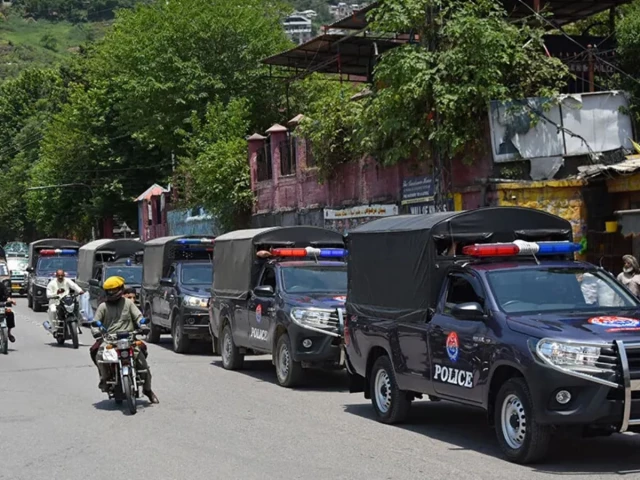
A key member of outlawed JAAC announces complete separation; five suspects arrested from Muzaffarabad under IBO
Commuters drive past security personnel as they patrol a street ahead of a protest by the outlawed JAAC in Muzaffarabad, the capital of Azad Jammu and Kashmir on June 7, 2026. Photo: AFP
The Azad Jammu and Kashmir (AJK) government on Tuesday announced a reward of Rs 10 million. for information leading to the arrest of four wanted persons associated with the recently banned Joint Awami Action Committee (JAAC).
“The President of Azad Jammu & Kashmir has been pleased to fix Rs10 million reward money to be given to any person providing information leading to the successful arrest of the following offenders belonging to the banned JAAC,” a release said.
The development emerged after fatal clashes in AJK sparked competing accounts of casualties, government complaints and political legitimacy, with official sources confirming at least seven deaths. Last week, the AJK government banned JAAC, accusing it of involvement in terrorism, promoting hatred and creating anarchy in the state. The ban followed JAAC’s call for a protest on 9 June. The organization has previously spearheaded mass protests demanding economic relief and political rights, with some demonstrations ending in violence and deaths during confrontations with law enforcement in May 2024 and September 2025.
The persons mentioned in the notice are Shaukat Nawaz Mir, Umar Nazir Kashmiri, Khawaja Mehran Arshad and Sardar Aman Khan. It further stated that the identity of the informant would be kept strictly confidential.
The AJK Home Department also directed the Superintendent of Police to take necessary steps for the immediate implementation of the reward scheme.
AJK Government has announced a reward of Rs. 10 million for information leading to the arrest of banned JAAC criminals Shoukat Nawaz Mir, Umar Nazir Kashmiri, Khawaja Mehran Arshad and Sardar Amaan Khan. The identity of the informants will be kept confidential #PakistanTV #AJK… pic.twitter.com/OBm6VlKMKS
— Pakistan TV (@PakTVGlobal) June 9, 2026
Meanwhile, Syed Faisal Gilani, a key member of JAAC, announced complete separation from the party.
In his statement, Gilani strongly condemned the attacks in Rawalakot, saying that “JAAC played a blood festival with the lives of innocent citizens.” Gilani further stated that he had become a part of JAAC for public interest but unfortunately it had deviated from its original path.
“The people of Azad Kashmir reject the banned JAAC violent rhetoric and prove that they are conscious citizens,” he said.
کالعدم جواینت public action committee کاهم روکن سید فیسال جیلانی کا ناد نار مکلک لاتالکی کاعالان
In his statement, Syed Faisal Gilani strongly condemned the violent attacks in Rawalakout and said that the innocent civilians on the part of the على على كلميتي… pic.twitter.com/7N50UjoYLb
— PTV News (@PTVNewsOfficial) June 9, 2026
According to Associated Press of Pakistan (APP), law enforcement agencies conducted a targeted, intelligence-led operation in the Chehla area of Muzaffarabad, resulting in the arrest of five suspects.
According to security sources, the authorities seized laptops, mobile phones and various communication devices during the raid.
“Initial investigations of the digital devices have already revealed suspicious links and sensitive material. During the interrogation, information from one of the detainees led to the recovery of a large cache of weapons, including seven automatic weapons, several grenades and other military hardware.”
Sources added that maps of sensitive installations, alleged attack plans and documents related to high-security sites were also confiscated. The investigators “uncovered evidence pointing to alleged contact with hostile foreign intelligence agencies”.
With the forensic and technical analysis of the recovered digital devices and materials currently underway, investigators widened the scope of the investigation to identify possible facilitators, financial backers and the wider network behind the group.
Security sources stressed that the timely operation successfully averted a potential threat to sensitive installations and public safety.
Reaffirming their commitment to national security, the authorities vowed to maintain a zero-tolerance policy towards activities that threaten state security, public order and national interests, and pledged strict action against all anti-state elements.
Meanwhile, law enforcement agencies continued their extensive investigation and appealed to the public to immediately report any suspicious activity to the appropriate authorities.
The latest intelligence-led operation, which led to the arrest of five suspects and the recovery of sensitive devices, reflects Pakistan’s continued efforts to counter security threats. The authorities remain committed to proactive action against any element that seeks to destabilize… pic.twitter.com/21qy2ewjhu
— Pakistan TV (@PakTVGlobal) June 9, 2026
Kashmiri, one of the banned leaders, said separately that the group’s movement was peaceful and that it would prefer to come forward with honor rather than surrender to the authorities.
Hamari movement is peaceful but we prefer to be in front of the forces instead of being pitted against them.
Omar Nazir Kashmiri— Awami Action Committee (@JAAC__Official) June 9, 2026
JAAC said many people from different parts of the territory joined it for their protest call.
স্র্র্যার স্র্য্র ক্র্য কাযালা ইস্ল্র্জ্দ কে ক্র্যার ক্র্ত্র্য কার্যায়া ক্র্তে
اس کا اونگرین بی اج این نی کیا هی کہ و 28 km کا سفر کرن ست کمتر کا سفر کہ کر ک آلام گرد کے اسلام گرد کے— Awami Action Committee (@JAAC__Official) June 9, 2026
The group claimed that three young men were killed in Kotli, while several others continued to be injured.
کوتلی ازاد کاشمر۔
திந்தை ஜான் ஜான் க்கியு வாயு வியு வியு வாயு வாயு க்கு க்கு சிய் பாட்டு பாட்ட்டுக்கு பாட்ட்டுக்க்கு அப்ப்பு அப்ப்ப்பு மாரை— Awami Action Committee (@JAAC__Official) June 9, 2026
Dialogue with JAAC
AJK Prime Minister Raja Faisal Mumtaz Rathore once again requested the JAAC to “please come back to the negotiating table”.
In a post on X, he said, “I request everyone daily to resolve matters through discussions instead of fire and blood. Your insulting comments, constant threats and senseless agitation are not helpful to anyone on this side of the LOC.
“Everyone recognizes your rights and freedoms. No one can dictate to Kashmiris how to solve our problems. All we have to do is remain calm and find a way out through talks. The only weapon a political activist carries is his reasoning and negotiation skills.”
A political activist without the ability to debate and negotiate is like a pilot without the ability to fly an airplane. They both end up causing wounds and damage to people behind them.
Please return to the negotiating table. I ask everyone daily to solve… pic.twitter.com/8GuMqaXmp3
— Faisal Mumtaz Rathore (@PMofAJK) June 9, 2026
A day earlier, he had offered to restart negotiations with the JAAC and called on protesters to return to the dialogue table.
“The people protesting in AJK are our own. No doubt about it. Agents and traitors? I don’t think so. Disillusioned? Naturally. Deluded? Surely,” he said in an X post.
“Come and sit with us. This is not a problem that can be solved at the cost of human life,” he said in a television interview, adding that previous talks had collapsed over unresolved clauses.
Rathore also acknowledged that while some protest demands, especially related to refugee seats, require careful review, resolution must come through discussion rather than confrontation.
The recent unrest and deadly clashes in areas including Rawalakot where the recently banned JAAC had held a sit-in outside the Combined Military Hospital Rawalakot. AJK police claim that armed JAAC members opened fire on deployed law enforcers in a planned attack, leaving four people dead and around 20 injured. JAAC, however, disputes this account and claims that security forces used tear gas and fired grenades at the hospital.
According to the AJK police, three people associated with JAAC and four policemen were killed during the protests on Sunday. However, JAAC said in a statement on the X that seven people were killed and dozens were injured when street shelling was carried out in the dark after power was reportedly cut.
The clash on Sunday came as the AJK government and the JAAC witnessed a face-off when the election date for AJK was announced on July 27.
AJK’s 53-member legislature includes 12 seats reserved for Kashmiri refugees – people who fled Indian-controlled Kashmir in 1947 and 1965 and are now spread across Pakistan. Six seats represent refugees from the Jammu division (~434,000 people) and six from the Kashmir Valley (~30,000 people) – an already lopsided arrangement that many see as unfair.
The region experienced one of its most turbulent periods last October, when protests led by JAAC broke out over demands for constitutional and government reforms. At least nine people, including three policemen, were killed during the unrest.
JAAC, which organized the protests and strike, had presented a comprehensive charter of demands, including an end to the privileges enjoyed by the ruling elite, the abolition of 12 assembly spaces reserved for refugees and the abolition of the quota system.
Two days after the violence, the government and JAAC reached an agreement covering 12 core points and 13 additional points. Under the agreement, both sides agreed to set up a high-level committee to look into the issue of refugee seats in the AJK Legislative Assembly.
Read more: Four policemen martyred, over 20 injured in Rawalakot firing: AJK Police
The unrest also triggered political upheaval in the region. The PPP subsequently presented a no-confidence motion against the then Prime Minister Chaudhry Anwarul Haq, with the Pakistan Muslim League-Nawaz participating in the effort. Haq, who had been elected in April 2023 with 48 votes, chose to face the vote rather than resign.
On 17 November, Rathore secured 36 votes in the election and became the 16th Prime Minister of Azad Jammu and Kashmir.
With elections now approaching and the refugee seat issue still unresolved, the AJK government convened an All Parties Conference (APC) in Muzaffarabad to build consensus. Almost all major parties participated – except PTI and JAAC, which boycotted it.
JAAC’s position is that the government had already rejected its written proposal submitted on May 30, so it would be futile to participate. It had proposed either to retain token refugee representation until the Kashmir dispute is permanently resolved, or to replace the 12 seats in the Assembly with 4 seats in the AJK Council – a body headed by the Prime Minister, which it argued would better preserve the political dimension of the Kashmir issue.
The APC rejected any change outside the constitutional and legislative framework, saying only the elected assembly could change refugee seating arrangements. The JAAC called the resolution “a page and a half of completely trivial lines” and accused participants of coming together to serve their own interests rather than those of the public.
JAAC called for a major protest on June 9 in Muzaffarabad, where caravans are converging from across the region.
Minister for Parliamentary Affairs Dr. Tariq Fazal Chaudhry on Sunday rejected allegations that the agreement with JAAC had remained unimplemented, saying the government had fulfilled the vast majority of its obligations in AJK.


