
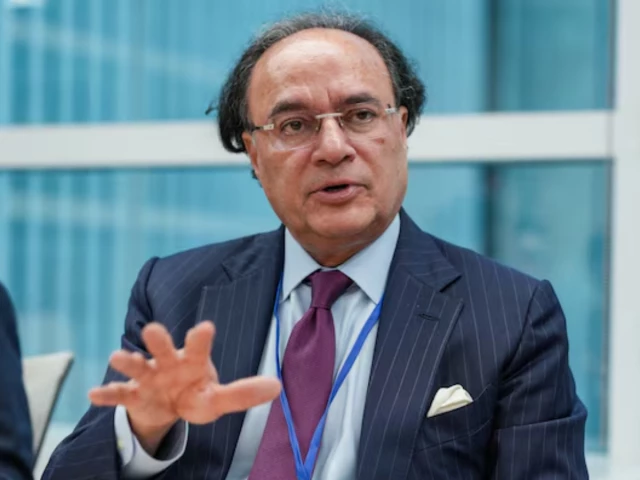
Pakistan’s Finance Minister Muhammad Aurangzeb. Photo: Reuters/ File
ISLAMABAD:
Finance Minister Muhammad Aurangzeb said on Saturday that provincial contributions to federal spending had been partially reflected in next year’s defense budget, adding that talks were underway on a three-year contribution framework.
Addressing his post-budget press conference, the finance minister elaborated on the use of a grant of over Rs1 trillion given by the provinces to the Centre, which enabled it to meet urgent financial needs that exceeded the available federal fiscal space.
The Finance Minister was accompanied by Information Minister Attaullah Tarar, Minister of State for Finance Bilal Azhar Kayani, Finance Secretary Imdadullah Bosal, FBR Chairman Rashid Langrial and Head of Tax Policy Najeeb Memon.
Aurangzeb said the arrangement was in place for the next year after the government raised defense spending by 18% amid regional uncertainty.
The provincial grants will be used for defense purposes and to provide a fiscal buffer against the inflationary effects of the second and third rounds of the Middle East war, as well as to meet the country’s broader security requirements, the finance minister said.
Expressing hope that the conflict “will come to an end sooner rather than later”, Aurangzeb said energy infrastructure has been hit and therefore “to expect that the Strait of Hormuz will open up, that things will normalize, or whether it’s LNG or other resources that have been hit, will normalize in a week or two weeks, that’s not going to happen”.
“So that will spill over into the next financial year,” he added.
The minister said discussions with the International Monetary Fund on some of the major tax breaks were underway as the government also approved a slew of relief measures worth Rs 20 billion. for civil servants.
In an attempt to appease disgruntled employees who had been protesting for the past few days, the government accepted over a dozen of their demands, including merging two benefits and increasing compensation under other benefits.
Similarly, the finance minister said the government was “in constant consultation with the IMF (on relief measures)”.
The government has proposed relief measures of Rs360 billion, but the sources said the IMF had objections to halving withholding tax on property transactions, which would cost the exchequer Rs115 billion.
The sources said the government and the IMF would resolve these issues in the coming days.
Asked about the IMF’s objections to the tax cuts and whether the government will withdraw the relief or levy more taxes to offset the over Rs100 billion impact, the finance minister said “whatever will be done will be done with their consultation”.
The government has also set aside Rs430 billion in cash buffers in the budget to counter the exogenous shocks.
While replying to a question on protection of Rs430 cash buffers in case of revenue shortfall, the minister said that the government would try to protect these buffers in the hope that all the targets would be met.
Salary and allowances
To a question, the finance minister said that the government has merged 2022’s ad hoc allowance of 15% and 2025’s 10% in the basic pay. This was one of the main demands of the federal government employees. The 7% increase has been given after combining these two quotas, resulting in a higher increase than the announced 7%.
The total cost of these relief measures including the ad hoc allowance is estimated at a little over Rs 20 billion.
According to another relief, the government has given an Inequality Reduction Allowance of 5% of basic pay to all employees in BPS-1 to 22 on the existing terms and conditions of those already receiving Inequality Reduction Allowance.
It has increased the rate of transport allowance by 50% of the existing amount, which has been frozen for a long time. Likewise, the government has revised the Permanent Companion Allowance for the Civilian Armed Forces by increasing it from Rs 7,000 to Rs 30,000 per month.
The Government has also revised the Special Area Compensation Allowance for Pakistan Coast Guard troops and provided 10% in compensation by canceling the existing allowance admissible at the rate of 40% but at the 1994 pay level.
The government has given 100% IMPAS allowance on current basic pay to the Immigration and Passports Department as per the terms and the special pay of officers and staff in the Cabinet and Cabinet Committee Wings of the Cabinet Division has been revised from Rs 6,000 to Rs 20,000. per month.
It has also provided 150% special NACTA/NIFTAC allowance to NACTA/NIFTAC employees but discontinued 100% risk allowance.
An interim allowance of 150% to police officers posted in the Frontier Constabulary has also been approved.
It has increased a special allowance for Grade 22 staff in the National Highway and Motorway Police from 10% to 50%. The Government gave a special allowance for the Police College of 50% to the officers who were posted at the Police College.
The Special Conveyance Allowance has also been revised from Rs6,000 to Rs10,000.
NFC
The finance minister once again said that there was a need to revise the resource allocation formula among the four provinces as giving 82% of the resources on the basis of the population contributes to a higher population in the country.
To a question, the minister said Prime Minister Shehbaz Sharif’s promise with Khyber-Pakhtunkhwa to introduce legislation to increase the province’s share due to the merged population of the districts would be fulfilled.
The finance minister also expressed gratitude to the provinces for “the way they’ve kind of stepped up to help us with some of the more pressing needs”.
“Some of that has been reflected in the defense budget,” he added, noting that for this year that arrangement is in place and “from our perspective, it’s a three-year discussion and we will take it forward with the provinces in the next couple of years as well”.
Wage earner class
Calling the budget pro-salaried and pro-people, the cabinet ministers said the budget would also stimulate growth.
“If we were to take this budget in the direction of pro-business, pro-growth, then construction, of course, housing plays a very important role, and the transaction taxes that we’ve lowered, you’ve already seen about that,” he said.
Discussing agriculture, he said: “This has increased by 15% year on year and it has crossed 2 trillion, which is the total agricultural financing.”
Finance Minister Kayani noted that “fundamentally, this is the budget of the salary class, this is the budget of industrial companies, this is the budget of exporters, this is the budget of the construction sector”.
Kayani added, “this is the budget for the person who wants to build his own house and does not have the means to do so”.
“The grade is at the top of the list,” Kayani said, adding that “that is why it has always been said that the government will give relief to the grade whenever it gets a chance”.
Kayani also discussed the reduction of the minimum and advance taxes for exporters, “whether it was the elimination of the first six slabs of super tax and the last block should be reduced from 500 million to 10% to 8%”.
“These were basically the primary demands of our exporters and our formal industry,” he said.
Information Minister Attaullah Tarar termed the budget as “aid-oriented” and said the reforms of the FBR are unprecedented and historic. “There have never been such major reforms in the history of the country,” Tarar said.
In a discussion of the oil tax, the finance minister clarified that “the size of the tax is not increasing”.


