
Says nationwide coordination between mosques, seminaries and religious boards can play key role in fighting terrorism
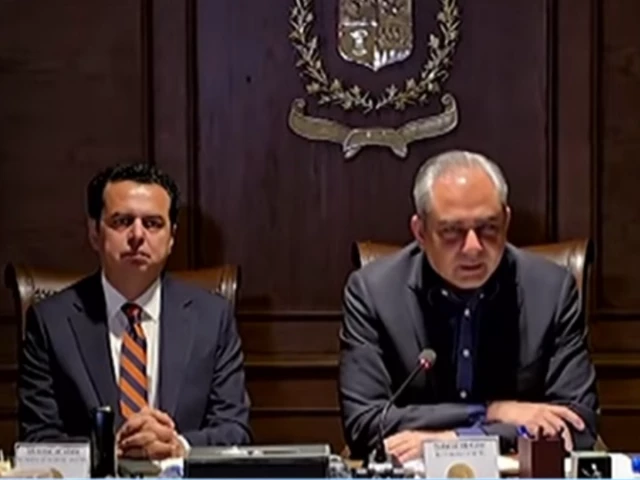
Interior Minister Talal Chaudhry and Interior Minister Mohsin Naqvi hold meeting of Paigham-e-Aman Committee. SCREEN GRAB
Interior Minister Mohsin Naqvi on Tuesday called for stronger coordination between the state and religious scholars, urging them to play a unifying role in fighting terrorism, social unrest and fitna while supporting a single national message of peace and stability.
Speaking at the special Paigham-e-Aman committee meeting in Islamabad along with Interior Minister Talal Chaudhry, he urged scholars to support the state’s counter-terrorism narrative by issuing clear religious guidelines based on Islamic teachings.
“First of all, regarding terrorism, I would like to ask you to give fatwas and declarations that strengthen us that you stand with us in the fight against terrorism,” he said. He added that scholars should refer to the Qur’an, Hadith and Islamic history to explain how fitna that weakens the state is dealt with in Islam.
“Throughout the history of Islam and hadith, if a fitna arises that weakens your state, how should it be dealt with and what are its consequences?” he said, adding that the public should also be guided on how Islam addresses those who oppose or challenge the state in the context of terrorism or other forms of disorder.
Naqvi said the platform should be strengthened into a national level forum involving all religious boards and seminaries. He recalled that a similar proposal had earlier been shared in Punjab, suggesting that the initiative be extended to the entire country.
“If, on one subject, 22,000 mosques deliver a single message, there cannot be a stronger message from Pakistan,” he said, adding that the inclusion of all madrassa boards had already strengthened the forum.
Read more: Economy showing signs of recovery: Khawaja Asif
He further emphasized that the committee should not remain confined to occasional religious periods but should function throughout the year through a structured coordination system.
“We will establish a coordinator. We need ulema throughout the year, not only in Ramazan or Rabiul Awwal,” he said, adding that monthly meetings should be institutionalized and regular engagement ensured.
The minister said that many tensions in society arise from a lack of focus on common priorities. “In my personal analysis, when we all focus on ourselves and stop looking at others, many of our problems will be solved,” he said.
He added that states do not allow hate speech or disrespect towards other religions or sects, and stressed the importance of responsible public messaging.
Naqvi said that in regional crisis situations, Pakistan’s leadership structure played a crucial role in managing outcomes, compared to a team system where strategy is set at the top and execution is done on the ground.
“There is a manager who is a captain. The manager gives direction, makes a strategy, gives the final approval and then the captain and the team go out on the field to achieve results,” he said.
Referring to US-Iran tensions, he credited coordinated leadership for preventing escalation and described the role of Pakistan’s top leadership in the process.
Read also: Naqvi, Hafiz Naeemur Rehman discusses political, economic and security challenges
Referring specifically to Chief of Defense Forces and Chief of Army Staff Field Marshal Asim Munir, the interior minister said his credibility and trustworthiness was recognized by all parties involved, enabling him to play a key role in communication and de-escalation efforts.
He said both sides had confidence in his neutrality, which helped Pakistan ease engagement at a sensitive phase of the crisis.
Naqvi also described the mediation process in detail, saying he was present in Tehran with the chief Iranian negotiator during high-level discussions aimed at preventing escalation. He said the situation at the time was extremely volatile, with diplomatic efforts running alongside impending military preparations.
According to his account, at one point the crisis had reached a point where escalation seemed imminent, with military assets already on alert. He said that at this critical stage, “jets were on standby preparing for possible attacks and missiles were ready” while talks continued simultaneously in Tehran.
He added that there was only a very short window left before potential military action, but continuous engagement with the Iranian side’s chief negotiator helped keep communications open.
Through sustained backchannel diplomacy and urgent engagement, he said, the situation was pulled back from the brink and escalation averted.
Naqvi concluded that the Paigham-e-Aman Committee should act as a continuous national platform for unity, peace and stability. Chaudhry also addressed the meeting and supported stronger coordination between the state and religious scholars.


