
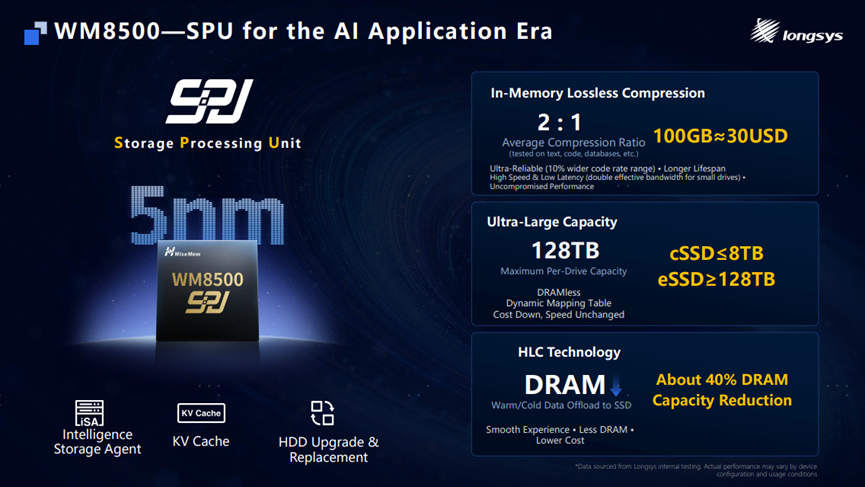
- The Longsys WM8500 offers as much as a 2:1 in-Memory lossless compression
- The 5nm chip currently supports up to 128TB of single drive capacity compared to standard consumer SSDs that are limited to 8TB
- This is made possible by using the DRAM-less SPU as an active player in the storage stack, leveraging both its High Level Cache (HLC) and intelligent Storage Agent (iSA) to deliver an industry-leading compression ratio
Longsys, the world’s second largest independent memory company and the power behind one of the best-known consumer brands in the West, Lexar, as well as one of the main B2B storage players, FORESEE, may have a solution to rising SSD and DRAM costs: a chip that compresses data on the fly extraordinarily well.
It has come up with a 5nm chip that handles on-the-fly compression for large SSDs, allowing them to essentially double their capacity beyond the 128GB single drive capacity it currently supports.
While this is nowhere near what hardware-based data compression on tape drives looks like (with ratios of up to 2.5:1), it’s still an impressive feat for an industry plagued by ever-increasing NAND flash costs, even as many data centers continue to use hard drives to keep costs down.

How does the Longsys WM8500 essentially double storage space?
The Longsys WM8500 is what the storage giant calls an SPU or Storage Processing Unit, built on a 5nm process and fundamentally different from technologies such as Samsung’s SmartSSD.
Unlike Samsung’s approach, which utilizes a general-purpose FPGA or an ARM-based CPU inside the SSD to manage computational tasks on the drive, the SPU is an Application-Specific Integrated Circuit (ASIC) designed for a specific purpose: compression and storage management.
The 5nm chip also offers a cost advantage that most high-end consumer and enterprise controllers don’t have, apart from its compression capabilities: it’s a completely DRAM-free design, which allows it to command a lower price, despite Longsys’ claim to offer ‘virtually’ twice the storage space for its AI consumers.
It should be noted that the 2:1 figure is an ‘up to’ ratio, and while it may be easier for an ASIC to compress data and context windows for certain AI models, others may make it significantly more difficult, especially if obfuscation or encryption is involved.
In an ideal scenario, the WM8500 SPU, combined with its High Level Cache (HLC) implementation and its Intelligence Storage Agent (iSA), together form what the manufacturer calls a “closed-loop software-hardware collaborative technology system” focused on AI customers.
The HLC cache claims a 40% reduction in DRAM requirements, making it a cost-effective alternative to HDD storage, even as competitors prepare to release 256TB enterprise SSDs later this year. AI data centers continue to require large amounts of storage and memory to meet their ever-increasing needs.

Follow TechRadar on Google News and add us as a preferred source to get our expert news, reviews and opinions in your feeds.


