
Shortly after the Federal Reserve convened for its final meeting, President Trump took to social media to launch a familiar line of attack. He demanded lower interest rates and lashed out at Jerome H. Powell, then chairman of the central bank – himself sharing an edited photo of Mr. Powell plunging into a dumpster full of garbage.
Mr. Trump’s relentless pressure had little effect on the Fed, which has kept borrowing costs unchanged for months as it tries to tame the fallout from the US war with Iran. For Mr. Powell, it was the last major action in a tumultuous period in leadership – and for his replacement, Kevin M. Warsh, it signaled the challenges that still lie ahead.
As the president’s long-awaited, handpicked Fed chairman, Mr. Warsh navigates the economic headwinds—and the many political risks—that come with serving in Mr. Trump’s second term. Like his predecessor, Mr. Warsh bound to face the unrelenting attention of the man who nominated him, and could likewise find himself at the receiving end of fierce and public pressure to lower prices.
In some ways, the task for Mr. Warsh exposed by the unusual circumstances under which he inherited the job.
Mr. Trump nominated Mr. Warsh back in January, amid months of unusually aggressive White House attacks on the Fed and its members. The president openly courted a list of loyalists at the central bank, and he repeatedly publicly flirted with the idea of firing Mr. Powell, despite having elevated him to the job in his first term.
At political rallies and on social media, Mr. Trump bailed on Mr. Powell as the president’s deputies investigated the Fed chair, an investigation that a judge would later find to be politically motivated. And Mr. Powell was not alone: Mr. Trump also tried to impeach another Fed member, Lisa D. Cook, in a case that would eventually reach the Supreme Court. (The judges could rule on that case as early as this week.)
The meddling often spooked markets, angered lawmakers from both parties and cast a shadow of doubt over Mr. Warsh before he could even take the job at the Fed, where he previously served as governor. That forced Mr. Warsh to face uncomfortable questions from Congress about his ability to resist Mr. Trump’s demands.
At a tense confirmation hearing in April, Mr. Warsh repeatedly convinced lawmakers that Mr. Trump “had never asked me to predetermine, commit, fix, take a position on any interest rate decision in any of our discussions, nor would I ever agree to do so.” Many Democrats remained unconvinced and later opposed Mr. Warsh’s confirmation, which the Senate gave in May.
The largely party-line vote gave Mr. Trump his long-sought new Fed chief just at a time when the central bank seemed least likely to live up to his demands for lower interest rates. In fact, Mr. Warsh’s first meeting, which began on Tuesday, as economists continued to debate the odds of a rate hike, with prices now rising at their fastest clip in more than three years.
Mr. Warsh is set to announce the Fed’s next rate decision on Wednesday in the same setting that often forced Mr. Trump’s to issue his fiercest public criticism of Mr. Powell.
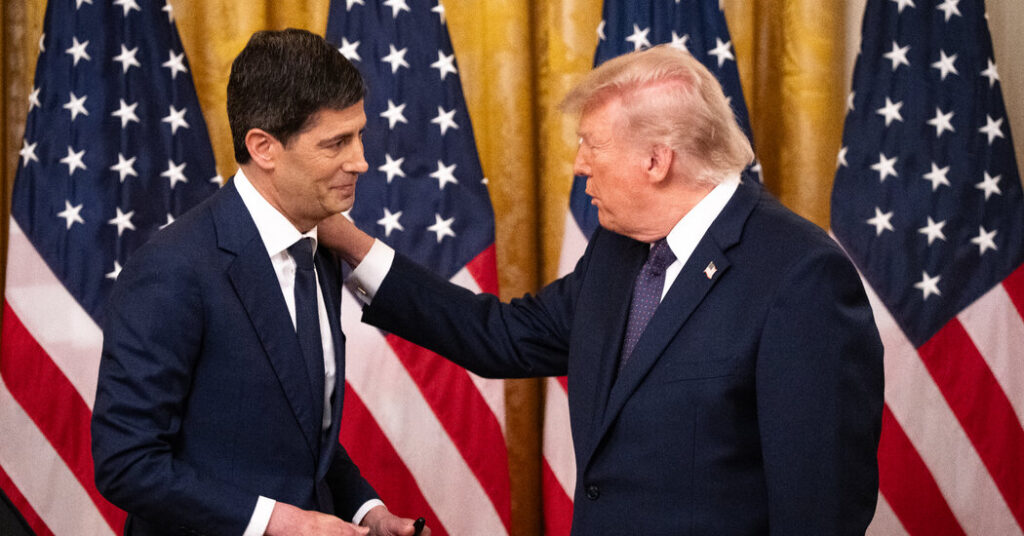
For his part, the president has hinted in recent weeks that he may want to ease some of the pressure on his newly confirmed chair. At a swearing-in ceremony for Mr. Warsh last month said the president wanted his new Fed chair to be “completely independent” when it came to setting interest rates.
“Don’t look at me,” said Mr. Trump. “Don’t look at anybody. Just do your own thing and do a good job.”


