
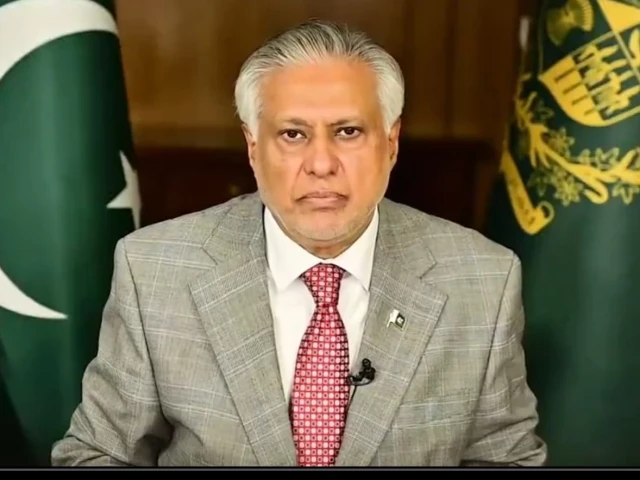
Deputy Prime Minister and Foreign Minister Ishaq Dar. SCREEN GRAB
Deputy Prime Minister and Foreign Minister Ishaq Dar warned on Thursday that India was pursuing what he described as a strategy of “hydro-hegemony”, saying at least 17 projects, including reservoir and river diversion schemes, were designed to drastically alter the Indus river system.
Last April, following a deadly attack on tourists in Indian-occupied Jammu and Kashmir (IIOJK), India unilaterally suspended the Indus Waters Treaty (IWT) after accusing Pakistan of supporting the attackers – a charge Islamabad categorically denied. The treaty has since remained at the center of renewed tensions between the two neighbors over the sharing of transboundary water resources.
Addressing the Brussels Conference on “Transboundary Water Resources: An Armed Global Common”Dar said India’s actions went beyond rhetoric and posed a challenge to the IWT framework.
Deputy Prime Minister/Foreign Minister Senator Mohammad Ishaq Dar @MIshaqDar50 delivered a keynote address via a recorded video message at the seminar “Transboundary Water Resources: A Weaponised Global Common” organized by the Embassy of Pakistan in Brussels @PakinBrussels,… pic.twitter.com/ZEUEto9OCH
— Ministry of Foreign Affairs – Pakistan (@ForeignOfficePk) June 18, 2026
“It is important to emphasize that our concerns are not based only on Indian statements,” he said.
“India has followed up its belligerent statements with illegal actions; these include projects to create reservoirs such as Sawalkot, Kirthai, Kwar, etc.; the expansion of existing structures such as Baglihar and Salal; and, most alarmingly, diversion projects on the Indus, Chenab and Ravi rivers.
“A total of at least 17 such projects that will drastically change the river system as a whole, giving India the tools for ‘hydro-hegemony’ that it wants,” he added.
Read: ‘Not a single drop of water will flow to Pakistan’: Indian minister threatens to block water supply
The Deputy Prime Minister said the conference was timely as it brought together experts to discuss climate change, water resource management and the political dimensions of transboundary water management.
“Shared resources require cooperative management through agreed frameworks; otherwise, competing interests can turn them into sources of conflict and weapons, as is increasingly seen today,” he said, adding that peaceful coexistence depended on respect for treaties, agreements and multilateral frameworks.
Referring to the Indus Waters Treaty signed between Pakistan and India in 1960, Dar said Pakistan had consistently upheld the principles of the UN Charter and remained committed to resolving disputes through the treaty’s legal framework.
“The treaty envisages the peaceful settlement of disputes within its own framework,” he said, noting that it had survived three major conflicts and numerous other challenges over the decades.
Keynote Address by Deputy Prime Minister/Foreign Minister Senator Mohammad Ishaq Dar at the Brussels Conference on “Transboundary Water Resources: An Armed Global Common”
18 June 2026 pic.twitter.com/8DDVt0USxk— Ministry of Foreign Affairs – Pakistan (@ForeignOfficePk) June 18, 2026
FM Dar said Pakistan had earlier expressed concern over certain Indian actions under the treaty but had always pursued available legal mechanisms.
“We sought a solution through international mechanisms and respected decisions even when they did not meet our expectations,” he said.
Criticizing India’s unilateral suspension of the treaty, Dar said abandoning established legal frameworks could not be considered a responsible course of action.
“Responsible states are acting within established legal frameworks rather than abandoning them,” he said.
“And yet today we face just such a challenge.”
The foreign minister said rivers were not just waterways but lifelines of historical, cultural and economic importance.
“Our eastern neighbor’s stated policy of deliberately depriving 240 million people of their rightful access to water represents a disaster in the making, of unprecedented magnitude.”
Also read: FM Dar urges UN Security Council President to pressure India to restore Indus Waters Treaty
He stressed that water must never be used as a means of coercion.
“It is a shared resource, a shared responsibility and ultimately a prerequisite for human dignity and sustainable development. The future of transboundary water management must therefore be anchored in cooperation and respect for international law.”
Dar said the issue should not be seen solely through the lens of South Asia, arguing that respect for treaties formed the basis of the international order.
“The sanctity of treaties is the foundation of the international order,” he said.
The foreign minister reiterated Pakistan’s position, saying the country remained committed to resolving disputes peacefully.
“Pakistan remains committed to resolving all issues through dialogue, diplomacy and the mechanisms established under international law,” he said.
“Our position is not guided by confrontation, but by the conviction that lasting solutions can only emerge through cooperation and respect for mutually agreed obligations.”
On the issue of climate change, Dar said Pakistan was facing the water challenge at a time when it was among the world’s most climate-vulnerable countries, despite contributing less than one percent of global greenhouse gas emissions.
Read more: Dar accuses India of violating IWT as Chenab levels drop
“This is a moment that calls for increased international cooperation and collaboration on water-related issues,” he said.
Dar urged the participants to learn from the Indus Waters Treaty while examining experiences from other regions.
“Let us reaffirm today that shared waters should unite nations rather than divide them, and that cooperation, not coercion, must remain the guiding principle of transboundary water management,” he concluded.
IWT and why it matters
The 1960 IWT stands as one of the most carefully negotiated and legally robust transboundary water agreements in modern international law. Signed between Pakistan and India with the good offices of the World Bank, the treaty was designed to remove water from the volatility of politics and conflict and anchor it firmly in law, engineering discipline and neutral dispute resolution. It is a binding international instrument governed by the fundamental principle of pacta sunt servanda – that treaties must be observed in good faith.
Read: Pakistan accuses India of violating the Indus Waters Treaty
At the heart of the IWT is a permanent and unqualified allocation of rivers. Article II assigns the eastern rivers – Ravi, Beas and Sutlej – exclusively to India, while Article III gives Pakistan exclusive rights over the western rivers – Indus, Jhelum and Chenab. This award was the basic agreement of the treaty.
India’s access to the western rivers is permitted only within the narrow limits of Article III, para. 2, of the Indus Waters Treaty, read with Annexes D and E, which allows limited, non-consumptive uses such as hydroelectric power plants in the river. These permits are subject to strict design and operational restrictions, including restrictions on water bodies, a ban on storage for flow regulation, and a ban on technical features that enable control of water flows to Pakistan.
These safeguards aimed to protect Pakistan as the lower river bank and prevent water from becoming a strategic tool. Pakistan’s objections to projects such as Kishanganga and Ratle stem from concerns over excessive water bodies, fenced drains and mechanisms that Pakistan says violate treaty provisions and can affect downstream flows, especially during lean seasons.
The dispute entered a more worrying phase in April 2025 when, following a terrorist incident in Pahalgam, India announced that it was putting the Indus Waters Treaty “on pause”.
Read more: India skips IWT proceedings in Hague
Earlier this year, India unilaterally approved the Dulhasti Stage-II hydropower project on the Chenab River, an act that violates the provisions of the Western Rivers Treaty and violates Pakistan’s legally protected rights under the binding international agreement.
The unilateral suspension and expedited approval of upstream projects, including the withholding of hydrological data, diversion of river flows and alteration of natural regimes, constitutes deliberate water weaponry that endangers Pakistan’s agriculture, food security, hydropower generation and ecological stability. Under the IWT, customary international law and Article 51 of the UN Charter, Pakistan has clear legal options to respond.
International law expressly prohibits the use of water as a weapon against downstream populations, making strict enforcement of the IWT essential not only for bilateral stability but also for the integrity of global water management norms.


