
LAHORE:
The Punjab Assembly’s budget debate on Sunday was dominated by sharp criticism from the opposition and the Pakistan Peoples Party (PPP), which described the document as a collection of misleading statistics and expressed reservations about development priorities and allocations for southern Punjab, agriculture, health and education.
On the other hand, Treasury members defended the government’s performance and accused the opposition of turning the House into a platform for political rhetoric instead of debating the budget.
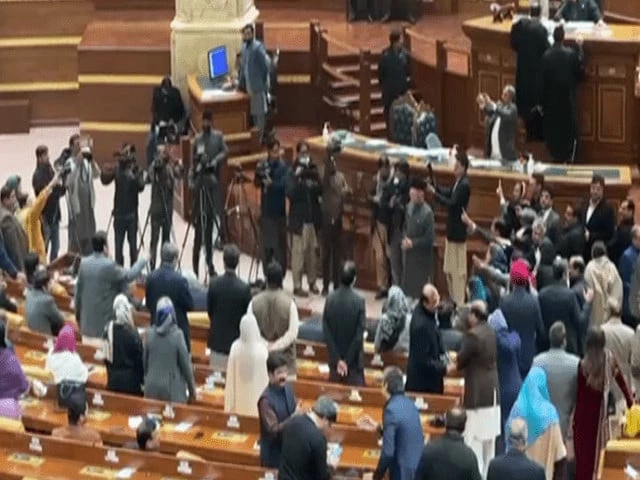
When proceedings started about an hour and a half late on the third day of the general discussion on the budget, only 30 lawmakers were present in the 371-member assembly, including 18 from the finance ministry and 12 from the opposition.
Opening the debate, opposition MPA Ejaz Shafi claimed the budget figures were a “numbers game” and argued that funding for agriculture, school and higher education, health and special education had actually been reduced despite the government’s claims of increased spending.
He questioned the utilization of last year’s development funds and criticized what he called declining investments in public welfare sectors.
Apart from budget criticism, he also raised the cases of jailed PTI leaders and workers and insisted that they were denied justice.
PPP legislator Wasif Mazhar Ran echoed concerns over the budget, wondering how the government could claim to have presented a tax-free budget while predicting a 65 percent increase in revenue collection. He called on the government to prioritize health and education.
Opposition members repeatedly claimed that South Punjab had been ignored in the provincial budget. PTI MPA Nadeem Qureshi claimed that only Rs96 billion had been allocated to South Punjab from a development budget of Rs752 billion despite the region contributing about 40 percent of Pakistan’s agricultural output.
He argued that funding for higher education and agriculture had remained disproportionately low. He also criticized the government for protesting when opposition members raised political issues, noting that politicians could not be expected to avoid politics in the assembly.
Another opposition member, Ali Imtiaz Warraich, argued that Punjab’s budget could not be understood without examining the federal outlay, claiming that the province had transferred Rs 546 billion. to the Federation without sufficiently taking the Assembly into confidence.
He criticized the government’s overall economic model, claiming that it had failed to improve public services, particularly in southern Punjab.
The opposition speakers often switched from the budget to politics. Several PTI lawmakers claimed that the party remained the province’s most popular political force despite its leadership being jailed.
PTI MPA Farrukh Javed Moon challenged the government to hold transparent elections in Lahore and claimed that the ruling PML-N could not win a fair contest. He alleged widespread corruption in departments, criticized the outsourcing of public schools, questioned wheat procurement policies and accused the government of making false promises during the election campaign.
MPA Saima Kanwal said voters had elected her party to seek the release of jailed PTI founder Imran Khan and demand the return of what she described as the party’s “stolen mandate”.
She criticized the government’s spending priorities, claiming that public funds were being used for luxury instead of welfare.
MPA Zarnab Sher also criticized the budget, claiming that development spending remained limited compared to total spending, while accusing the government of reducing allocations for health and education but increasing spending on administrative offices and the chief minister’s secretariat.
The debate also briefly turned to law and order after opposition leader Moin Riaz Qureshi raised the killing of an Australian-Pakistani child during a police operation in Chakwal.
He raised the question why similar incidents involving Pakistani citizens had not received the same attention.
Speaker Malik Muhammad Ahmad Khan agreed that an impartial inquiry was needed and directed the government to present details of both the Chakwal incident and another one reported from Bhakkar before the assembly.


