
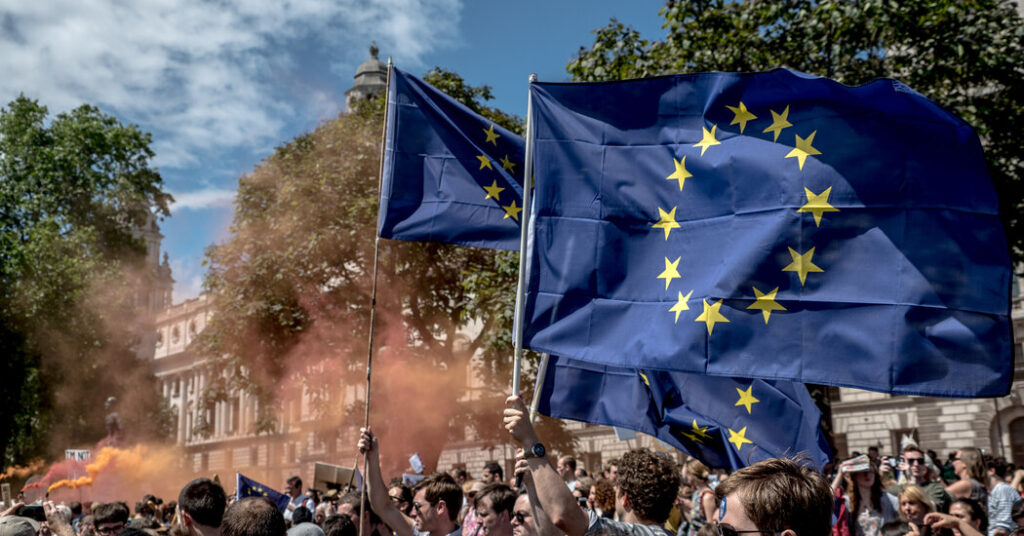
Just before Britain’s fateful referendum on its membership of the European Union 10 years ago, today’s government issued a stark warning. A vote to leave the bloc would lead to “an immediate and profound shock” to the economy. By a small margin, the public voted to go anyway.
The economic warnings were wrong, but only in their timing.
Brexit has hurt the UK economy and the costs have steadily accumulated over the past decade, far outweighing any benefits, economists say. More visibly, Brexit has unleashed a wave of political instability: the country will soon have its seventh prime minister since the June 23, 2016 vote, after Keir Starmer announced his resignation on Monday.
The turmoil has led to a sense of regret: In a recent poll, almost half of Britons said Brexit went worse than expected, a sharp increase from five years ago. Another survey found that just over half would support the re-entry of the EU.
It is difficult to be precise about the cost of Brexit given the other hits to the UK economy since the referendum, including the Covid-19 pandemic, President Trump’s tariffs and the wars in Ukraine and Iran. Here’s what you need to know about the economic impact so far, according to several recent reports.
The economy is smaller than it would have been.
In 2016, the UK government assumed that a vote to leave would mean an immediate severance of the country’s trading links with the 27 other members of the EU. Instead, there were years of negotiations. The UK did not officially leave the bloc until the end of January 2020, and even then there was an 11-month transition period. It obscured the economic effects because trade rules did not change fundamentally until 2021, four and a half years after the vote.
The Covid pandemic, an energy crisis and other events have made it difficult for economists to work out Brexit’s effect on the economy. But many have tried. A much-publicized study, led by Nicholas Bloom, a Stanford professor, estimated that Brexit has reduced Britain’s gross domestic product by up to 8 percent, “with the impact accumulating gradually over time.”
While other economists quibble with this study’s methodology, they broadly agree that Britain’s economy is 4 to 6 percent smaller than it would have been if it had stayed in the EU, a significant output loss. This means lower tax revenues to finance public expenditure and a slower improvement in people’s living standards.
The Office for Budget Responsibility, Britain’s independent fiscal watchdog, believes Brexit will reduce the country’s long-term productivity, which has lagged other major economies since the global financial crisis, by 4 percent.
New trade deals have not offset the Brexit losses.
Most of the economic costs have come from adding trade friction with the market of 450 million people on Britain’s doorstep.
A 2021 trade deal kept tariffs mostly at zero, but it raised other trade barriers by introducing extra paperwork, border controls and new rules. Brexit reduced Britain’s exports of goods and services to the EU by about 12 percent and imports from the bloc by about 16 percent, according to the Center for European Reform, a research group.
British agriculture and food exports have been particularly hard hit, falling by almost 30 per cent, the CER found. For some, like shellfish farmers, the extra border controls made exporting goods unaffordable. Many small businesses in particular have scaled back their efforts to unlock European customers because of the added time and cost.
Britain’s trade in services has fared better. But most economists attribute this to the pandemic, as demand increased for services, especially those delivered online. Britain’s well-established service providers, including consultancies and law firms, benefited.
Brexit has freed the UK to sign its own trade deals, replacing deals set by the EU. But while Britain has since signed 39 trade deals covering 72 countries, it has not made up for lost trade with the EU.
Despite the extra costs and obstacles introduced by Brexit, Europe remains by far the UK’s largest trading partner, accounting for more than 40 per cent of its trade, only marginally lower than before the referendum. In its regular forecasts for the UK economy, the Office for Budget Responsibility simply assumes that new deals with countries outside the EU “will not have a significant impact.”
UK businesses are still feeling the pain.
One of the first and biggest economic effects of the Brexit vote was a freeze on business investment as businesses retreated under the uncertainty of protracted trade negotiations and political instability.
Eventually, business investment grew again, but less strongly than it would have otherwise, economists say. The National Institute of Economic and Social Research, an independent think tank, recently said that Brexit-induced uncertainty has reduced long-term business investment by around 4 percent.
Has anyone benefited? “The professions and sectors that will benefit are the consultants, lawyers and probably customs agents,” said Anton Spisak, senior researcher at the Center for European Reform. But overall, Brexit has had a “very negative effect” on the economy, he added.
One of the biggest effects has been on migration. Instead of slowing immigration, as many of Brexit’s supporters suggested, there has been a large influx of people from outside the EU. They face different visa requirements and bring different skills, reshaping the labor market.
Many industries, such as hospitality, food processing and health and social care, have struggled with additional costs and disruption after losing their traditional work base.
“We’re only really in the early stages of knowing how the really profound shift in UK immigration patterns after Brexit will play out,” said Sarah Hall, an economic geographer at the University of Cambridge and deputy director of UK in a Changing Europe, a think tank.
London has retained its place as Europe’s financial centre.
In 2016, the financial sector was vocally opposed to Brexit, which threatened London’s role as the gateway to Europe. A decade later, London has maintained its position as Europe’s largest financial hub.
No other European city has become the financial industry’s preferred destination, Ms Hall said. But London has still lost significant parts of its business, such as stock trading to Amsterdam and wealth management to Dublin.
It’s been “like a slow puncture,” added Ms. Hall. Rather than a sudden transition, there has been “a whole series of moves and now increasingly new job openings that are not taking place in London.”
Last year, Mr Starmer’s government held a summit of European leaders to “reset” their relationship. But over a year later, development has stalled. Another summit, planned for next month, was postponed by the Europeans after Mr Starmer’s resignation.
While aiming for a closer relationship, the Labor party has ruled out a return to Europe’s single market and customs union or allowing free movement across its borders. Analysts also say there is limited interest in Brussels to renegotiate deeply with Britain.
“Quite a lot that can change in the next decade,” said Mr Spisak of the Center for European Reform. But he does not expect major changes in the next two or three years, before the next general election is around the corner.
And so the costs will continue to rise, and the biggest one has been the hardest to quantify, Mr. Spisak said.
“The main cost of Brexit is the opportunity cost,” he said. “That is, all the things that have not happened because of Brexit.”


