Accounting for 15 percent of confirmed cases and over 25 percent of deaths since the outbreak in April, children are almost twice as likely to die as adults, according to the United Nations Children’s Fund (UNICEF).
“Children are particularly vulnerable because they are dependent on caregivers and cannot distance themselves from a sick parent or sibling in the same way an adult can,” said UNICEF chief Catherine Russell.
“To better protect children, we need sustained access and the necessary resources to reach all affected communities.”
Combating instability and online disinformation
More than 130 children have already lost one or both parents in Ituri, the origin and epicenter of this current outbreak.
“Our team in Ituri have met children who have lost their mothers, and in some cases both parents, to Ebola,” Russell said.
“Children are trying to make sense of the threat while surrounded by rumors and online misinformation.”
While testing capacity has recently improved, surveillance and contact tracing remain limited, including by insecurity and limited access in a troubled region scarred by clashes between government forces and armed groups.
New nursery serves Ebola orphans
Ituri province, particularly the Mongbwalu, Rwampara and Bunia health zones, remains the epicenter, with cases also reported in North Kivu and South Kivu.
In Ituri, 135 children orphaned by the outbreak are receiving support, including with psychosocial care, referral to key social services and alternative care, said UNICEF, which also opened a nursery as a safe place for youth separated from their parents or caregivers and plans to operate two more soon.
Calling for immediate, safe and sustained humanitarian access to affected communities, UNICEF is initially seeking $70.7 million for its six-month response, with $20 million still unfunded, as part of the multi-partner Ebola preparedness and response plan to limit the spread of disease.
WHO and ‘blue helmets’ build care unit in Bunia prison
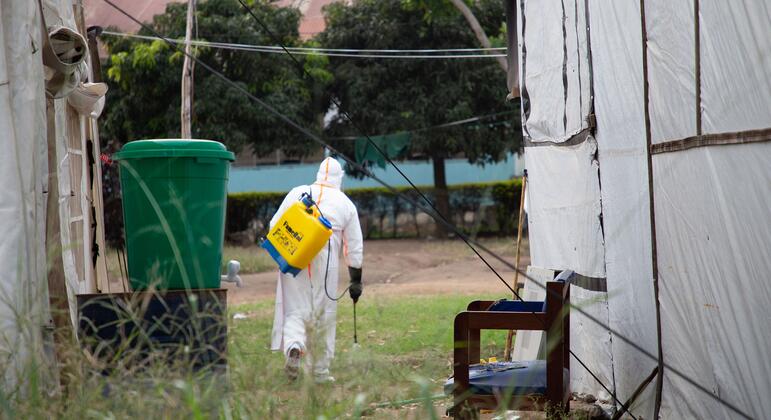
Behind the blue walls of Bunia Central Prison in Ituri, where 2,000 inmates live close together, the World Health Organization (WHO) built an Ebola isolation and care unit as part of its support to DRC health authorities to end the ongoing outbreak.
“The project was delivered in close collaboration with members of the local community, with the majority of the workforce consisting of inmates who contributed their skills and labour, demonstrating the positive impact of community engagement and rehabilitation efforts to strengthen the local health response,” said Michele Di Marco, a technical coordinator and architect from the World Health Organization (WHO).
Built in partnership with the UN peacekeeping mission, MONUSCO, the four-bed temporary isolation unit aims to provide safe clinical care, protect the health of inmates and staff and help prevent the spread of the virus, which the UN health agency said is “an investment in preparedness”.
Protection beyond prison walls
Strong infection prevention and control measures are critical in prison environments, where overcrowding, frequent movement and close social interaction can accelerate the spread of infectious diseases such as Ebola, the WHO said.
For prison officials, the facility offers reassurance against a disease that can spread quickly if left undetected, the WHO said.
By integrating Ebola preparedness into routine health services, the UN health agency said authorities are strengthening their capacity to respond quickly to public health threats while maintaining essential care for detainees.
As Bunia prisoners regularly interact with visitors, congregate in common spaces and participate in such activities as soccer matches, the WHO said such environments make it critical to maintain robust prevention, screening and preparedness measures to reduce the risk of infection. This protects both the prison population and the wider community, the agency said.