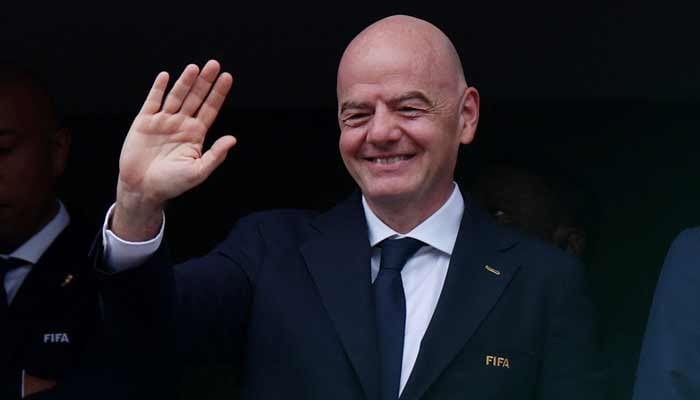
Fifa president Gianni Infantino has defended the introduction of hydration breaks at the World Cup, insisting that for football’s governing body they are driven purely by sporting considerations and not commercial interests.
Mandatory three-minute breaks, introduced in the 22nd and 67th minutes of each match in the tournament, have drawn criticism from players, coaches and fans since the opening round.
The breaks, introduced to help players cope with high temperatures across North America, have opened up additional advertising windows for broadcasters.
This has given rise to debate about their impact on the game, with some viewers complaining of being exposed to advertisements during the three-minute stoppage.
“There is no additional income for Fifa as all commercial agreements were signed in good time. So this is not a financial issue for us. For us it is purely a sporting matter,” Infantino said in a statement on Wednesday.
The breaks allow the coaching staff to give in-game tactical instructions, a shift critics say disrupts the momentum of the game and fundamentally changes the nature of the game.
England coach Thomas Tuchel said the extra break “interrupts and changes the identity of the football match”, while Uruguay coach Marcelo Bielsa said dividing the matches into shorter segments removes the fundamental characteristics of the game.
Spain coach Luis de la Fuente and Netherlands captain Virgil van Dijk have backed the intent behind the rule in extreme heat, but questioned the need for it in cooler conditions and in covered venues.
“The main reason is the heat, but we also have to understand that in a competition like the (Fifa) World Cup, which is played over 39 days, where teams potentially play eight games in those 39 days, it is extremely important to have a moment to rest,” Infantino said.
“What matters even more to us is to ensure that every team, in every match, plays under the same conditions.
“It is very difficult to accept that a coach can have the opportunity to influence a game by making adjustments simply because it is warmer, while the same coach in another game where the temperature is slightly lower does not have the same opportunity.”
Infantino added that the breaks had not reduced the intensity of the matches, suggesting that players were able to maintain a high level of performance throughout the matches.