
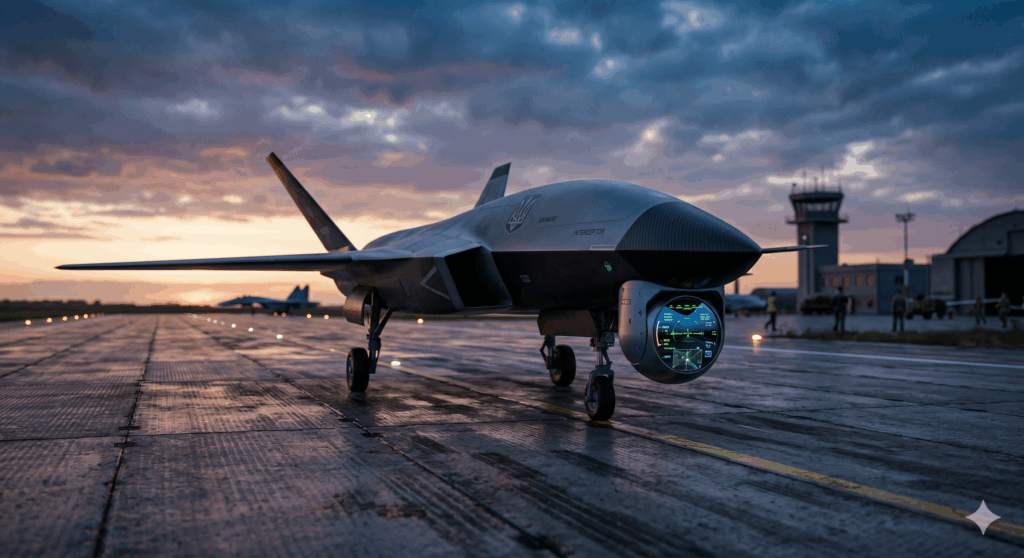
- Ukraine’s autonomous interceptors pursue and destroy Russian Shaheds without human control
- Ukraine compressed years of drone development into twelve battlefield months
- Brave1’s interceptor automates 95% of the kill chain – the human only selects the target
Ukraine has cleared its first autonomous drone interceptor for battlefield deployment following combat tests that were recently completed in the Kharkiv region.
The system was developed under the Brave1 defense accelerator specifically to counter Shahed drones, which Russia is increasingly launching in coordinated saturation attacks against Ukrainian cities and infrastructure.
These attacks depend heavily on volume and timing, because large numbers of incoming drones can gradually overwhelm conventional air defense systems and human reaction speeds simultaneously.

Autonomous interceptors reach combat test
Ukraine’s response now involves reducing how much of the interception process still depends on direct human control during active combat involving multiple air threats.
According to Ukrainian officials, the interceptor automates about 95% of the engagement sequence from launch to terminal destruction of the incoming drone.
Human operators still decide which drone to activate before the interceptor assumes responsibility for navigation, recognition, pursuit and attack execution independently afterwards.
This operational structure allows crews to monitor engagements instead of manually piloting interceptors through all stages of air combat during high-pressure battles.
Ukrainian officials believe that reducing the operator’s workload could become increasingly important during large night bombardments involving multiple incoming drones approaching defended airspace simultaneously.
The manufacturer reportedly went from prototype development to verified combat deployment in less than twelve months under continued operational pressure from the war across Ukraine.
This unusually compressed timeline appears to be closely related to Brave1’s institutional and financial backing, which reduced delays commonly associated with traditional peacetime procurement procedures.
Officials argue that wartime conditions leave little scope for longer-term development plans because delays in interception increasingly determine whether drones successfully reach populated urban areas.
“We continue to systematically strengthen the defense of the sky,” the ministry stated while discussing interceptor systems that have already been tested in active combat conditions recently.
Scaling ambitions meet an unconfirmed record
Ukraine now says it is expanding the production and deployment of these interceptors as part of a broader effort to increase national military drone production capacity nationwide.
Publicly available information on actual kill rates and long-term battlefield reliability remains extremely limited outside of official Ukrainian statements.
Evaluating the system is also made more difficult because Russia has continuously modified its Shahed drones throughout the conflict, using changing airfoils and components.
Autonomous interception can become even more complicated when electronic interference, airborne decoys, civilian aircraft and friendly drones begin to share the same contested airspace simultaneously.
Because no independent technical assessment has yet been published, the actual battlefield accuracy of the interceptor system remains difficult to verify externally.
The Kharkiv deployment nonetheless establishes an early proof of concept that demonstrates Ukraine’s growing interest in semi-autonomous air defense systems in modern drone warfare.
Via Fedorov

Follow TechRadar on Google News and add us as a preferred source to get our expert news, reviews and opinions in your feeds.


