
ISLAMABAD:
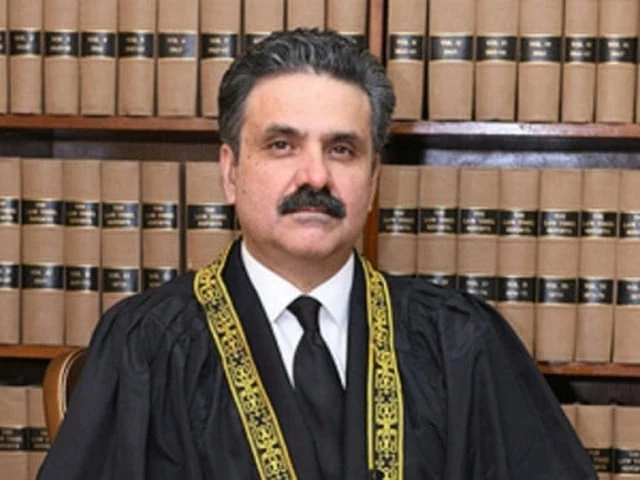
Chief Justice of Pakistan Yahya Afridi led the Pakistani delegation to the 14th St. Petersburg International Legal Forum (SPILF) in the Russian Federation, where he engaged with judicial leaders from around the world to strengthen international judicial cooperation and advance Pakistan’s ongoing judicial reform agenda.
The forum, which is held in Skt. Petersburg from 24 to 26 June, has brought together judicial leaders, policy makers, legal scholars and practitioners from several jurisdictions. The Pakistani delegation also included the Chief Justice of the Federal Constitutional Court (FCC) of Pakistan and the Ambassador of Pakistan to the Russian Federation.
On the sidelines of the forum, the Chief Justice held a series of bilateral meetings with heads of foreign judicial bodies with the aim of strengthening institutional cooperation and expanding judicial dialogue.
Legal proliferation raises eyebrows
Since the enactment of the 26th Constitutional Amendment, the Supreme Judiciary, headed by the Chief Justice of Pakistan Yahya Afridi, has actively engaged with the Judiciary of several foreign states.
But sections of the legal fraternity question why the chief justice is seeking to establish a framework for bilateral judicial cooperation with countries where they claim the courts operate under the influence of the executive.
The Supreme Judiciary, headed by Justice Afridi, has so far signed memorandums of understanding (MoUs) with the highest courts in China and Turkey. A section of lawyers believe that the executive power exercises dominance over the judiciary in both countries.
In the latest development, Judge Afridi held an engagement with representatives of the Supreme Court of the Russian Federation to establish a framework for bilateral judicial cooperation.
The proposed cooperation includes judicial exchanges, professional and legal training, legal research, court administration, digital transformation and sharing of best practices.
Former Additional Attorney General Waqar Rana states that courts in Russia, China and Turkiye have traditionally supported authoritarian regimes to promote fictitious and real security concerns.
“Courts in Pakistan have tried to maintain a balance between liberty and order, but over the past few years there has been a tendency for the balance to shift towards order, ignoring liberty and seemingly siding with the executive,” says Rana.
Commenting on the engagement, lawyer Asad Rahim Khan states that given how new rules have so limited legal interaction with the outside world, it is quite extraordinary that an exception is made for a trip to Russia.
“The state of the Russian judiciary – and its completely compromised independence – is well known. At a time when Pakistan is suffering from the greatest judicial decline in its history, there is indeed much to be learned from a foreign court system that has completely subordinated itself to its executive power,” he continues.
CJP Afridi heads the Pakistani delegation to the 14th St. Petersburg International Legal Forum (SPILF), which will be held from 24 to 26 June 2026 in St. Petersburg, Russian Federation, where he engaged with judicial leaders from around the world to strengthen international judicial cooperation and advance Pakistan’s ongoing judicial reform agenda.
Besides Justice Afridi, the Pakistani delegation consists of Chief Justice of the Federal Constitutional Court Aminuddin Khan and the Ambassador of Pakistan to the Russian Federation.
Lawyer Faisal Siddiqi states that with this conference, “the judiciary has achieved its rightful place in the world of autocratic legalism, i.e. weak courts within a dominant executive,” he adds.
According to a Supreme Court statement, the forum also provided an opportunity to showcase Pakistan’s ongoing judicial reform initiatives, including progress in court digitization, responsible adoption of new technologies, institutional strengthening and measures aimed at improving access to justice.
These engagements facilitated a meaningful exchange of experiences on contemporary challenges facing justice systems and strengthened Pakistan’s commitment to learning from international best practices.
The opening day concluded with the plenary session where the Pakistani delegation interacted with judicial leaders, policy makers, legal scholars and practitioners from several jurisdictions, further strengthening Pakistan’s engagement with the global legal community.
The delegation’s participation confirmed the Supreme Court’s commitment to judicial diplomacy, international cooperation and the promotion of an independent, efficient, accessible and technologically supported judicial system through sustained cooperation with the partner judiciary, the statement from the Supreme Court PRO stated.


