
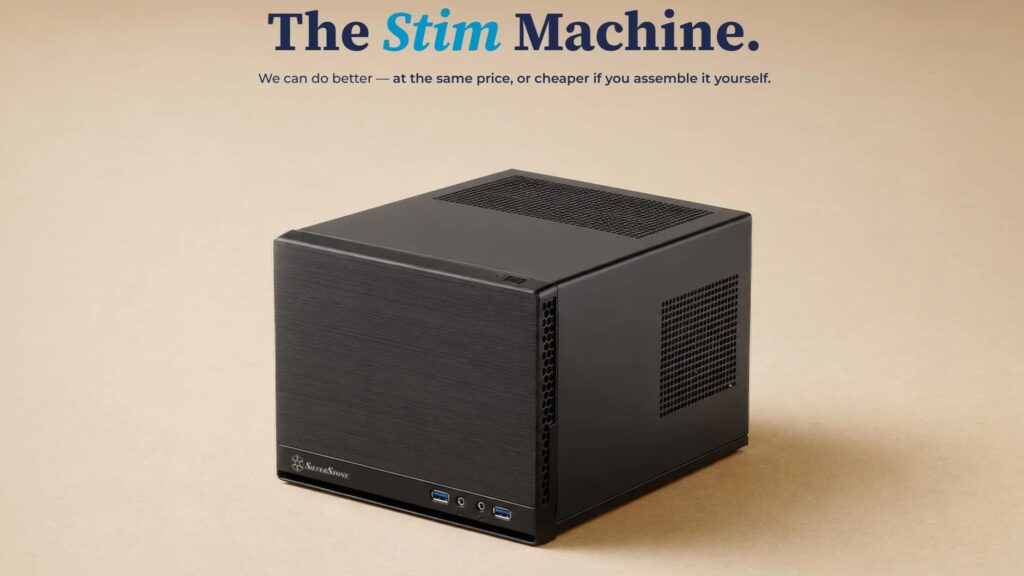
- A French retailer has created its own version of the Steam Machine
- The ‘Stim Machine’ has an RX 9060 XT GPU which gives it much faster frame rates for the same price.
- There are other advantages to the alternative PC as well, as well as compromises where the device loses out to the Steam Machine
With the price of the Steam Machine, we’ve inevitably seen a lot of talk about alternatives, either in DIY form or with pre-built ones, and here’s another one of the latter: the ‘Stim Machine’.
VideoCardz reports that French retailer LDLC made the Stim Machine, although it has since dropped the cheeky name, but I’ll still use it here as I like it and it’s much better than LDLC ‘PC Box’ which is the new (gasp-something) name.
The device largely follows the specifications of Valve’s gaming PC with a few key differences.

The main change is that instead of the RDNA 3 semi-custom AMD GPU that is in the Steam Machine, you get a current-gen (RDNA 4) RX 9060 XT graphics card. It’s the 8GB model (same loadout as the Steam Machine’s GPU), but the 9060 XT has considerably more grunt under the hood.
The processor is the AMD Ryzen 5 8400F, a 6-core and 12-thread effort like the Zen 4 chip in the Steam Machine, and there’s also 16GB of DDR5 RAM. You get a 500GB SSD (again, the same as Valve’s), but with two extra SATA slots for more storage if you want it (as opposed to the microSD option with the Steam Machine).
The price is exactly the same as the Steam Machine in France if you want the dealer to supply you with the pre-built version (or you can save 4% if you just order the parts to ship and build the rig yourself).
Analysis: Steam versus Steam – the relative pros and cons
As mentioned, the biggest difference is the RX 9060 XT, which will increase your frame rates quite a bit over the Steam Machine. Not only is the GPU significantly faster, but you also get FSR 4 with the current generation Radeon family for better frames per second. second still images. And there is an option to upgrade the graphics card in the future, which is missing with the Steam Machine.
In fact, even upgrading the RAM on the Steam machine is a relatively difficult task by all accounts, as you have to remove quite a bit of the internals to get to those RAM slots. The Stim machine also gives you the extra storage options.
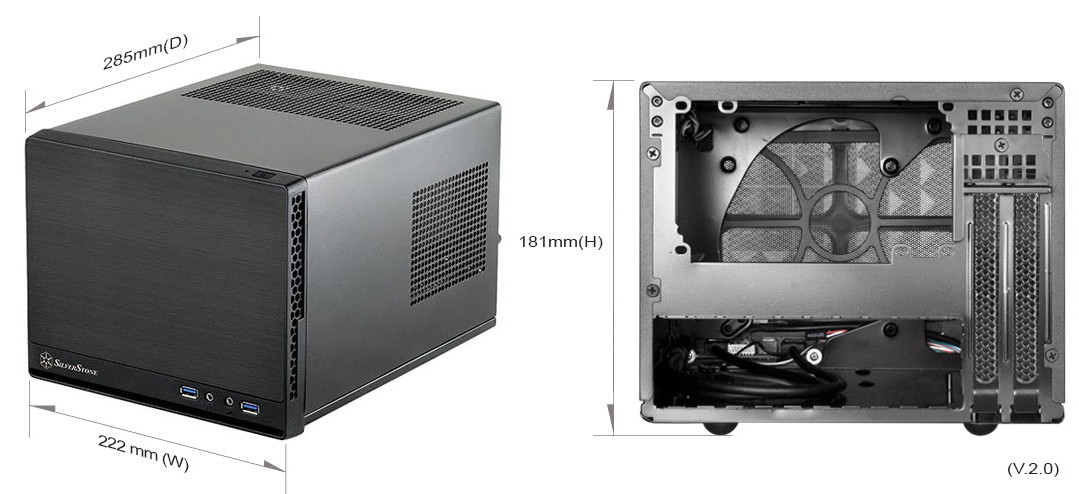
Having argued the case against Valve’s creation, it’s only right to mention the disadvantages of the Stim Machine. For starters, while it’s a Mini-ITX case and a compact PC — apparently a SilverStone SST-SG13B Sugo case, as pointed out on Reddit — it’s still quite a bit larger than the Steam Machine (11.5 liters vs. 3.8 liters).
In other words, volume-wise it’s three times the size of Valve’s PC, and yes, it’s still small enough, but part of the appeal of the Steam Machine is its diminutive size that lets the device sit unobtrusively in your living room. There’s also the thermals, cooling, and noise to consider when hitting the 9060 XT GPU in the Stim Machine, especially in a living room. Valve’s Steam Machine is impressively quiet, as reviews have made clear.
What Steam Machine alternatives also lack are some of Valve’s quality-of-life features for more streamlined (steam-lined?) operation, including instant sleep/wake functionality and HDMI CEC support (allowing your TV remote to control volume or turn the TV on or off with Steam Machine). These are some really thoughtful details from Valve.
Not to forget that with the Stim Machine, you have to set it up and install SteamOS yourself (although the retailer provides a guide), which can be a stumbling block for newbies. Everything is done for you with Steam Machine, with just a simple experience to navigate around.
So all in all, it’s not quite that simple a face-off here, but there’s no arguing that the Stim Machine, because it packed an RX 9060 XT, will offer a lot more framerate pep than Valve’s compact gaming PC. So if framerate smoothness is your top priority and you can put up with the trade-offs mentioned, an alternative like Stim Machine is the way to go.

What we also shouldn’t forget is that whether you buy a Steam Machine or an alternative pre-built like this one (or you go the DIY route yourself), it’s a win for Valve as it’s another gamer on SteamOS – and buying software from its store, which is the real point of this living room PC. In fact, Valve actively encourages people to build their own Steam Machines if they feel the official model is too expensive (but of course, building any computer is an uphill battle these days).
Another interesting point to note is that among the many interviews Valve’s engineers have been giving lately, PC Gamer has a fresh nugget on the next-gen Steam Machine from Pierre-Loup Griffais and Yazan Aldehayyat.
As for a potential sequel for the PC, Griffais noted, “I don’t think we’re thinking [the Steam Machine] with quite as long a time frame as something like Steam Deck.”
So a Steam Machine 2 with more powerful guts shouldn’t be as long a wait as a Steam Deck sequel, but that said, Aldehayyat elaborated that it’s not just around the corner (unsurprisingly).
The next Steam Machine will happen “in line with typical PC upgrade cycles and what people typically do,” and Aldehayyat said, “It’s just a matter of when it makes sense to [upgrade]at what price point, at what time, on what games are available. Like if a bunch of new games come on Steam that require more performance, that would probably make us upgrade the Steam machine faster.”

Follow TechRadar on Google News and add us as a preferred source to get our expert news, reviews and opinions in your feeds.

The best pc controllers


