“Don’t think about making women fit the world – think about making the world fit women.” —Gloria Steinem
The story from the Panchatantra, the ancient book of wisdom, goes like this. Deep in a forest, a flock of hungry pigeons led by their wise king, Chitragriva, saw rice spread under a banyan tree. Ignoring Chitragriva’s intuitive warning of a snare, the flock descended and were caught under a heavy net. As the hunter approached to claim them, panic ensued. Chitragriva remained calm and ordered the pack to stop fighting individually and act as one. At his signal, the birds rose in a synchronized burst of wings and lifted the net into the sky. They flew to a nearby hill where a loyal mouse gnawed at the web and restored their hard-fought freedom through collective unity.
Like the flight of the dove, sustained liberation is never the result of chance or isolated work. It becomes possible through strategic leadership, shared determination and an unwavering recognition of structural deceptions disguised as opportunity. The aforementioned ancient story directly addresses women’s struggle for autonomy in modern times, reminding us that coordination, consideration, and the courage to face the invisible nets that bind are necessary to survive within restrictive systems.
Pakistan’s ongoing quiet revolution has successfully moved women from the domestic periphery to the professional core, proving that economic empowerment remains the ultimate architect of self-esteem. Over the past four decades, unprecedented progress has transformed the “working woman” from a societal anomaly to a mainstream role model visible everywhere from lecture halls to boardrooms and receptions.
This profound structural turning point is no historical accident; it represents an ephemeral convergence of mounting economic pressures, sustained feminist momentum, and strategic civil society advocacy. But if true empowerment is fundamentally political, the enterprise remains highly ideological and deeply fraught with corporate deceptions and diversions. To survive the test of time, contemporary movements advocating for women’s well-being must now decisively pivot away from symbolic milestones and annual rituals and instead focus on securing a permanent, structural seat at the table of macroeconomic and political power that fends off, and with it the salvo of market-generated illusions.
Streets and the self – a tale of two women’s movements
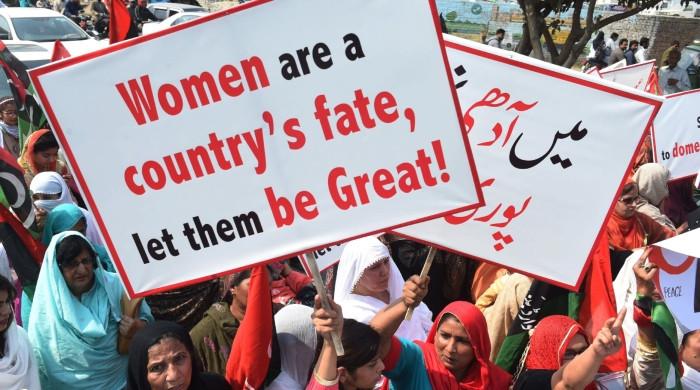
Five decades of structural shifts have radically transformed women’s rights in Pakistan, migrating the struggle from public barricades to private boardrooms. In the 1980s, the movement was forged in visceral street confrontations against state-sponsored legislative abolition. Today, census data tracking rapid urbanization reveal an indoor pivot toward classrooms and offices. The contemporary battlefield is largely digital and deeply personal, focused on internal negotiations over career autonomy, delayed marriage, and bodily agency. While the pioneer generation struggled to secure a public voice, the modern Pakistani woman acts as a personal architect, transforming the hard-fought vote into individual choice.
A quiet revolution – talk and hope
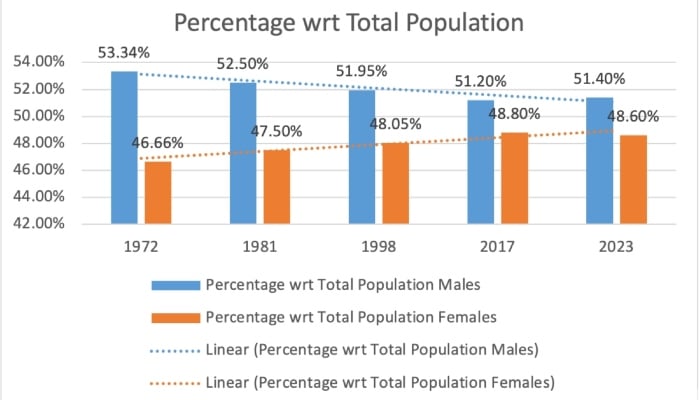
Pakistan’s long-term demographic trajectory reveals a profound structural shift, with female population growth consistently outpacing males. Between 1972 and 2023, the nation added 176.58 million people, with women making up 49.32% (87 million) of this expansion, setting their total population share at 48.60% in the 2023 census. This demographic increase represents more than just statistics; it signals a fleeting transition from a traditional agrarian identity to a chaotic market economy—a macroeconomic development that places unprecedented pressure on both the contemporary Pakistani woman and the broader struggle for institutional rights.
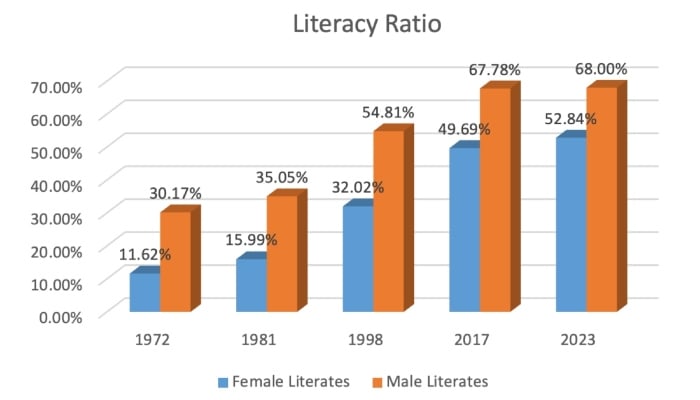
Pakistan’s female literacy landscape has undergone a seismic shift in four decades, evolving from a dismal 11.62% in 1972 to 52.84% in 2023, narrowing the gap with male literacy at 68%. The literate female population rose from 4.2 million in 1981 to 13.8 million in 1998—a staggering 14% annual growth—while primary enrollment rose from 0.14 million in 1951 to 6.45 million in 1998. Yet structural gaps remain.
According to the World Economic Forum’s (WEF) Global Gender Gap Report 2023, Pakistan ranks 138th globally in educational attainment, while the net enrollment rate for primary education is 61% for boys and only 51% for girls, according to the Annual Status of Education Report (ASER) 2021. Given these statistics, exclusion and exclusion have left millions.
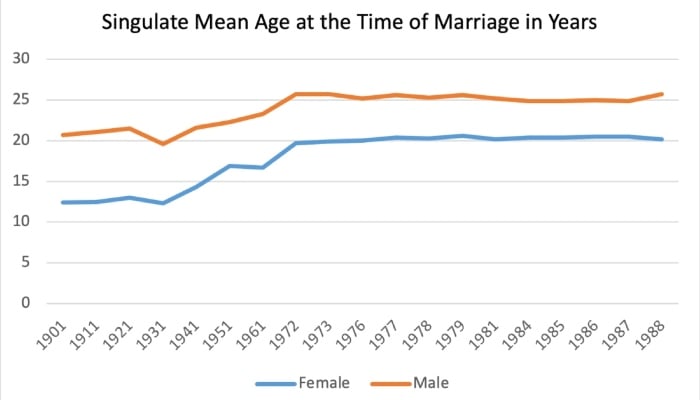
National census data reveals sharp drop in Pakistan’s marriage rate. Between 1981 and 1998, the percentage of married women aged 15 and over fell by 4.2 points – falling from 70.80% (15.5 million) to 66.60% (23.1 million) – despite a net volume addition of 7.6 million. Although this share increased to 68.51% in 2023, long-term demographic changes continue. Highlighting this trend, a 2024 media report found that an estimated 10 million Pakistani girls over the age of 35 remain unmarried. Pakistan’s average age of marriage for women has risen steadily over the decades. From 1901 to 1973, the singular median age remained under 20, shifting to the early 20s in the late 1980s, and climbing to the mid-20s during the 1990s. Today, a distinct “delayed marriage” phenomenon is visible in urban centers such as Karachi, where women increasingly marry in their late 20s or early 30s. This demographic pivot signals a new frontier for the women’s movement: shifting focus from basic educational access to demanding the vital structural scaffolding—including safe transit, childcare, and legal property rights—necessary to sustain independent lives.
Degrees without a desk
The progress in women’s education levels is undeniable. Female enrollment in higher education has increased from around 32% in 2002 to a staggering 52% in 2025. This achievement places Pakistan in the company of regional neighbors such as Iran, where women dominate over 60% of university places, and China, where women make up the majority of graduate students. However, the “graduation-to-employment” pipeline is seriously broken. Despite these educational gains, the labor market remains a difficult frontier. According to the Gallup Pakistan Analysis of Labor Force Participation in Pakistan 2024-25 report, Pakistan’s female labor force participation (FLFP) remains dismal at 24.4% with a gender gap of 45%.
Mirage of consumerism – a Pakistani dream
The current Pakistani landscape presents a contradiction: while women remain trapped at the bottom rungs of the labor ladder, struggling against stagnant mobility and wage disparity, they are simultaneously bombarded by the “Pakistani Dream,” a carefully constructed illusion. This standardized vision of success sold through soaps and the curated vanity of TikTok has abandoned human grit for blatant consumerism. It is a utopia of gated communities, luxury vehicles and outsourced labour, where the ultimate status symbol is a chauffeur-driven car and a life of leisurely transit. In this hollowed-out narrative, success is no longer a personal achievement but a performative commodity. Although women are systematically marginalized as economic wage earners, they are targeted as the primary agents of this consumption, forced to feed a lifestyle that values exclusionary wealth over substantive progress.
Invited to use, forbidden to own
For today’s Pakistani working woman, the “modern dream” is corporate predation. Institutions such as the media, academia and the fashion industry have systematically inflated women’s expectations, not to promote empowerment, but to fuel a consumer-driven profit engine. This is structural derivation by design. Market forces have eagerly traded genuine policy reforms—such as flexible childcare or restructured, secure workplaces—for the shallow, obscene illusion of choice wrapped in luxury consumerism.
This capitalist co-option has successfully created an aggressive consumer class while reinforcing the patriarchal structures that deny women a high-value worker status. The labor market remains hesitant to hire them, but aggressively targets them to use. Cosmetic empires sell serums that promise to “save the skin,” a grotesque lie that masks the harsh systemic burden of poor nutrition, toxic pollution, and cramped, unventilated housing. No animal “glow” can survive the mental siege of chronic load shedding, gas shortages or the crippling anxiety of unsafe streets. Until structural security—functioning utilities, safe transit, and legal justice—is realized, corporate empowerment remains a farce. The ultimate indictment of this profitable illusion? A reality where Pakistani women are invited to spend but forbidden to own, with just two to three percent owning the roofs above their heads.
The mirror trap
Pakistan’s narrative of female advancement is shadowed by a grim paradox: while professional barriers fall, public and psychological spaces remain crowded. The modern workplace celebrates corporate accolades, yet the public sphere—from transit stops to media screens—routinely reduces women to their physical appearance. In parallel, the “tyranny of physical attractiveness” has intensified into a new servitude, where societal value is dictated by mirrors, cosmetics and the fear of an arbitrary “expiration date”. Even when a woman climbs to head a multinational corporation, she is still judged on her physical appearance on the commute there. Ultimately, in the battle between professional intellect and aesthetic presentation, the patriarchal mirror holds more sway than the resume. The glass ceiling cracks, but the mirror remains a formidable barrier
Within Pakistan’s hyper-capitalist urban sprawl, the younger generation faces a modern existential snare, lured by deceptive market promises. Like the classic fable, isolated struggles in this structural trap only tighten the cage. Survival, however, requires mechanical, collective defiance of individual panic. True liberation requires a synchronized, multi-gender political take-off to dismantle the patriarchal hierarchy and reject hollow consumerism. The herd must rise as a united body, and lift the very machinery of its imprisonment towards a structural revolution. The verdict of history remains unbending: authentic empowerment is never a solo endeavor, but a shared, aggressive march toward a shared future.
The author is a city peripatetic and board member of the Urban Resource Center. He can be found at [email protected]