
Nvidia’s RTX 5090 is an exceptionally capable GPU – the company’s highest consumer-grade GPU to date packs a whopping 21,760 CUDA cores and 32GB of GDDR7 memory in its stripped-down GB202 configuration.
It also happens to be one of the most expensive GPUs that retail consumers can buy in 2026, going for as much as twice its listed MSRP of $2,000 for the Founders Edition at launch, leaving many cost-sensitive AI builders turning to older Nvidia GPUs equipped with 24GB of VRAM such as the RTX 30900 and 3090Ti.
As AI models continue to evolve in complexity (and memory requirements), a DRAM crisis is making it impossible for many to secure a suitable GPU for their local AI needs, although one option seems largely ignored: Intel’s Arc Pro B70.

A mid-range GPU with plenty of VRAM
Most consumers don’t think of Intel as a GPU manufacturer, but instead associate it with consumer and enterprise-grade CPUs. This is despite the chip maker offering some of the best value for money options in the mid-range segment in which it currently competes.
However, Intel’s Arc Pro offering is unapologetically different; They focus exclusively on professional quality, or rather, AI-centric workloads, while dropping any pretense of catering to gaming consumers, although they’re still capable of running most titles you can throw at them.
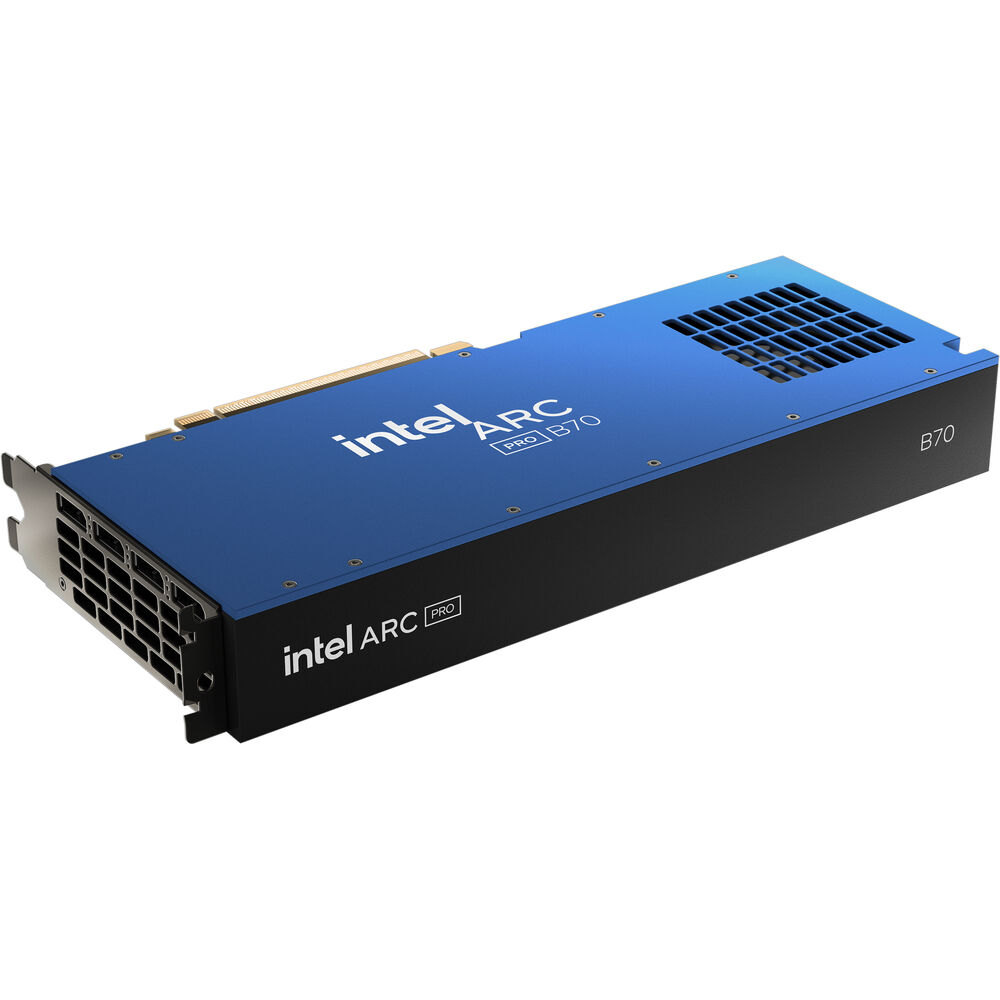
The Intel Arc Pro B70 is its best offering and has a reference price of $950, with most resellers and OEM partners selling SKUs for around $1,000. With 32GB of GDDR6 memory in tow and a price effectively a quarter of most RTX 5090 SKUs on sale at the time of writing, it holds its own as a value-centric alternative to Nvidia’s Blackwell-based behemoth.
It utilizes Intel’s BMG-G31 “Big Battlemage” chip, originally intended to appear in its since-cancelled Arc B770 GPU, as it aims to address a vacuum in the local AI space that both AMD and Nvidia are unwilling to address given their focus on maximizing profits at the highest end of the spectrum with business customers.
For those interested in looking at the setup of 4 of the Arc Pro B70, Puget Systems has gone ahead and performed the necessary tests, even drawing a direct comparison with the RTX 5090, which it finds 4-5 times faster in decoding tasks thanks to a significantly greater amount of memory bandwidth in games (1792 GB/s GB/s/609)
However, the observations also pointed to a slightly obvious caveat in the comparisons: models that require more computation and bandwidth in relation to memory will lean towards the RTX 5090, which offers a significant advantage even against multiple Arc Pro B70 GPUs, but those that require a large amount of memory for their parameters would find a B70 configuration a similar access to a more cost-effective memory than RTX0-based games. offer.
However, Nvidia’s value proposition runs deeper than the silicon itself, and that’s where Intel struggles to find a willing buyer, thanks to better software support on different OSes, CUDA-based software stacks that Arc Pro can’t emulate, and Nvidia-coded libraries that won’t work on Intel’s hardware.
Intel’s own offerings (oneAPI, OpenVINO and IPEX) are improving, but are widely considered to be behind even AMD’s ROCm stack, which in turn lags behind Nvidia’s ecosystem. Despite this, as mentioned above, the Arc Pro B70 benefits from the lack of a true high-VRAM alternative and remains available close to its listed MSRP, making it a formidable and scalable alternative to Nvidia’s heavy GPU.

Follow TechRadar on Google News and add us as a preferred source to get our expert news, reviews and opinions in your feeds.


