
States that the Prime Minister will attend the condolence ceremony for martyred Iranian Supreme Leader Ayatollah Ali Khamenei
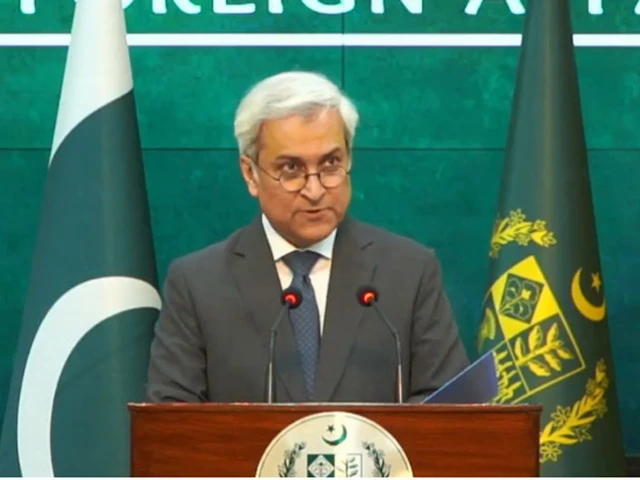
Spokesman for the Ministry of Foreign Affairs, Tahir Hussain Andrabi. PHOTO: Radio Pakistan
Foreign Ministry spokesman Tahir Andrabi said Thursday that Prime Minister Shehbaz Sharif will pay official visits to Iran and Turkey from July 3 to 5.
“Prime Minister Shehbaz will first travel to Iran to attend the funeral ceremony of Iran’s late Supreme Leader Ayatollah Ali Khamenei and, on behalf of the people and the government of Pakistan, will convey condolences to the Iranian leadership and the bereaved families while reaffirming solidarity with the brotherly nation in their brief hour of deep grief in Islam for an hour of deep grief in Islam for a week.
The spokesman said the premier would also travel to Türkiye at the invitation of President Recep Tayyip Erdogan.
“The prime minister will hold discussions on the full spectrum of the bilateral relationship with a special focus on boosting bilateral trade and investment cooperation between the two brotherly countries. The summit will also reflect on issues related to regional peace and security,” he said.
Andrabi further added that during his stay in Istanbul, the Prime Minister would also address a business conference hosted by Pakistan to highlight Pakistan’s trade and investment potential in priority areas including the SEZs, energy, trade, IT and privatization sectors.
“The conference will bring together leading Turkish businessmen and investors together with senior officials, dignitaries and other prominent participants from the business community,” he said.
The spokesman further said that during the visit, Deputy Prime Minister and Foreign Minister Ishaq Dar and other cabinet ministers and senior officials would accompany Prime Minister Shehbaz.
Pakistan, Qatar engaged with the US-Iranian negotiator in Doha yesterday
Discussing the US-Iran war and the situation in the Gulf region, Andrabi said Pakistan had stepped up its diplomatic engagement with key regional and international stakeholders as well as key interlocutors to facilitate serious follow-up and implementation of the Iran-US Islamabad MOU in line with the Pakistan-Qatar joint statement issued in Bergenstock on June 21.
“Pakistan and Qatar engaged with the relevant parties in Doha yesterday and held separate meetings with the US and Iranian negotiators in Doha and these culminated late last night, well into the morning in fact,” he said.
The spokesman highlighted three more specific points about the Doha negotiations.
“One, there was positive progress on issues related to the various aspects of the Islamabad MOU, building on the Lake Lucerne summit. Two, the parties agreed to continue the discussion in the coming period and three, the next meeting will be set at the earliest possible time after the funeral procession of the former Iranian Supreme Leader,” he said.
He said Pakistan would continue to play a facilitating and mediating role in the negotiation process along with Qatari partners.
“FM Dar also continued his high-level consultations and telephone calls, a number of which were held this week with the foreign ministers of Saudi Arabia, China, Bahrain and Iran. He also spoke to the British Foreign Secretary and the EU High Representative for Foreign Affairs and Security Policy,” he said.
Speaking about the seminar on the Indus Water Treaty, an instrument of peace and regional stability, he said the participants generally called for the upholding of the treaty.
“Participants rejected a weaponization of water and called for settling disputes through established legal and diplomatic mechanisms rather than unilateral actions. They warned that any attempt to deprive the country of its shared water would have profound implications for regional peace and security,” he said.
Recalling FM Dar’s statement during the IWT seminar, Andrabi said that FM Dar had said that the six-decade-old IWT could not be suspended or terminated under any pretext and the suspension was quote-uncite illegal, unilateral and without any basis.
“Pakistan unequivocally rejected this so-called abeyance. Let me add that Pakistan also rejects India’s attempt to invoke baseless allegations of terrorism as a pretext to put the IWT on hold and obstruct the legal flow of the Pakistani shares in the Indus Waters,” he said.
The spokesman said the real problem was not terrorism; the real problem was the growing attitude of the Indian leadership to treat the shared international river system as a strategic asset that could be controlled, detained or diverted at will.
“This mindset of unilateral appropriation is fundamentally incompatible with the letter and spirit of not only international law but also the IWT itself. Water is not a tool of coercion or political pressure,” Andrabi said.
He said that “Any attempt to deny Pakistan its legitimate share of Indus Water constitutes a clear violation of the international legal obligations undertaken by India and undermines India’s credibility of its commitment to a treaty-based relationship.”


