
- Samsung is quietly preparing DRAM-free PCIe 4.0 SSD with flagship-level read performance
- Host Memory Buffer replaces dedicated DRAM inside Samsung’s upcoming budget SSD
- Leaked specs reveal 7,150 MB/s speeds from Samsung’s mystery SSD
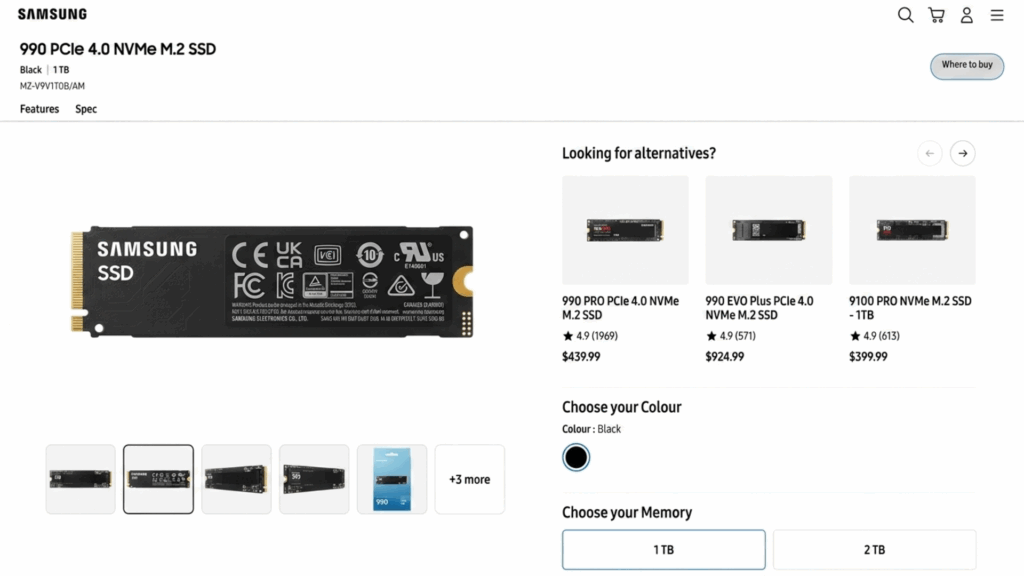
Samsung appears to be preparing a budget PCIe 4.0 NVMe SSD that does away with the on-board DRAM cache found in traditional drive designs.
The unannounced model briefly appeared on Samsung’s website recently before the listing was removed without any official confirmation from the company.
Specs listed describe a 1TB drive with sequential read speeds that reach 7,150 MB/s and write speeds that reach 6,450 MB/s.

How Samsung plans to compensate for missing DRAM
Traditional SSDs rely on dedicated DRAM to store the flash translation layer, which lets the controller locate data across NAND flash quickly and efficiently.
But as the global “RAMpocalypse” continues to worsen, even the largest vendors are looking for ways to reduce their reliance on DRAM.
Without that DRAM, drives can suffer from higher latency and weaker performance during sustained workloads or heavy multitasking sessions.
To bridge this gap, Samsung uses NVMe’s Host Memory Buffer (HMB) function, which reserves a small portion of system memory over PCI Express instead.
The borrowed memory contains mapping metadata instead of user files that link logical addresses directly to their physical NAND locations.
HMB generally cannot match the responsiveness of dedicated DRAM, although it improves performance compared to drives with no caching mechanism at all.
The drive has an endurance rating of 400 TBW, a modest figure for a 1 TB SSD by current industry standards.
That number suggests Quad-Level Cell (QLC) NAND flash, which stores four bits per memory cell and lowers both cost and durability.
Samsung hasn’t disclosed what specific NAND flash technology is inside this particular unannounced drive model.
Rising component costs are reshaping SSD design choices
Samsung’s moves come as NAND flash and DRAM prices continue to rise strongly across the wider global storage industry this year.
Removing the DRAM package directly reduces component costs, simplifies PCB design, and helps maintain competitive pricing within the mainstream SSD segment overall.
QLC NAND increases storage density and lowers manufacturing costs, although it trails Triple-Level Cell NAND in sustained write performance and long-term endurance ratings.
It also remains significantly less durable than older Multi-Level Cell (MLC) and Single-Level Cell (SLC) NAND technologies still found in some enterprise storage products.
Despite these trade-offs, the claimed sequential speeds of 7,150 MB/s and 6,450 MB/s place the drive alongside many mainstream PCIe 4.0 SSDs with dedicated DRAM caches.
Samsung has not announced pricing, availability, the official product name, or the specific NAND technology used in the drive.
Until those details emerge, the leaked specs point toward a cheaper PCIe 4.0 SSD designed to balance competitive performance with reduced manufacturing costs as memory prices continue to rise.
Via The Guru of 3D
Follow TechRadar on Google News and add us as a preferred source to get our expert news, reviews and opinions in your feeds. Be sure to click the Follow button!
And of course you can too follow TechRadar on TikTok for news, reviews, video unboxings, and get regular updates from us on WhatsApp also.


