
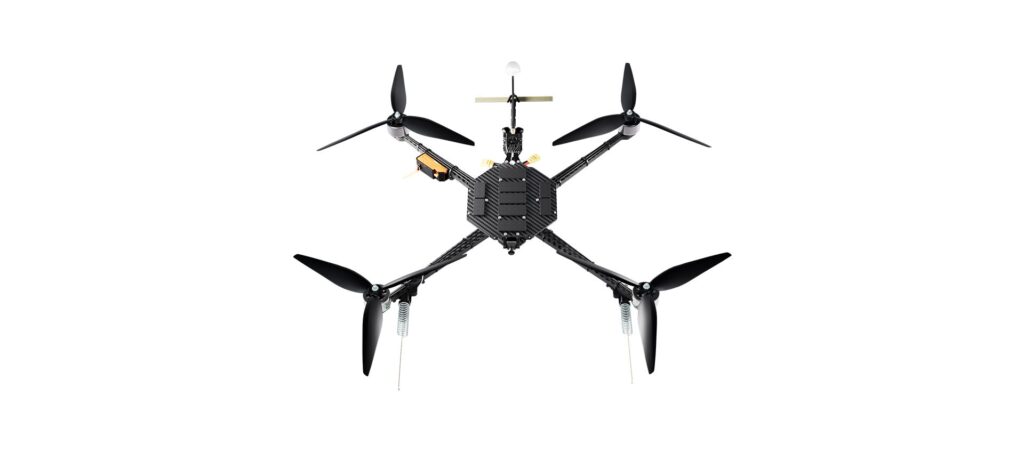
- Vyriy 15 FPV with The Fourth Law’s TFL-1 AI guidance reportedly hit Russian logistics 68 miles (110 km) away
- Ever-innovating Ukrainian drone industry continues to achieve economies of scale, even as it becomes a growing threat to Russian advances
- With a payload capacity of 8kg and the option to be equipped with a thermal imaging module as well as electronic warfare deterrence, it offers an interesting alternative to comparable fixed-wing drones costing thousands of dollars
Basic FPV drones are hardly new in a market flooded with hundreds, if not thousands, of options that can cost as little as $100 to $200, but the Russia-Ukraine conflict could have raised the price of affordability for another kind of UAV that utilizes the same technology: attack drones.
The Vyriy 15 is a self-designed “kamikaze drone” by the company, offering a stated strike range of 40-70 km with up to 8 kg of payload in tow, which can be retrofitted with a thermal imaging module as well as an extended band VTX module to make jamming more difficult.
With a control range of up to 30 km and a flight duration of 20 minutes (with a payload) and a cruising speed of 60-100 km/h, it’s not the most technologically advanced drone out there, but at its claimed price of $500, it doesn’t have to be.

An FPV strike record powered by AI
On July 10, Yaroslav Azhnyuk, CEO of Ukrainian autonomy developer The Fourth Law, announced the X what he called “a new FPV strike record”: a Vyriy 15 quadcopter, flown by Ukraine’s 5th Border Guard Division and equipped with his company’s AI terminal floating 10km guidance module, had an 8-mile 10-mile strike module. goal.
This is both a significant achievement for Ukraine’s domestic drone industry and a key indicator of how quickly the Russia-Ukraine war has turned into an attrition, with supply lines increasingly targeted to prevent significant progress in either direction.
It also shows how AI on the battlefield is shaping the conflict: Vyriy 15 is by default a manually controlled drone that would otherwise need an operator or a relay to be closer to the theater of war.
The competition is American-made Hornets, fixed-wing drones that can cost upwards of $5,000, 10 times the cost of an already cash-strapped Ukrainian military that is increasingly looking toward local solutions.
The optional AI module used to set the record is The Fourth Law’s TFL-1, a machine vision terminal control module that operates on a fire-and-forget principle: when the operator visually designates a target, an on-board computer takes over the final approach, essentially countering Russian jammers that would otherwise disrupt a video link.
If Ukraine manages to mainstream such warfare in the future while cutting costs to a tenth of what they do right now, reliably striking as deep as 100 km into enemy territory while proving difficult to jam or expensive to intercept, drones like the Vyriy 15 could signal an evolution in the modern battlefield, even if low-cost aggression is already at odds with other conflicts. US-Iran war.

Follow TechRadar on Google News and add us as a preferred source to get our expert news, reviews and opinions in your feeds.


