
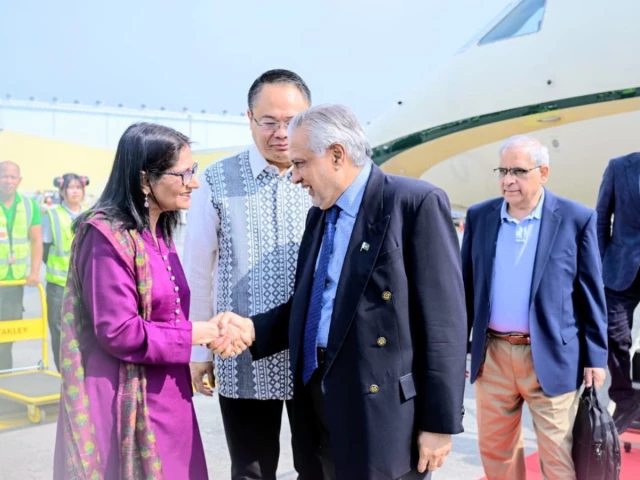
The program includes participation in the ARF plenary meeting, bilateral meetings with counterparts on the sidelines
Foreign Minister Ishaq Dar reaches Manila to attend the 33rd Ministerial Meeting of the ASEAN Regional Forum. PHOTO: FO
Deputy Prime Minister and Foreign Minister Ishaq Dar arrived in Manila, Philippines on Wednesday to attend the 33rd Ministerial Meeting of the ASEAN Regional Forum (ARF), according to the Ministry of Foreign Affairs.
The FO said Dar reached Manila with his delegation and is scheduled to attend the ARF plenary as well as hold a series of bilateral meetings with his counterparts on the sidelines of the forum.
Deputy Prime Minister/Foreign Minister Senator Mohammad Ishaq Dar @MIshaqDar50 arrived in Manila, Philippines with his delegation to attend the 33rd ASEAN Regional Forum (ARF) Ministerial Meeting. A busy program of engagements lies ahead, including attending… pic.twitter.com/gn3Jqqwifl
— Ministry of Foreign Affairs – Pakistan (@ForeignOfficePk) July 22, 2026
It added that “a busy program of engagements lies ahead, including participation in the ARF plenary and bilateral meetings with counterparts on the sidelines”.
On his arrival at the airport, Dar was received by Assistant Secretary of the Office of Intelligence and Security Services (OISS) Elmer G Cato, Department of Foreign Affairs (DFA) of the Philippines, along with Pakistan’s Ambassador to the Philippines Ambassador Asima Rabbani and officials from the Embassy of Pakistan, the FO said.
Read: DPM Ishaq Dar discusses links with Venezuela FM
The week-long summit, which runs until July 24, brings together foreign ministers and top diplomats from ASEAN nations and major powers to discuss issues surrounding geopolitical challenges, energy supplies, trade, food, security cooperation, the Myanmar civil war and the five-point consensus, as well as the consequences of the US-Iran conflict.
US Secretary of State Marco Rubio and Chinese Foreign Minister Wang Yi will attend the ASEAN-led meeting in the coming days and may meet on the sidelines. Among others, participants include India, Japan, Australia, South Korea, Russia, Great Britain and the EU.
Southeast Asia, a major oil importer with a combined gross domestic product of $3.8 trillion, is highly exposed to the supply crisis and has sought to speed up an ASEAN oil-sharing mechanism to cushion the impact.
Additional information from Reuters


