
calls on India to comply with UN resolutions and uphold Kashmiris’ right to self-determination
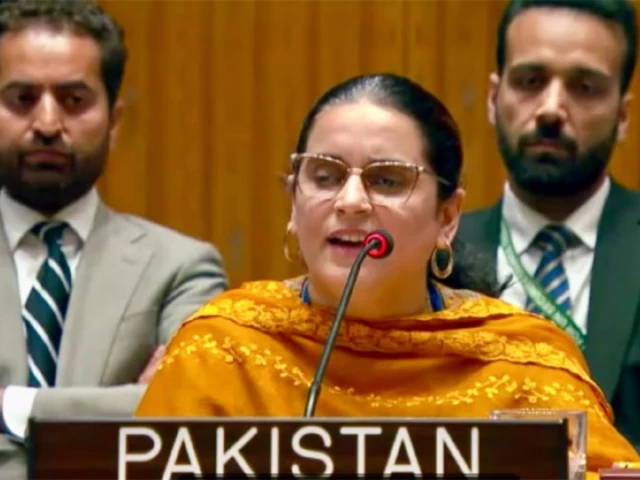
Counselor Saima Saleem exercises Pakistan’s right of reply during an open debate in the UN Security Council on strengthening mechanisms for the peaceful settlement of disputes on July 23, 2026. Photo: Radio Pakistan
Pakistan on Friday rejected India’s claim that Jammu and Kashmir was its “integral part” or “an internal matter” and told the United Nations Security Council (UNSC) that the territory remained an internationally recognized dispute that should be resolved in accordance with relevant UNSC resolutions and the aspirations of the Kashmiri people.
The remarks were made by Counselor Saima Saleem while exercising Pakistan’s right of reply during an open debate in the UN Security Council on strengthening mechanisms for the peaceful settlement of disputes. “Jammu and Kashmir is neither a so-called integral part of India nor its internal affair,” Pakistan’s representative at the UNSC told his Indian counterpart.
She said India’s claims could not “rewrite history, change Jammu and Kashmir’s internationally recognized disputed status or hide nearly eight decades of systematic human rights violations against the Kashmiri people, including the denial of their inalienable right to self-determination.”
Calling on India to respect international law, Saima said it was “ironic to hear India preach peace while breaking international law and Security Council resolutions and practicing aggression against its neighbours, repression in Indian-occupied Jammu and Kashmir, persecution of minorities and practicing state-sponsored terrorism throughout the region and beyond.”
Right to reply from counsel, Ms. Saima Saleem
In response to comments made by the Indian representative
At the Security Council’s open debate on strengthening the mechanisms for the peaceful settlement of disputes as a follow-up to resolution 2788
(July 23, 2026)
*********Madam President, … pic.twitter.com/GghHZFo5SR
— Permanent Mission of Pakistan to the United Nations (@PakistanUN_NY) July 24, 2026
Reacting to India’s remarks during the debate, she said the Indian delegation had tried to undermine the discussion through “denial, distortion, false accusations and gross misrepresentation of its conduct”.
She said India itself had brought the Jammu and Kashmir dispute to the Security Council before later overriding its resolutions.
“Let me remind the Indian delegation that Security Council resolutions do not have an expiration date,” she said, stressing that respect for international law remains essential to maintaining international peace and security.
Saima also accused India of committing widespread human rights violations, including arbitrary detentions, extrajudicial killings, enforced disappearances and restrictions on political freedoms in the Indian illegally occupied Jammu and Kashmir (IIOJK) and elsewhere in the country.
Comparing Azad Jammu and Kashmir (AJK) with IIOJK, she said Kashmiris in AJK exercised their political rights and enjoyed freedom of expression, whereas in IIOJK voices were silenced and dissent criminalised.
Read also: Pakistan, seven other countries condemn Israel’s ‘flagrant violation’ of Al-Aqsa in joint statement
She stated that thousands of cases of arbitrary detention, extrajudicial killings, enforced disappearances, conflict-related sexual violence, political repression and demographic changes had been documented in the IIOJK, while the Kashmiri people continued to be denied their right to self-determination.
Saima highlighted what she described as India’s disregard for international law, citing New Delhi’s unilateral decision to suspend the Indus Waters Treaty (IWT).
She said the Indus River was the lifeline of more than 240 million people and should never be used as a “weapon of war”, warning that such actions could undermine peace and security in South Asia.
Saima also mentioned that India was sponsoring terrorism against Pakistan and said that groups supported by New Delhi had carried out attacks that caused nearly 100,000 casualties, including children.
She urged India to support militant groups operating through Tehreek-e-Taliban Pakistan (TTP), Balochistan Liberation Army (BLA) and Majeed Brigade.
It is ironic to hear India preaching peace while breaking international law and Security Council resolutions, practicing aggression against its neighbors, repression in Indian Occupied Jammu and Kashmir, persecution of minorities and practicing state-sponsored terrorism… pic.twitter.com/oPfkrOvSJ5
— Permanent Mission of Pakistan to the United Nations (@PakistanUN_NY) July 24, 2026
In support of her claims, she cited the arrest of Indian national Kulbhushan Jadhav in Pakistan as well as what she described as assassinations carried out by Indian agents in North America through proxies. “India’s terror franchise has gone from regional to global,” she said.
Saima also accused India’s “Hindutva-inspired right-wing fascist RSS-BJP government” of normalizing hate crimes and discrimination against Muslims and other minority communities.
“Christians are persecuted, Dalits dehumanized and Sikhs disenfranchised in the world’s greatest hypocrisy,” she said.
Concluding his remarks, Saima said Pakistan had consistently shown restraint despite tensions with India and remained committed to dialogue and peaceful resolution of disputes.
“The path to peace in South Asia lies neither in denial nor defiance, but in adherence to the Charter and international law,” she said, urging India to abide by its treaty obligations and engage in the peaceful settlement of the Jammu and Kashmir dispute in accordance with relevant UN Security Council resolutions.


