On 16 July, the UN peacekeeping mission in DR Congo (MONUSCO) deployed the base near the town of Nyakunde in Ituri province – allowing ‘blue helmets’ on patrol to better protect hospitals and patients.
The base opened a day after a series of incidents rocked the community in and around Nyakunde.
On July 15, a group of youths vandalized the local Ebola treatment center. The killing of local militia leader Kakani Tondabo caused clashes that led to the death of five others.
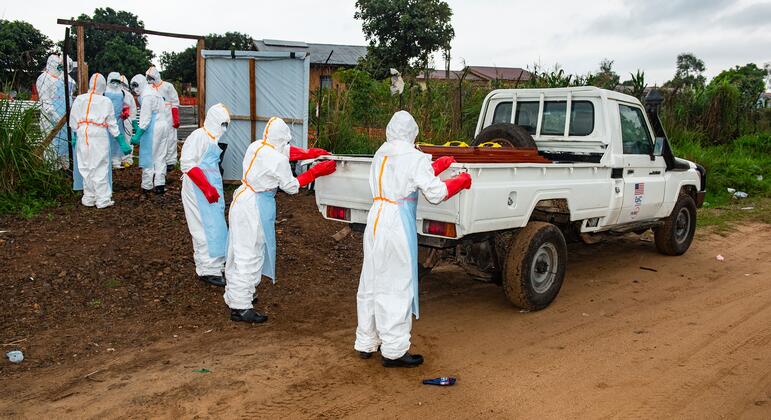
Since the Congolese government declared the current Ebola outbreak on May 15, national health authorities have reported more than 2,500 cases and more than 1,000 deaths.
At least a dozen facilities have been attackedmainly due to fear, misinformation and deep distrust in society of external authorities.
MONUSCO said its presence in Marabo – near Nyakunde – has restored calm and allowed residents fleeing the violence to return home.
“People quickly understood that we had come to help restore security and protect the Ebola treatment center,” said Major Atiqur, commander of the new mobile base. “Today we receive a warm welcome wherever we go.”
Safety needed for Ebola treatment
The local center is located next to the Nyakunde General Referral Hospital. It has a capacity of 31 beds.
Dr. Charles Kashindi, medical director of the hospital, said awareness campaigns in the area have begun to reduce Ebola cases.
“Just a few weeks ago, we were receiving six to seven patients a day,” he said. “Today, we only see two or three.”
Local health officials are now calling for a permanent MONUSCO presence to ensure patient safety while being treated.
“Our mission is to restore hope to communities that have gone through extremely difficult times,” said the local MONUSCO patrol commander, Captain Ary.
The violence continues in the east
In the midst of the ongoing Ebola outbreak, the conflict between DR Congo’s armed forces and the Rwandan-backed M23 armed group is raging in the eastern part of the country, especially in the provinces of North Kivu and South Kivu.
It was reported by the United Nations Office for Humanitarian Aid (OCHA). at least 60 civilians have been killed since July 12 along the border between North Kivu and Ituri – the epicenter of the Ebola outbreak.
On Thursday, 30 people were killed near the town of Mambasa.
According to UN humanitarian partners, 25,000 displaced people have recently arrived in the town of Beni in North Kivu, sheltering in the homes of already vulnerable families or in abandoned buildings.
OCHA warned on Friday that recent cases of Ebola in Kisangani have raised concerns that the virus may soon spread across the Congo River to the rest of DR Congo.
The UN and its partners are currently preparing for the possibility of further proliferation in the region by setting up protocols for the prevention and control of infections, expanding treatment facilities and preparing safe burials.
“The UN reiterates its call for the protection of civilians and for safe and sustained humanitarian access to people affected by violence and the Ebola outbreak,” the aid coordination agency said.