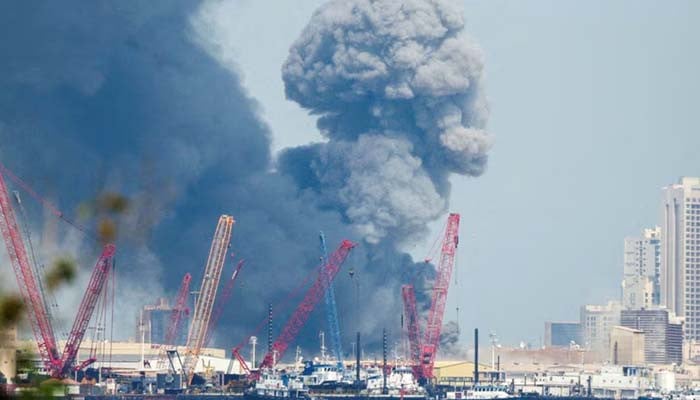
In a surprise move, US President Donald Trump unilaterally halted daily attacks on Iran on Friday.
It is unclear what prompted President Trump to halt direct attacks on Iranian infrastructure, and how long this so-called temporary ceasefire would last?
Still, there are signs that one must not read too much into this cessation of hostilities.
After all, the Iranian blockade of the Strait of Hormuz is in full effect.
On Saturday, the Central Command disabled two ships and diverted twelve others that did not comply with orders in the strategic waterways.
Despite recent talks with Oman, Tehran has also made it known that “There has been no change in the transit situation in the strait.”
In addition, the undeclared temporary ceasefire has also come into force at a time when Iran has claimed to have killed over two hundred US personnel (not independently verified) and destroyed eleven US warplanes, including an F-15 and a number of helicopters and drones, during fifteen days of renewed fighting.
What Western experts have admitted, however, is Iran’s high-speed, maneuverable reentry missile technology that hit US bases in Jordan and Kuwait by bypassing defense systems.
Meanwhile, Iran has also claimed to have downplayed threats emanating from alleged separatist elements across the border province of Erbil, Iraq.
On the other hand, Tehran has accused the US of killing 55 of its citizens and leaving 629 others injured since June 27. It has also accused the Pentagon of destroying a number of bridges, a train station and an airport. Something the Pentagon has denied.
At the same time, Ansarullah from Yemen has also opened a large front. Their aggressive actions in the Bab al-Mandab Strait are causing stress on the global supply chain.
The unilateral semi-ceasefire has also come into play when pressure to convince Iran to accept the southern route between the US and Oman in the Strait of Hormuz fails.
An attempt to assume a mediating role by political newcomer Iraqi Prime Minister Ali Falih al-Zaidi has also failed.
Last week, Zaidi had landed in Tehran after his maiden visit to the White House. In Washington, he was hailed by President Trump as a ‘brilliant leader’ who shared ‘tremendous chemistry’.
On the contrary, Iran rejected the need for more mediators by blaming the ‘irrational, expansionist and hegemonic approach of the United States’ for solving the problems.
After all, Qatar and Pakistan already play an active role, as Oman is sidelined.
With this in mind, experts believe that it is highly likely that the current cessation of hostilities will only be used by the US to recalibrate its war strategy.
They see the tense status quo in the strategic Strait of Hormuz as a big thorn.
“If President Trump was serious about ending the war, he could announce the opening of the naval blockade of Iran once he had declared a cease-fire,” said a diplomat who wished to remain anonymous.
Tehran had made it known that it would not accept a blockade or allow the Strait of Hormuz to return to pre-war conditions.
So where do we go from here?
Well, experts believe it’s a lull before a full-blown war. President Trump intends to ‘finish the job’ despite a Washington Post-Ipsos poll showing that 68% of Americans believe ‘this war is not worth fighting’.
He may be right. Most Americans care least about their country’s foreign policy. They care more about the credit cards charged at gas stations or to buy groceries.
It is clear that they pay out of their own pockets. The current average gas price per gallon has risen again to $4.1110 in the US, which does not bode well for Republicans fighting the midterm elections.
Will the outcome change the course of the war?
“It is highly likely that the Iran war will continue regardless of the midterm election results,” another diplomat argued.
“If the Republicans win, President Trump will seal it as an endorsement of his policies. If he loses, there’s nothing left to lose. So you better get the job done,” explained the diplomat, who asked not to be named as he was not authorized to speak on the matter.
Continued deployment of military personnel and assets in the region is provided as evidence to support this argument. Despite negotiations and the MoU, Washington and its allies are also imposing harsh sanctions on Tehran.
The designation of the Islamic Revolutionary Guard Corps (IRGC) as a terrorist organization by the United States and Great Britain is another indication.
It is noteworthy that the IRGC is not only a military force, but also the most powerful economic and political entity working under the Supreme Leader. In retrospect, the entire system of government in Iran is blacklisted.
“And that is why the clouds of war will remain thick over Tehran”. concluded the diplomat.