
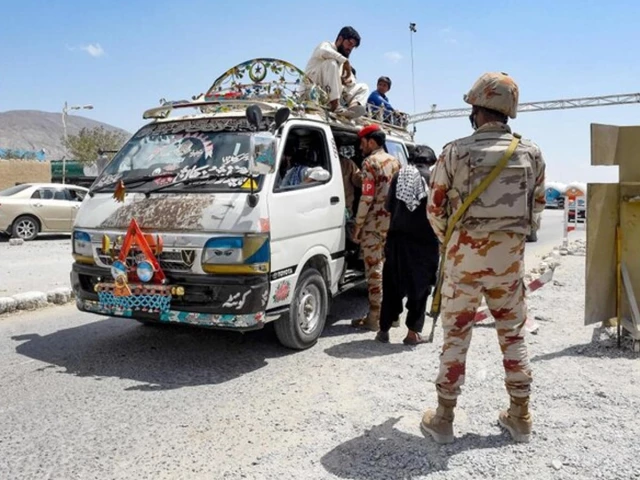
Security sources say he received militant training at a camp in Balochistan during interrogation
Security sources shared on Monday that a terrorist belonging to Fitna al-Hindustan told investigators that he had been recruited through false promises and financial incentives and was paid Rs 25,000. to carry out attacks on Baloch people. They added that the disclosures were made during interrogation.
According to the sources, the arrested suspect, identified as Habibullah, is a resident of Sirandow in Ornach tehsil of Khuzdar district. They added that the suspect told investigators that he had been transporting weapons, ammunition, explosives, food and medicine to terrorist groups operating in the area.
During interrogation, he told investigators that the militant organization had recruited him through false promises and financial incentives before taking him to Chanal Dasht for ideological indoctrination.
He was later shifted to the Sargadh camp where he received training in the use of weapons, explosives and ambush tactics. The suspect said he was also taught how to hide his identity and evade capture after carrying out attacks, security sources said.
According to the sources, Habibullah said he had participated in attacks against other Baloch people in return for Rs25,000. He further said that he had been identified during sit-ins organized by the Baloch Yakjehti Committee (BYC), which security sources described as a proxy for Fitna al-Hindustan.
Fitna al-Hindustan is the term used by the state for terrorists belonging to the banned Balochistan Liberation Army (BLA) and other militant groups operating in the province.
Read also: Security forces kill 16 terrorists in Operation Al-Azm in Balochistan
Security forces have launched intelligence-based operations in the wake of the terror attacks in Balochistan. previous, Operation Shaban was launched after terrorists attacked Mangi Dam police station.
A District and Sessions Judge and his security guard were also killed after unidentified gunmen opened fire on their vehicle on the National Highway in Mastung, while an additional Sessions Judge and another person sustained serious injuries.
Security forces on Sunday killed 16 terrorists in ongoing intelligence-based operations during Operation Al-Azm in Balochistan, where several terrorist hideouts were also destroyed and weapons and explosives found.
Security sources said counter-terrorism operations are continuing in several parts of the province, including Killi Kundi Umrani, Khad Kocha and Mastung, where the group referred to by the state as Fitna al-Hindustan had suffered heavy losses.
On Friday, the Chief of Defense Staff and Chief of Army Staff Field Marshal Syed Asim Munir expressed a resolve to dismantle the terror infrastructure in Balochistan, saying that consistent efforts by security forces and law enforcement agencies, backed by the steadfast support of the people, would bring lasting peace to the province.
Munir said, “Targeted operations against Fitna al-Khawarij and Fitna al Hindustan will continue with full determination until the menace of terrorism and its supporters is eliminated from Pakistan.”
UNSC confirms increase in TTP attacks from Afghanistan
Terrorism has increased significantly in Pakistan, especially in Khyber-Pakhtunkhwa and Balochistan, in recent days. The increase in terrorist activity has led to growing concern over the security situation in these regions. In response, security forces have carried out intensive operations to counter the threat, targeting terrorist groups.
The United Nations Security Council (UNSC), in a report released in February, also drew attention to a series of attacks by the outlawed Baloch Liberation Army (BLA) against Pakistani security forces and projects linked to the China-Pakistan Economic Corridor (CPEC).
Read more: The number of terrorists killed in Balochistan’s Operation Al-Azm reaches 13
“On 16 September 2025, the BLA ambushed a Pakistani military convoy patrolling the corridor, killing 32 soldiers. While counter-terrorism operations by Pakistan limited the BLA’s operational space, it remained active”.
The report added that some member states reported that the BLA cooperated with the TTP and ISIL-K through shared training camps and resources, coordination of attacks and meetings between commanders. Some member states assessed that there was neither an association nor growing ties between the BLA and Al Qaeda or ISIL.
It further highlighted that various groups in Afghanistan had acquired modern weapons and equipment through cross-border smuggling and black market trade. “The TTP used advanced assault rifles, night vision equipment, thermal imaging equipment, sniper systems and drone strike systems. Most of these were provided by the de facto authorities in connection with weapons permits and travel documents,” it said.
In August 2025, the UN’s 1988 Taliban Sanctions Committee Monitoring Team Annual Report said that outlawed terrorist groups – the BLA, including its Majeed Brigade, and the TTP had “close coordination”.
The UNSC report said that “some BLA attacks showed a high degree of complexity and brutality”, referring to the hijacking of the Jaffar Express in Balochistan on 11 March 2025, which killed 31 people, including 21 hostages.


