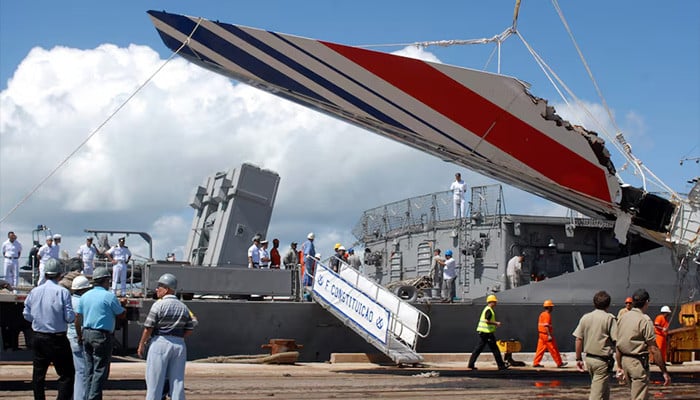
A French appeals court found Airbus and Air France guilty of corporate manslaughter on Thursday after the Rio-Paris plane crash, but a 17-year legal battle over the country’s worst aviation disaster will continue.
“Justice has definitely been done,” Daniele Lamy, president of AF447’s victims’ association, whose son was one of 228 people who died in the crash, said outside the courtroom.
Relatives of some of those who died when the Airbus A330 crashed in pitch darkness into the Atlantic Ocean during an equatorial storm on June 1, 2009, listened to the verdict in silence.
A lower court had acquitted the two French companies in 2023, both of which have repeatedly denied the charges.
Thursday’s verdict is the latest milestone in a legal marathon involving relatives of the mainly French, Brazilian and German victims and two of France’s most emblematic companies.
The appeals court ordered them both to pay the maximum fine for corporate manslaughter, €225,000 ($261,720), at the request of prosecutors during last year’s eight-week trial.
The fines, equivalent to just a few minutes of both companies’ revenue, have been widely dismissed as symbolic punishment, but families said the company’s reputation was at stake.
Airbus and Air France both said they would appeal to France’s highest court, ignoring pleas from the relatives.
“There is no human, moral or legal justification for continuing this procedure,” said Lamy, who appealed to both companies to stop what she called “procedural harassment.”
Divisions over cause of crash
Lawyers had predicted further appeals on legal points and warned that these could potentially drag out the process for years.
The families’ lawyer Alain Jakubowicz told Reuters that another full retrial, where the evidence is repeated a third time, could not be ruled out if the Court of Cassation erred in Thursday’s ruling.
Relatives and lawyers sat in a courtroom with tall windows that has witnessed some of France’s most historic trials as a judge read out a list of victims, many with the same family name.
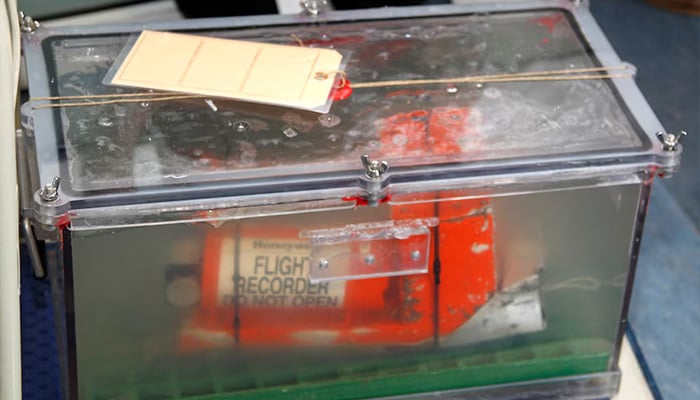
The black boxes from Flight 447 were retrieved in 2011, after a two-year deep-sea search that was almost called off.
The trial revealed bitter disagreements between the airline and the aircraft manufacturer over the cause of the crash and a gap between a civilian accident report that focused primarily on the pilots’ actions and a broader chain of cause and effect highlighted by the court.
Analysts said the ruling was unlikely to change regulators’ view of the crash, which did not lead to major technical changes. France’s BEA crash investigators found the plane’s crew had pushed their jet into a stall and cut the elevator from under the wings after mishandling a problem with de-iced sensors.
However, prosecutors focused their attention on alleged wrongdoing by both the aircraft manufacturer and the airline. These included poor training and failure to follow up on previous sensor failures.
To prove manslaughter, prosecutors had to not only establish negligence, but also pull the strings to demonstrate how this caused the crash. Their failure to make that part of the argument hold had resulted in the earlier acquittal.
Lamy said the deceased pilots had been “rehabilitated”.