
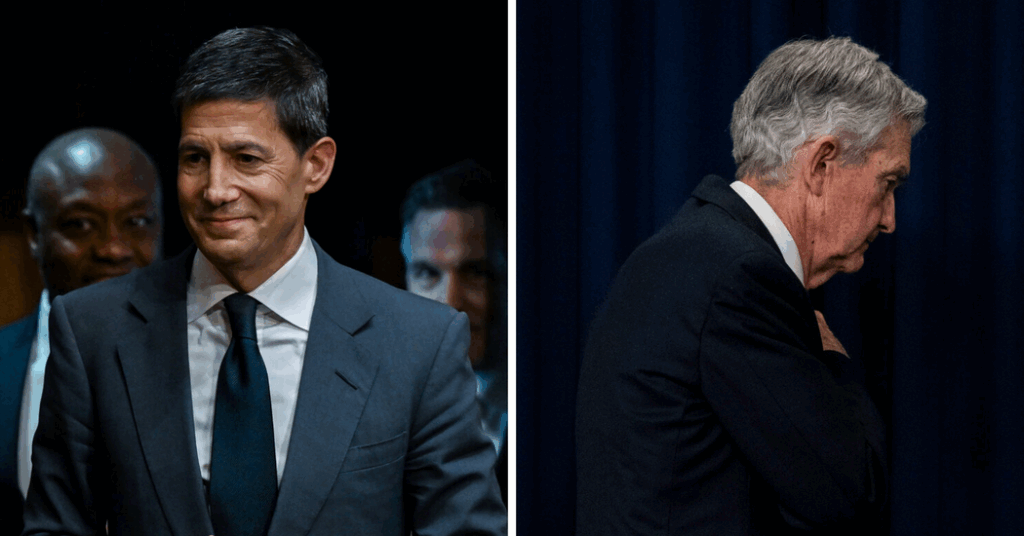
Kevin M. Warsh’s campaign to become the next chairman of the Federal Reserve centered on the premise that the central bank had lost its way.
The Fed had committed a major policy blunder in the wake of the Covid-19 pandemic, which helped trigger the worst inflation shock in four decades. It had intervened in the financial markets to such an extent that it distorted the fundamental way in which assets around the world were priced. And Mr. Warsh argued that the Fed had jeopardized its own policy independence by engaging in issues outside of Congress’s mandate.
Warsh’s solution was to call for “regime change” across an institution that had become a magnet for attack from President Trump over its refusal to cut interest rates.
The pitch worked for Mr. Trump. It also swayed Republicans in the Senate, who confirmed Mr. Warsh for the top job just days before Jerome H. Powell’s term ends on Friday. Mr. Powell has chosen to remain as one of seven members of the Governing Council, a decision he made to stave off further intervention at the Fed.
An assessment of Mr. However, Powell’s eight-year tenure as chairman points to a far more constructive legacy than that of Mr. Warsh depicts.
Mr. Powell is remembered as an effective leader who navigated the Fed through an extraordinary series of shocks that put it through grueling tests. He proved nimble as the economic backdrop shifted, managing to build consensus among the political establishment of the Federal Open Market Committee to quickly adjust rates in either direction.
Mr. Powell’s casual communication style made him popular across Wall Street, while his frequent trips to Capitol Hill won over lawmakers. He met with senators more than twice as often as his predecessors did, according to an analysis of his calendar.
Mr. Powell took advantage of that support this year when he welcomed Mr. Trump directly to defend Fed independence. That battle has now come to define Mr Powell’s legacy.
Yet the central bank made consequential mistakes under his watch, ones that left it vulnerable to criticism from Mr. Warsaw.
Mr. Warsh will need to rally his own backers if he is to implement his agenda, a goal that is already at risk of being overshadowed by a worsening inflation problem due to the war with Iran. Resurgent prices have dissuaded officials from rate cuts, potentially putting the new chair in the shoes of Mr. Trump if he doesn’t deliver relief.
“Warsh is going to have to repair damage with the board staff and other members of the Federal Open Market Committee because I doubt they believe the Fed is as broken as he implied in his comment,” said William Dudley, who served as president of the Federal Reserve Bank of New York from 2009 to 2018.
“Do I think the Fed is broken? No, but I think there are a number of things the Fed could do better.”
A “mold” of inflation
Mr. Powell’s legacy could look very different had it not been for the president’s relentless pressure campaign, which this year escalated into a criminal investigation.
At the onset of the pandemic, Mr Powell unleashed the central bank’s full firepower to save the global economy and financial system from the brink of collapse. The Fed cut interest rates to zero in 2020 and then began a series of interventions, including unlimited purchases of government bonds and historic purchases of corporate bonds and municipal debt. Mr. Powell also took the unusual step of expressly encouraging lawmakers to turn on the taps. Congress eventually gave the green light for about $5 trillion in federal aid.
The economy recovered quickly. But that was followed by a painful inflation shock, one that became a “damage” to the Fed, said Charles Evans, who ran the Chicago Fed for 16 years until 2023.
The Fed initially misdiagnosed the extent of the price pressures that had begun to build as strong demand driven by fiscal stimulus collided with limited supply. The Fed then made mistakes throughout 2021 that further delayed it from taking steps to curb inflation.
To make matters worse, a year earlier Mr. Powell had unveiled a new approach to policymaking, one that appeared to address the opposite problem from the one the Fed was about to confront. This approach was to temporarily tolerate periods of higher inflation to compensate for earlier stretches where it was too low, and to focus on “broad and inclusive” employment.
“It fought the last war,” said Kristin Forbes, a former Bank of England official now at MIT, “It didn’t think about how the world was changing and the bigger role global supply shocks are playing.”
Politicians dispute that the framework held them back from addressing the rise in inflation, but the optics were far from ideal. Last year scrapped Mr. Powell it.
The Fed was primarily hampered by overly prescriptive so-called forward guidance to raise interest rates. That, combined with a promise to first wind down a bond-buying program that many later admitted was excessive, added another delay.
When the Fed began raising interest rates in March 2022, Mr Powell was praised for how aggressively it eventually moved as new risks emerged. Weeks before the Fed’s first hike, Russia invaded Ukraine, sending energy prices skyrocketing. Through July 2023, the Fed raised interest rates 11 times to a range of 5.25 percent to 5.5 percent, the highest level since 2001.
The scope and scale of the rate hikes sent a strong message. So did a powerful speech Mr. Powell gave at the Fed’s annual conference in Jackson Hole, Wyo., in August. Those remarks had been hastily rewritten in the previous week when it became clear to Mr Powell that he needed something that would make an impact. In just over eight minutes, he delivered his version of a microphone drop, reaffirming the Fed’s commitment to taming inflation, even if it involved “pain.”
Inflation was not the only issue Mr Powell was grappling with at the time. Several policymakers had resigned following an ethics scandal involving financial transactions carried out when the Fed provided support throughout 2020. Mr. Powell tightened the rules, but the episode left lasting damage. Last August, another governor resigned because of her family’s trading activities.
Mr. Powell also had to deal with a regional banking crisis that many blamed on the Fed’s own failure to oversee lenders under its purview. The Fed stepped in to stem the 2023 panic.
Despite these missteps, Mr. Powell the good will across Wall Street and Washington, mainly because he performed a rare feat: bringing down inflation without causing a recession.
By September 2024, inflation was within spitting distance of the Fed’s 2 percent target, while the unemployment rate remained low by historical standards, around 4 percent. Successive setbacks have prevented Mr Powell from declaring victory.
“It’s been five years since we’ve had inflation on target,” said Michael Strain, an economist at the American Enterprise Institute. “It’s a problem for the Fed’s credibility.”
For Mr. Warsh puts the blame squarely on the Fed.
Had it developed better models to forecast inflation, been more careful about its market interventions and relied less on broadcasting its next policy moves, the central bank would have been better equipped to deal with shocks over the past eight years, he has argued. The Fed would also have been better off if it hadn’t engaged in “mission creep” and delved into issues like climate change.
To change all this, Mr. Warsh that the Fed is rethinking its understanding of what drives inflation and how best to measure it. He has suggested that the Fed reduce its portfolio of government bonds and mortgage bonds and that there be closer coordination with the Treasury Department on the balance sheet. Mr. Warsh has also said Fed officials should speak less publicly.
Many inside and outside the central bank dislike Mr. Warsh’s use of “regime change”. They counter that the central bank was never distracted by fringe issues, noting, for example, that Mr Powell stated three years ago that the central bank would not be a “climate politician”.
Some also suggest that the administration’s broadsides against the Fed are more costly than any of the central bank’s missteps.
“The real damage that’s being done is not because of the Fed’s mistakes,” said Loretta Mester, president of the Cleveland Fed for a decade ending in 2024. “It’s the fact that the Fed is under this vicious, consistent attack, and it undermines confidence in the institution.”
But aspects of Mr. Warsh’s ideas have resonated.
Discussions about how to shrink the balance sheet are already underway. Others are considering how to better structure future bond-buying programs. Nellie Liang, who served as Treasury secretary and is now at the Brookings Institution, said there was a “legitimate” need to distinguish between interventions aimed at market functioning and those related to supporting the economy.
Even Mr Powell has admitted there is work to be done on communications, although he has not suggested a drastic overhaul is needed.
First test
As chairman, Mr. Warsh will decide which changes to prioritize, but he will need buy-in from his new colleagues to implement them.
Many decisions, including those related to banking regulation, are made by the governors in Washington. The FOMC — composed of the governors, the New York Fed president and a rotating set of four presidents from the regional banks — votes on interest rates and other policies.
That setup creates a “push and pull” dynamic that acts as “a check and balance in itself,” said Esther George, who served as president of the Kansas City Fed. The result has often been a compromise that doesn’t give anyone exactly what he or she wants.
“Warsh has all the professional tools to be an excellent Fed chair, but he can’t jump to the moon,” said Randal Quarles, a former vice chairman for supervision at the central bank. “You just can’t change the basic fact that you have people on the committee who disagree a lot. It’s a feature, not a bug.”
Mr. Warsh’s first big test will come in June when he holds his inaugural policy meeting. There is little support for interest rate cuts, and some policymakers have already suggested the Fed should signal openness to raising rates. That leaves Mr. Warsh faced with a stark choice: anger the president or undermine his own credibility.
“Warsh wants the history books to reflect that he was a great chair, and that means he’ll be very keen not to waste his ability to shape the Fed, which would happen if he was perceived as saying things that the data just don’t justify,” Mr. Quarles said.


