
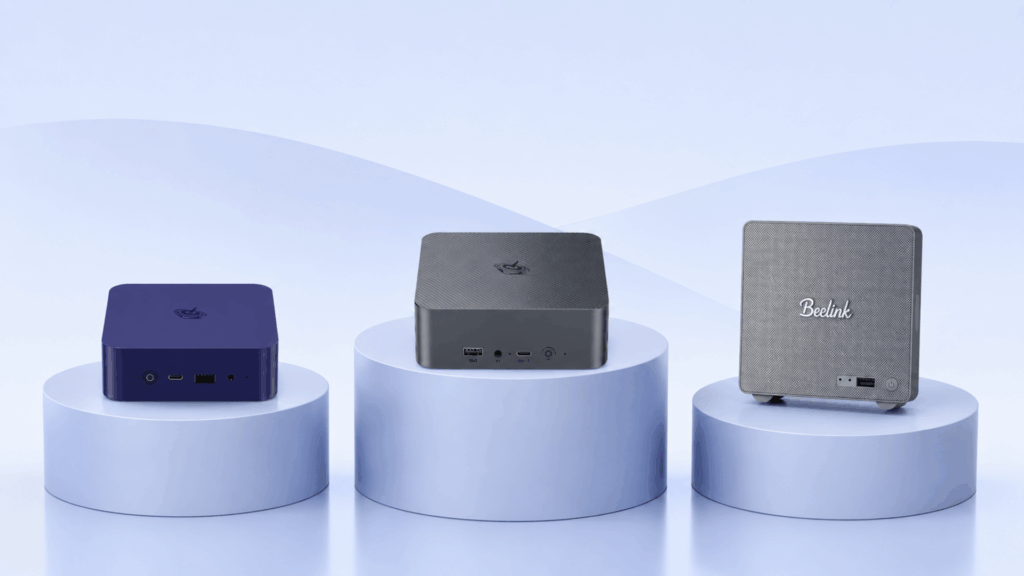
- Beelink equips EQ, EQi and ME Pro-2 mini PCs with 10 GbE networks
- Intel’s 18A process provides faster performance for compact desktops
- Inexpensive mini PCs gain networking capabilities once they are reserved for workstations
For years, high-speed networking remained a privilege reserved for expensive desktop motherboards and premium workstation models costing thousands of dollars.
Beelink has now broken the unwritten rule by equipping its most affordable mini PC series with 10GbE LAN ports as standard equipment instead of an expensive upgrade.
The company achieved this feat through its new Wildcat Lake product family, which leverages Intel’s latest 18A process technology across multiple compact system categories.

Intel 18A technology delivers low power performance
The company claims that Intel’s RibbonFET transistor design and PowerVia power supply on the back improves signal stability while reducing power leakage in small device systems.
An Intel spokesperson reportedly noted that 18A manufacturing enables higher performance density without increasing thermal output in constrained case systems.
These innovations enable compact systems to maintain higher sustained frequencies under heavy workloads.
According to Beelink’s announcement, the Intel Core 3 304 processor delivers single-core performance improvements of approximately 120% compared to the previous generation.
This mini PC can now run as a lightning-fast soft router, a network-attached storage device or a local AI inference machine without choking on data transfers.
Three different models serve different applications
Beelink structured its Wildcat Lake series around three configurations, each sharing the same Core 3 304 processor and two USB4 ports.
EQ mini is aimed at minimalist AI desktops with an ultra-compact chassis and a built-in 45W power supply for lightweight productivity tasks.
As the smallest model in this series, this device measures 112×112×37, but includes LPDDR5 memory, UFS 3.1 storage, two M.2 PCIe 4.0 SSD slots, two USB4 40Gbps ports and one 10GbE port.
The EQi model adds dual-LAN network support with both 10GbE and 2.5GbE ports along with an integrated 85W power supply, making it suitable for edge network installations.
This is a larger 126×126×44.2mm system that supports both LPDDR5 and DDR5 memory options.
It includes UFS 3.1 storage, two M.2 PCIe 4.0 SSD slots and two USB4 ports for high-speed connectivity.
The ME Pro-2 expands further by combining PC and NAS functionality in a single compact platform that includes two HDD 3.5-inch and 2.5-inch drive bays.
The device also supports DDR5 memory, UFS 3.1 storage, an M.2 PCIe 4.0 SSD slot, two USB4 ports, 10GbE plus 2.5GbE LAN and a 120W external power supply.
Like a mobile workstation, these entry-level desktop computers pack server networking into small enclosures.
The promise of 10 GbE on budget hardware sounds impressive, but several questions remain unanswered about actual implementation and user benefits.
Most home networks still run on 1GbE switches and cables, meaning owners will need additional investment to see any real speed improvement from these ports.
The integrated NPU delivers up to 24 TOPS of AI compute performance, but software optimization across operating systems and applications typically lags behind hardware releases by many months.
Beelink deserves credit for pushing an industry standard down in price, even if the average consumer buying an entry-level mini PC never connects a 10GbE device to the other end of that port.

Follow TechRadar on Google News and add us as a preferred source to get our expert news, reviews and opinions in your feeds.


